A new IRENA assessment finds that delivering basic Tier 2 electricity by 2030 across Burkina Faso, Mali, Nigeria and Senegal could require 568 MW of mini-grids and about 2.25 GWh of battery storage.
The economic case strengthens when grid expansion stalls: under the report's most favourable constrained-grid scenario, storage value approaches USD 25 billion while mini-grids could serve tens of millions of people.
West Africa Confronts Its Electricity Gap
West Africa's electricity access deficit is now a test of whether falling clean-energy costs can be converted into working infrastructure.
Across Sub-Saharan Africa, about 565 million people lacked electricity in 2024. In the four countries, IRENA estimates that approximately 171 million people would need new connections by 2030 for universal access.
The International Renewable Energy Agency's 2026 report links geospatial settlement data with a mini-grid optimisation model to test different levels of household demand, grid expansion and technology cost.
- It covers Burkina Faso, Mali, Nigeria and Senegal and compares grid extensions, renewable mini-grids and stand-alone solar systems at each location.
Its central measure is the value of storage: the discounted life-cycle cost saved when a solar PV-diesel mini-grid includes batteries instead of depending on diesel generation for flexibility.
That framing matters for governments pursuing Mission 300 because it treats batteries as an economic and energy-security asset, rather than an optional technical addition.
Storage Economics Shift the Access Equation
The headline opportunity appears at basic Tier 2 supply.
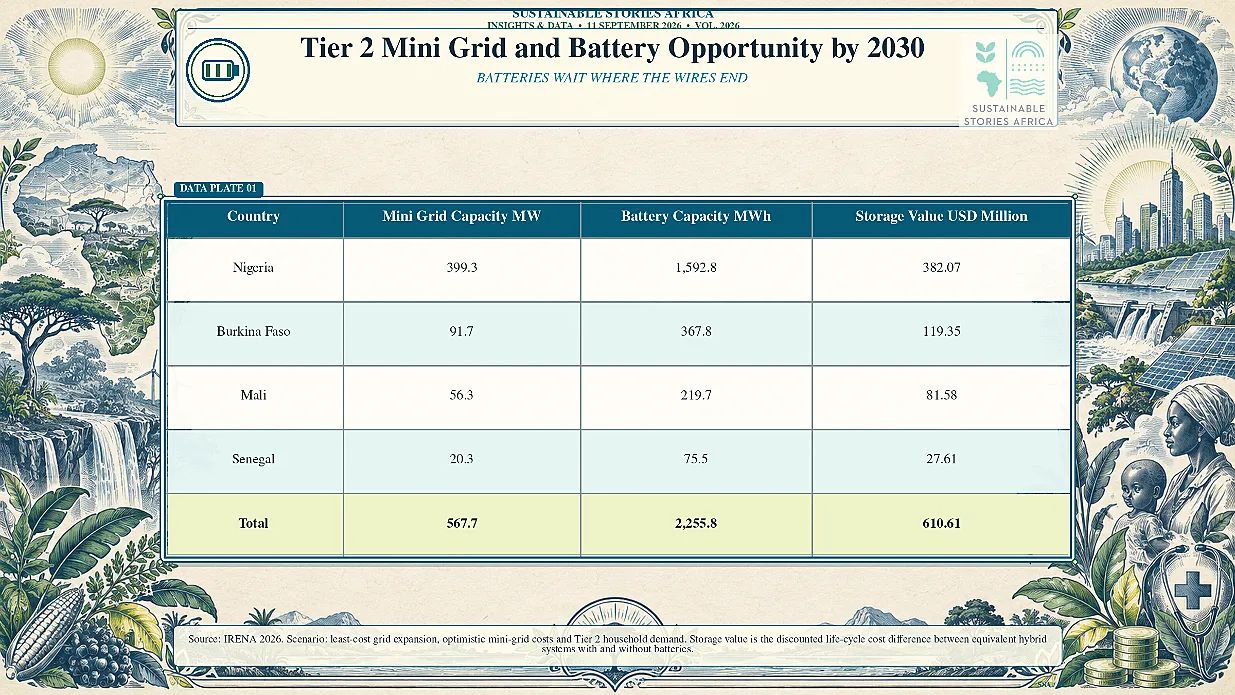
- Under least-cost grid expansion and optimistic mini-grid costs, IRENA estimates that the four countries would need 567.7 MW of mini-grid capacity and about 2.25 GWh of batteries by 2030.
- The mini-grids could reach about 42,700 settlements and serve around 21 million people.
That 568 MW requirement is almost four times the 149 MW of solar PV mini-grid capacity recorded across Africa in 2025.
More than 98% of the sites identified by the model use solar PV; hydropower represents less than 2%, while wind accounts for less than 0.1%.
The result reflects the region's solar resource and the technology's ability to scale across dispersed settlements.
The economy becomes larger when utilities cannot extend the grid as planned.
- In restricted-grid scenarios, mini-grids could supply between 47 million and 110 million of the required new connections.
- Under optimistic costs and Tier 5 demand, the model raises battery deployment to about 130 GWh and the value of storage to almost $25 billion.
- Under unconstrained grid expansion, storage remains below 8 GWh.
IRENA's scenarios also show that electricity access is progressive rather than binary.
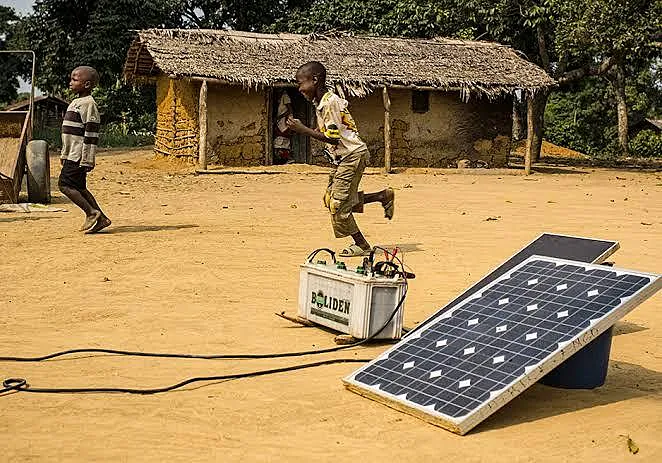
- Stand-alone solar systems serve between 70 million and 122 million people when demand is low, but their role falls as households and businesses require more power.
- From Tier 3 upwards, mini-grids become more prominent, while grid extension remains the largest source of new connections where utilities can expand at least cost.
This movement between technologies changes the planning question.
- A settlement that can initially rely on a solar home system may later need a mini-grid, and a viable mini-grid may eventually meet the national network.
- Demand estimates, productive-use programmes and rules for grid arrival therefore affect which investment is least cost and whether private developers can recover capital over the asset's life.
Scenario Modelling Reveals a Large Market
Nigeria dominates the near-term Tier 2 opportunity because of its population, access gap and settlement pattern.
- The model assigns Nigeria 399.3 MW of mini-grid capacity and 1,592.8 MWh of batteries.
- Burkina Faso follows with 91.7 MW and 367.8 MWh.
- Mali and Senegal have smaller but still material requirements.
The figures below combine the report's Tier 2 results for least-cost grid expansion and optimistic mini-grid costs.
They show the scale needed for basic electricity service, not a forecast of projects already financed or under construction.
Across the four countries, the same scenario assigns storage an economic value of $610.61 million.
- Nigeria accounts for the largest share, but the smaller markets remain strategically important.
- Burkina Faso and Mali face higher exposure to transported diesel.
- Senegal's lower absolute requirement still calls for technical standards, trained operators and project finance that can reach remote communities.
At the most constrained end of the modelling range, mini-grids could serve approximately 397,270 settlements and connect roughly 100 million people.
- Total capacity rises from less than 1 GW in the most grid-led cases to almost 34 GW when grid expansion is restricted, demand is high and mini-grid costs are favourable.
Those outcomes demonstrate the size of the planning envelope; they are not a single recommended build-out.
Batteries Cut Diesel Costs and Risks
Battery value comes mainly from lower diesel use over a project's life.
- Across the modelled scenarios, avoided fuel costs average about twice the incremental battery investment.
- At Tier 2 and Tier 3 demand under favourable mini-grid costs, each additional dollar invested in storage can avoid three to four dollars of fuel expense.
IRENA's diesel-price sensitivity test strengthens that case.
- At baseline fuel prices, every dollar of battery investment avoids between $1.94 and $2.85 in lifetime diesel costs.
- If diesel prices double, the range rises to $3.72 to $5.89.
- The levelised cost of a hybrid PV-battery mini-grid increases by only 10% to 15% in that shock because added storage reduces generator use.
For landlocked Burkina Faso and Mali, storage also hedges against long fuel routes, border disruption and already high pump prices.
- For communities, lower exposure to diesel can support more predictable service and tariffs.
- Productive demand from agriculture, commerce and small industry can then improve mini-grid utilisation and help households move from basic supply towards higher service tiers.
Policy and Finance Must Match Deployment
The report's first priority is integrated planning.
Governments should map settlements and demand, then allocate grid extension, mini-grids and stand-alone solar according to local cost and service conditions.
- Geospatial tools can also define utility and developer service areas, reduce overlap and show where a mini-grid may later connect to the main network.
Regulation must keep pace with deployment.
- West African markets need enforceable standards for battery quality, safety and interoperability, along with open metering systems that allow regulators and financiers to compare performance.
- Tariff rules, concession areas and asset buy-out clauses should recognise that communities may progress from solar home systems to mini-grids and eventually to grid supply.
End-of-life planning cannot wait until batteries begin to fail.
- A 130 GWh deployment could create 0.65 million to 1.3 million tonnes of batteries for recycling 10 to 15 years later.
- Extended producer responsibility, regional recycling capacity and technician certification should therefore form part of today's market rules.
Finance remains the immediate constraint.
- Blended finance, guarantees and other de-risking tools can lower the high cost of capital that inflates African renewable projects.
- Regional co-operation on equipment standards and local content could aggregate demand, reduce foreign-exchange exposure and create viable opportunities in assembly, component supply, maintenance and recycling.
Project design should also prepare for changing demand and grid arrival.
- Concession contracts can specify service upgrades, interoperability and compensation if a utility reaches a mini-grid territory.
- Finance can then support a staged pathway instead of assuming that one technology will remain the final solution for every settlement through 2030 and beyond.
Building a Durable Regional Battery Market
West African governments should turn the modelled opportunity into investable national pipelines, backed by settlement-level plans, predictable mini-grid rules and finance that reflects avoided diesel costs.
The path to universal access will still combine grids, mini-grids and stand-alone systems.
Batteries make that mix more resilient, but building lasting value depends on skills, standards, recycling and regional markets alongside the hardware.