
A foreign court victory does not become cash in Nigeria by itself. Registration, jurisdiction, notice and timing determine whether the judgment can be enforced.
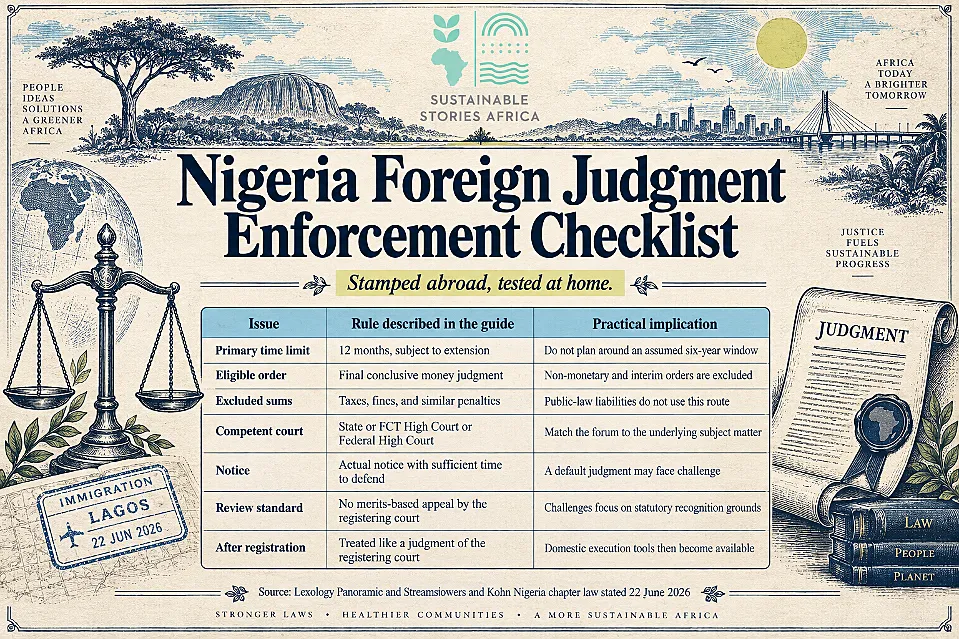
A 2027 Lexology Panoramic guide says the operative registration window is generally 12 months because the ministerial order needed to activate a six-year regime has not been made.
Nigeria's Judgment Rules Reward Early Preparation
Cross-border trade depends on more than contracts and arbitration clauses.
- Businesses also need to know whether a court decision obtained abroad can be recognised and enforced where the debtor or its assets are located.
For investors dealing with Nigerian counterparties, that question sits at the intersection of governance, credit risk and the rule of law.
The Nigeria chapter of Lexology Panoramic's Enforcement of Foreign Judgments 2027, prepared by lawyers at Streamsowers and Kohn, describes a framework built from older legislation, a later statute that has not been fully activated, court rules and common law.
Its practical message is direct.
- The creditor must identify the correct court, move within the applicable period and show that the foreign court had jurisdiction, that the debtor had enough notice to defend the case, and that the decision is final and enforceable.
A valid foreign judgment is an important asset, but procedure determines whether that asset can travel.
A Twelve-Month Clock Shapes Recovery
Nigeria is not a party to a bilateral or multilateral treaty for reciprocal recognition and enforcement of foreign judgments, according to the guide.
- Recognition therefore rests mainly on the Reciprocal Enforcement of Foreign Judgments Ordinance 1922, the Foreign Judgments Reciprocal Enforcement Act in the Laws of the Federation of Nigeria 2004, relevant court and enforcement rules, and common law.
Part I of the Act allows registration within six years for judgments from a country designated by the Minister of Justice based on substantial reciprocity.
- The guide says no such order had been made.
As a result, the operative statutory route for countries outside the older Ordinance is section 10 of the Act, which provides 12 months from the date of judgment, subject to any longer period the court may grant.
The Ordinance also uses 12 months with judicial power to extend time. A creditor who assumes six years may discover the problem after the shorter window has closed.
Recognition Requires More Than A Foreign Win
The registrable order must be final and conclusive between the parties and require payment of money.
- Taxes, similar public charges, fines and penalties are excluded, as are non-monetary judgments and interlocutory orders.
- The applicant must be the judgment creditor, the judgment must remain wholly or partly unsatisfied, and it must be enforceable by execution in the country where it was issued.
Nigerian courts may also examine jurisdiction and notice.
- For an action against a person, the foreign court may be treated as having jurisdiction where the debtor lived in that country, voluntarily appeared, agreed to submit, or, for a company, maintained its principal place of business there or undertook to perform the contract there.
- The debtor must have received actual notice in enough time to defend the proceedings.
Registration can be refused or set aside for fraud, conflict with Nigerian public policy, lack of jurisdiction or insufficient notice.
The Nigerian court does not sit as an appeal court over the merits of the foreign decision.
Legal Certainty Can Strengthen Investment Confidence
A predictable enforcement regime lowers the cost of cross-border business because lenders, suppliers and investors can price recovery risk more accurately.
- It can also discourage opportunistic delay by showing that a final foreign money judgment will be recognised when jurisdiction, notice and public policy standards are satisfied.
- Once registered, the judgment has the same force and effect for execution as a judgment of the Nigerian superior court that registered it.
Available execution tools include attachment of movable and immovable property, garnishee proceedings against money owed to the debtor, judgment summons and sequestration.
- Where a decision contains separable parts, the court may register only the part that qualifies or remains unpaid.
- The regime therefore has mechanisms capable of converting recognition into recovery, provided the creditor has identified reachable assets and prepared for objections and appeals.
Appeal protection can preserve that possibility.
- A debtor may challenge an order recognising the judgment at the Court of Appeal.
The guide explains that the creditor may seek a post-judgment Mareva injunction to restrain asset dissipation.
The appellate court can direct that the judgment sum be placed in an interest-bearing account pending the appeal.
- These measures do not remove delay, but they can reduce the risk that a successful appeal leaves the creditor with an empty remedy.
Creditors Must Design Enforcement Before Litigation
The enforcement plan should begin when the contract is drafted, not when the foreign case ends.
- Parties need a clear jurisdiction or dispute-resolution clause and should map where the counterparty's assets are held.
- If litigation begins abroad, the claimant should preserve evidence of service, actual notice, jurisdiction and the final status of the judgment.
- Certified copies, currency calculations and an asset search should be prepared before the Nigerian filing window becomes tight.
Forum selection inside Nigeria is equally important.
- The Act defines superior courts to include State High Courts, the High Court of the Federal Capital Territory and the Federal High Court.
The guide cites decisions indicating that the registration application should go to the court that would have had subject-matter jurisdiction over the original dispute if it had arisen in Nigeria.
- A dispute concerning company law, aviation or another federally assigned matter may therefore belong in the Federal High Court rather than a State High Court.
The public-sector dimension requires special attention.
- Section 84 of the Sheriffs and Civil Process Act may require the consent of the relevant attorney-general before funds held by a public officer in an official capacity can be attached through garnishee proceedings.
The guide records continuing judicial debate over who counts as a public officer and the capacity in which funds are held.
- Reform should protect public budgeting without allowing executive consent to defeat final judicial outcomes.
For creditors, the immediate lesson is to analyse the particular garnishee and the character of the funds before seeking attachment.
Reform Must Balance Treasury And Justice
Nigeria can improve commercial confidence by clarifying reciprocal coverage, limitation periods, forum rules and the treatment of public funds.
Faster appeals and consistent application would reduce recovery uncertainty.
Until reform arrives, creditors should treat enforcement as part of transaction design
Early advice, precise service records, the correct court and action within 12 months offer the strongest route from a foreign victory to domestic recovery.