Developing countries may need US$310-365 billion a year for climate adaptation by 2035, while international public flows stood at US$26 billion in 2023.
UNEP's Adaptation Gap Report 2025 finds stronger planning but a $284 - $339 billion annual finance gap, with debt-heavy instruments and incomplete African reporting weakening implementation.
Adaptation Plans Advance While Finance Retreats
Countries are writing adaptation plans faster than the world is financing them.
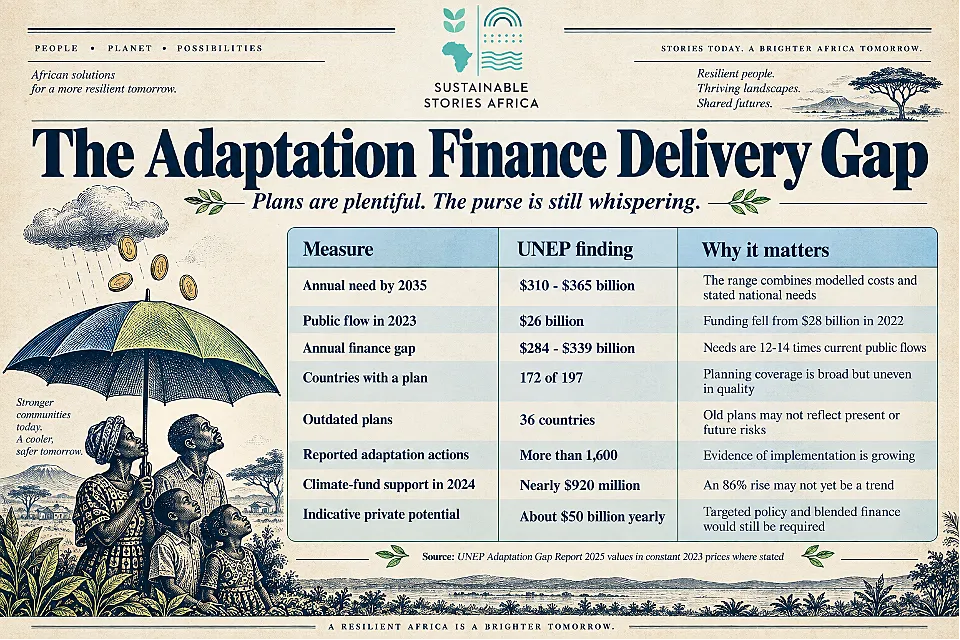
- The United Nations Environment Programme reports that 172 of 197 countries now have a national adaptation policy, strategy or plan.
- However, 36 have plans that are more than a decade old or beyond their stated period of validity, and the money available to turn planning into protection remains far below the need.
UNEP's Adaptation Gap Report 2025 estimates that developing countries will require $310 - $365 billion every year by 2035, expressed in constant 2023 prices.
International public adaptation finance from developed to developing countries was $26 billion in 2023, down from $28 billion in 2022.
The resulting gap is $284 - $339 billion annually, with needs 12 - 14 times current flows.
The consequences are immediate for African states facing floods, heat, drought, food insecurity and infrastructure damage.
- Planning creates a basis for action; however, plans that cannot secure finance or track outcomes do not reduce exposure.
The report therefore treats adaptation as a development and fiscal priority, not a secondary environmental programme.
Developing Countries Face A Widening Deficit
The finance trend is moving in the wrong direction.
The Glasgow Climate Pact called for developed countries to double international public adaptation finance from 2019 levels to about $40 billion by 2025.
UNEP says that target will be missed if current trends continue.
- The newer climate-finance goal of at least $300 billion a year by 2035 covers both mitigation and adaptation.
- It is not adjusted for inflation, leaving no assurance that adaptation needs will be met.
The report also warns about the form of finance.
- Debt instruments accounted for an average of 58% of international public adaptation flows in 2022 and 2023.
- Non-concessional borrowing can create an adaptation investment trap in which countries take on more debt to protect themselves from climate impacts, then lose fiscal space as disasters intensify.
This is particularly damaging for least developed countries and small island developing states that contributed little to accumulated emissions.
Planning Progress Still Masks Delivery Gaps
Implementation data tell a mixed story.
- Support for adaptation projects through the Adaptation Fund, the Global Environment Facility and the Green Climate Fund reached nearly $920 million in 2024, 86% above the five-year moving average of $494 million between 2019 and 2023.
UNEP cautions that one strong year may not establish a durable trend as development budgets tighten.
The first biennial transparency reports under the Paris Agreement include more than 1,600 adaptation actions.
- Biodiversity and ecosystems account for 23%.
- Food and agriculture, water and sanitation, and infrastructure and human settlements each account for 14% - 18%.
However, reporting is weighted towards government programmes, research, natural-resource management and training.
- Structural and technological measures represent only 5%.
Most African countries, least developed countries and small island developing states had not yet submitted a report with comparable detail, limiting the global view of what is working.
Even where reports exist, evidence of results is thin.
- Nearly three-quarters of the reported results describe direct outputs such as risk assessments, training or climate-information systems.
- Outcomes account for 16% and longer-term resilience impacts for 12%.
That imbalance makes it difficult to judge whether a completed activity changed water availability, agricultural production, health protection or ecosystem condition.
It also weakens the feedback needed to update national plans before risks and development patterns move beyond their assumptions.
Resilience Investment Produces Measurable Public Returns
The economic case for adaptation is stronger than the flow data suggest.
- UNEP cites evidence that every $1 spent on coastal protection can avoid $14 in damages, while urban nature-based solutions reduce ambient temperatures by more than 1 degree Celsius on average.
- These investments protect homes, roads, food systems, water supply and public health.
- They can also reduce fiscal shocks that arrive after disasters and crowd out education, health and productive investment.
Private capital can contribute, but it is not a substitute for public finance.
- UNEP estimates an indicative private-sector potential of about $50 billion a year for national adaptation priorities, compared with tracked flows of roughly $5 billion.
- The opportunity is concentrated in agriculture, water and infrastructure and is likely to be greater in upper-middle-income countries than in low-income markets.
- Flood defences, social protection and other public goods will continue to require grants, concessional resources and domestic budgets.
The distribution of current finance shows why equity must remain part of the design.
- Least developed countries received an average of $10.4 billion in 2022 and 2023, while small island developing states received about US$1.2 billion.
Those flows remain modest relative to need, at roughly $9 per person in least developed countries and $20 in small island states.
- Climate vulnerability is therefore not only a reason to increase finance; it should shape eligibility, pricing and the share delivered as grants.
Finance Must Reach Countries Without New Debt
International providers should increase grants, highly concessional finance and other non-debt-creating instruments, with allocation methods that reflect climate vulnerability as well as income.
Multilateral development banks can use guarantees and first-loss capital to reduce risk where projects generate revenue, but blended finance should be transparent about who ultimately pays.
- Mobilising a loan does not close the funding gap if households or governments inherit unaffordable costs.
African governments also need investment-ready pipelines that connect national plans to budgets, procurement and measurable outcomes.
- Ministries of finance should embed physical climate risk into public-investment appraisal and debt strategy.
- Sector ministries need costed priorities for water, agriculture, health, settlements and ecosystems.
- Local governments and communities should shape the interventions because poorly designed adaptation can shift risk to other places or groups.
Reporting must improve alongside spending.
- The next biennial transparency reports should link each hazard and exposed system to an intervention, output, outcome and resilience effect.
- Gender equality and social inclusion require clearer budgets and results, while health, poverty, livelihoods and cultural heritage need fuller coverage.
- Better evidence will not replace funding, but it will show financiers which approaches are effective and help citizens hold institutions accountable for delivery.
Closing The Gap Requires Fairer Capital
Developing countries need more adaptation finance, delivered mainly through grants and affordable instruments that do not deepen vulnerability.
African plans should become costed pipelines with visible outcomes and local ownership.
Public providers must lead, while private capital supports investable sectors under clear safeguards.
Stronger reporting can direct money towards effective action, but the scale of the gap demands new resources rather than better documentation alone.