
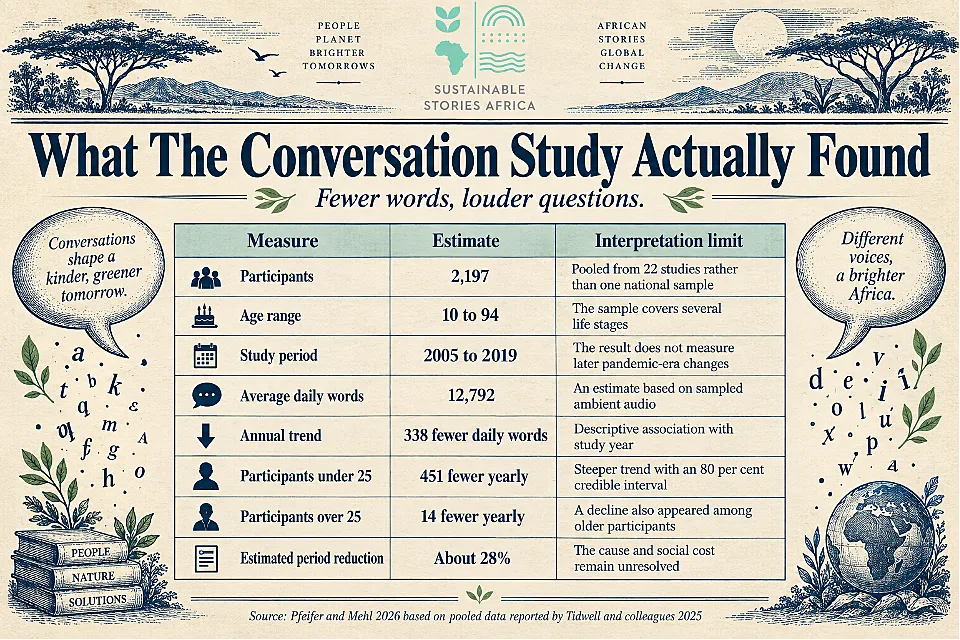
An analysis of 2,197 participants estimated that daily spoken language fell by 338 words for every year between 2005 and 2019.
The authors describe a 28% decline and a steeper trend among people under 25, but the evidence is mostly outside Africa and does not establish that digital communication caused the change.
Daily Conversation Is Quietly Losing Ground
A small decline repeated every year can become a large social change. Psychologists Valeria Pfeifer and Matthias Mehl estimate that participants spoke 338 fewer words per day for each successive year between 2005 and 2019.
Across that period, the modelled reduction in daily speech was about 28%.
The finding comes from a joint analysis of 22 studies involving 2,197 people aged 10 to 94.
- Their speech was estimated from passively sampled ambient audio in daily life.
- Participants lived mainly in the United States, with others in Mexico, Australia and Europe.
- The average across the pooled data was 12,792 words per day, compared with 15,959 in an earlier 2007 study using the same method.
The paper raises an important question for workplaces, schools, families and public-health systems:
- What happens when ordinary spoken contact declines?
- It does not provide an African estimate or prove why the trend occurred.
- Its value for African readers lies in the research question it exposes and the need to measure conversation within local linguistic, cultural and digital settings.
The Decline Accumulates Across Ordinary Days
The headline number is 338 fewer daily words per year, with a 9% Bayesian credible interval from 25 to 652 fewer words.
- At the central estimate, the shift in daily speech from one study year to the next represents more than 120,000 fewer spoken words across a full year.
- The cumulative trend matters because conversation is usually experienced in small exchanges: a greeting at work, a discussion during a commute, or a longer answer at home.
The authors connect the finding to a wider concern about loneliness and social isolation.
- They point to existing evidence associating conversation quantity with well-being and loneliness with poorer health outcomes.
The analysis does not show that speaking less caused ill health, and it did not measure the content or quality of the conversations that disappeared.
- It identifies a trend that deserves explanation, not a completed causal account.
Age Differences Do Not Prove Technology
Participants under 25 showed a steeper decline.
- Among 980 adolescents and emerging adults, the estimate was 451 fewer daily words for each year after 2005, with an 80% credible interval from 89 to 825 fewer words.
- Among 1,146 participants over 25, the estimate was 314 fewer words, with an 80% credible interval from 41 to 579 fewer.
- The younger trend was about 44% larger.
That pattern is consistent with a period of expanding texting, social media and other digital communication, but it does not demonstrate that technology replaced speech.
- The authors say digital causes remain unclear and that age accounts for only part of the overall decline.
- Structural changes in how people gather, work and communicate may also matter.
The data cannot reveal whether lost words came from family, friends, colleagues or strangers, or whether typed conversations provided equivalent connection.
The comparison with the 2007 estimate also needs care.
- The earlier figure of 15,959 words came from a prior study using the same general method, not from repeatedly measuring the same people over the full period.
- The stronger evidence for decline comes from relating participants' estimated word counts to the year in which each study collected data through a Bayesian multilevel model.
- The credible interval excludes zero at the 95% level, but its width shows meaningful uncertainty about the exact annual pace.
Small Conversations Can Support Social Connection
The practical appeal of the finding is its scale.
- 300 spoken words can fit into a brief exchange with a neighbour, a colleague or a shopkeeper.
- It can be a fuller response to a routine question or a conversation that continues after the transactional purpose has ended.
The paper proposes such contact as a simple personal counterweight to isolation, while recognising that stronger research is needed.
For employers, the implication is not to impose more meetings or count employees' words. Conversation quality, consent and context matter.
- A better response is to create conditions in which useful human contact can occur: manageable workloads, psychologically safe teams, thoughtful hybrid-work design and time for informal exchange.
- Schools and community organisations can protect spaces for discussion across age groups, especially where services and social life are moving online.
Public services should also distinguish access from connection.
- A digital channel may make banking, health advice or government information easier to reach while reducing live interaction for people who depended on those encounters.
That trade-off will vary by service and user.
- Agencies can monitor whether digital migration leaves older people, people with disabilities or those living alone with fewer opportunities for conversation, then retain human options where the social and practical benefits justify them.
Africa Needs Its Own Conversation Evidence
African universities and public-health researchers should test the question locally before drawing policy conclusions.
- Multilingual speech, code-switching, household size, communal practices, transport patterns, mobile-data costs and informal work could produce very different baselines.
- Rural and urban experiences may also diverge.
- A study designed for the continent should sample several countries and languages rather than treat one city or student population as representative.
Method matters because passive audio collection creates serious privacy obligations.
- Researchers should minimise recorded content, secure informed consent, protect bystanders where possible and separate word-count features from identifiable speech.
- Published results should report uncertainty, demographic coverage and missing data.
The original paper's open-data approach supports scrutiny, but African replication would need governance that reflects local law and community expectations.
Institutions can act without claiming to know the cause.
Employers can survey isolation and belonging, review whether remote routines eliminate spontaneous contact, and train managers to notice exclusion.
Health campaigns can encourage regular conversation while making clear that loneliness can require professional or community support.
The goal is not to romanticise constant talk.
- It is to understand whether a measurable social resource is diminishing and which groups bear the cost.
Path Forward – Measure Carefully Then Rebuild Human Contact
The study offers a warning, not a universal verdict. Its trend should be replicated across African languages, age groups and living conditions with strong privacy protections.
Meanwhile, workplaces, schools and communities can make room for voluntary, meaningful conversation.
The useful target is better connection, not a compulsory word count, and every intervention should be tested for who benefits.