Renewable additions reached a reported 793 GW in 2025, but the systems needed to absorb that power are struggling to keep pace.
RatedPower's 2026 trends report places storage, grid reform and faster permitting at the centre of the next phase, with African markets facing both the largest infrastructure gaps and some of the strongest solar opportunities.
Renewable Growth Meets Its Infrastructure Test
The global renewable energy industry entered 2026 with record deployment and an increasing practical problem: adding generation is no longer enough.
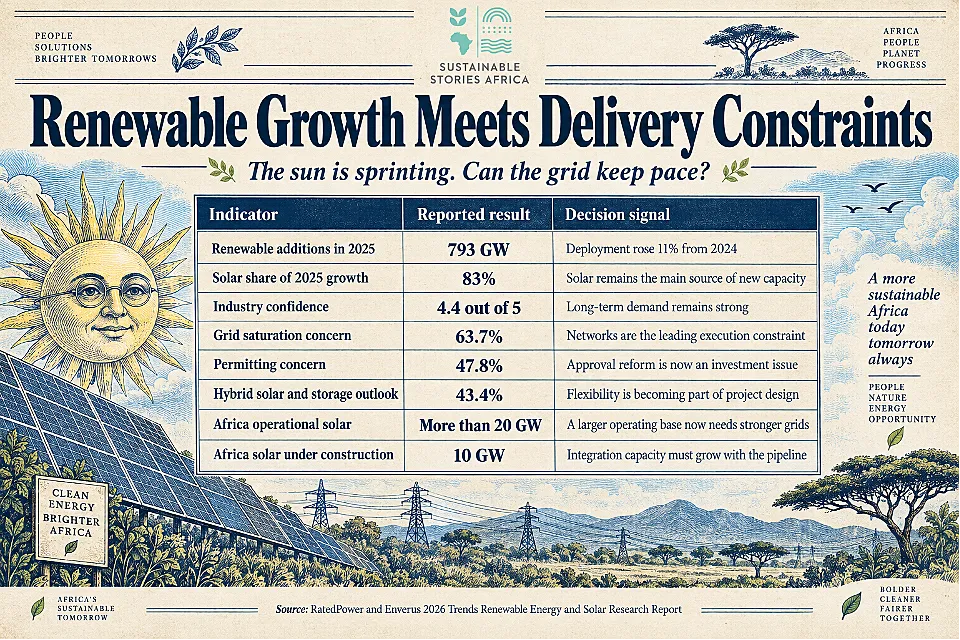
RatedPower, part of Enverus, reports that 793 GW of renewable capacity was added in 2025, 11% more than in 2024, with solar photovoltaic power accounting for 83% of the growth.
The report also says renewables overtook coal in global electricity generation for the first time.
That expansion is colliding with congested networks, slower approvals and shortages of skilled workers.
In a survey of more than 100 energy professionals, market confidence averaged 4.4 out of 5, even as 63.7% identified grid saturation and instability as a leading challenge and 47.8% selected permits and regulation.
For Africa, the tension is especially sharp.
- The continent has abundant resources and urgent demand for reliable electricity; however, its national policy frameworks, grids and financing conditions remain uneven.
- The report estimates that operational solar capacity in Africa exceeds 20 GW, with another 10 GW under construction.
Turning that pipeline into dependable power will require storage and network investment advancing alongside panels.
Record Additions Conceal A Grid Constraint
The report's central finding is that renewable growth has developed faster than the infrastructure around it.
- Between 2025 and 2030, an estimated 4,600 GW of new renewable capacity could be added worldwide, double the deployment of the previous five years.
- Solar is expected to provide nearly 80% of that expansion.
- By 2030, renewables could supply 45% of global electricity.
However, record capacity does not automatically become usable electricity.
- The report says Europe curtailed 11% of renewable generation in summer 2025 because the grid could not absorb it.
- Comparable pressures were emerging in China, Brazil, Germany, Chile and the United Kingdom.
Inverter-based generation can also reduce system inertia and expose weak networks to frequency and voltage instability.
These are operational constraints with direct revenue consequences for developers and reliability consequences for consumers.
Storage And Solar Rewrite Project Economics
Battery energy storage is becoming the bridge between renewable ambition and grid reality.
- RatedPower projects the global battery energy storage system market to grow from $50.81 billion in 2025 to $105.96 billion by 2030.
- 85% of surveyed professionals were already offering or planning to offer storage, while AC-coupled systems were preferred in 83% of the simulations reviewed for the report.
- Hybrid solar-plus-storage led respondents' five-year growth expectations at 43.4%, ahead of standalone storage at 21.2% and solar alone at 16.8%.
Technology choices are changing.
- Bifacial modules, which generate electricity from light reaching both sides, are expected to reach a 90% - 95% market share by 2032.
- String inverters are gaining favour because they are modular and can limit the effect of a single failure.
- Digital tools are also moving into project development: 55% of respondents use advanced tools for permitting, and 56% use drone imagery or LiDAR.
Artificial Intelligence (AI) is expected to improve design, forecasting and predictive maintenance, although it cannot remove physical construction or transmission bottlenecks.
Project economics are also becoming more exposed to location and timing.
- Negative electricity prices can appear when production exceeds demand and network capacity, weakening revenues during the hours when solar plants generate most.
- Land is another constraint: 61.9% of respondents reported difficulty securing suitable sites, even though only about one-fifth ranked land among the coming year's largest challenges.
- Agrivoltaic projects, which combine farming and power production, may reduce some conflicts, but they still require credible consultation, grid access and bankable contracts.
Africa Can Build Flexibility Into Expansion
Africa has an opportunity to avoid reproducing the inflexibility now limiting mature power markets.
The projects highlighted in the report already point in that direction.
- South Africa's Kenhardt complex combines utility-scale solar with about 1,140 MWh of storage.
- Egypt's AMEA Power is developing 1,500 MWh of standalone storage.
- Uganda plans a 100 MWp solar plant with 250 MWh of storage
- Malawi's Dwangwa project includes a 10 MWh battery system.
- South Africa's Redstone concentrated solar plant adds 1,200 MWh of molten-salt storage.
Those examples matter because storage can shift solar output into evening demand, provide frequency and voltage support, and reduce the amount of clean electricity discarded during congestion.
Mini-grids can bring the same principle to communities beyond reliable transmission networks.
- If regulators allow storage to earn revenue for the services it provides, hybrid projects can improve both energy access and system resilience rather than operating as isolated generation assets.
Policy Must Catch Up With Technology
The next step is institutional.
- Grid operators need transparent information about connection capacity and must update grid codes for reactive power, dynamic feed-in limits and grid-forming capabilities.
- Regulators should define how batteries participate in energy and ancillary-service markets, while procurement programmes should evaluate deliverable power and system support, not only the lowest generation tariff.
- Clear rules would allow financiers to assess hybrid revenue instead of treating storage as an unpriced add-on.
Permitting is the second pressure point.
- Nearly 71% of respondents considered current incentives inadequate.
- 35.4% placed simplified permitting at the top of their policy wish list, followed by storage incentives at 24.8% and subsidised finance at 16.8%.
One-stop approval processes, published timelines and coordinated land and grid reviews could reduce avoidable delay without weakening environmental and community safeguards.
Skills and supply chains also require deliberate investment.
- Some 55.8% of surveyed companies reported difficulty hiring qualified people.
African governments, developers and training institutions can respond with programmes for power-system engineering, battery safety, commissioning, data analysis and maintenance.
- Local capability will determine whether imported equipment becomes reliable infrastructure.
Circularity plans for panels and batteries should begin before volumes reach end of life, with procurement standards that require traceability and responsible recovery.
Path Forward – The Next Phase Depends On Integration
Africa's renewable opportunity now depends on building generation, storage and networks as one system.
Transparent connection rules, investable storage markets and faster approvals can turn solar capacity into reliable electricity.
Governments and industry should pair every growth target with a grid plan, a workforce plan and an end-of-life strategy.
That is how record deployment can produce durable access, lower emissions and stronger energy security.