
Foreign court judgments no longer stay politely at home; they follow assets.
For African businesses trading globally, the Enforcement of Judgments, Law Over Borders Comparative Guide 2026 shows how fast the enforcement strategy is becoming a make‑or‑break governance issue.
It's Nigeria and broader cross‑border insights signal a new reality: contracts, capital flows, and ESG credibility all hinge on how well firms anticipate, structure, and mitigate enforcement risk in a multipolar, increasingly litigious world.
Judgment Risks At Africa’s Trade Gate
Foreign judgments and arbitral awards used to feel like distant concerns for African businesses.
That era is over. As African firms sign larger cross-border deals, raise international capital and operate through complex asset structures, the enforceability of court decisions has become a frontline business risk, rather than a niche legal matter.
In Nigeria, enforcement lies within a dense legislative framework spanning the Reciprocal Enforcement of Judgments Ordinance 1922, the Foreign Judgments Reciprocal Enforcement Act, the Sheriffs and Civil Process Act, and the Arbitration and Mediation Act 2023, which gives effect to New York Convention obligations.
The Enforcement of Judgments, Law Over Borders Comparative Guide 2026, edited by Andrew Bartlett of Osborne Clarke LLP, with contributions from Ibukun Enigbokan and Yussuf Akinola Oyenbanjo of Streamsowers & Köhn (Nigeria), makes clear this is equally a governance and ESG story.
Enforcement risk shapes how companies disclose contingent liabilities, manage disputes and protect stakeholders from value-destroying litigation outcomes.
Originators of the document: Enforcement of Judgments, Law Over Borders Comparative Guide 2026 is published by Global City Media Ltd (Global Legal Post), edited by Andrew Bartlett of Osborne Clarke LLP, with country chapters, including Nigeria and other African and global jurisdictions, authored by specialist law firms such as Streamsowers & Köhn, S. P. A. Ajibade & Co., and others.
A new class of cross‑border risk
The uncomfortable truth is this: a court judgment that cannot be enforced is a pyrrhic victory; however, for African businesses in global trade, an enforceable foreign judgment can quickly become an existential threat.
The guide underscores that cross‑border enforcement is no longer rare; it is an increasingly routine part of complex disputes, backed by sophisticated asset tracing, interim relief, and coordinated proceedings across multiple jurisdictions.
The thesis is simple and stark. African firms that treat litigation and enforcement as “after‑the‑fact legal issues” are structurally exposed.
Global counterparties now plan enforcement strategy from day one—choosing forum, cause of action, and asset location with recovery in mind.
Many African companies still sign boilerplate jurisdiction and arbitration clauses, scatter assets across opaque structures, and only think about enforcement when the demand letter arrives.
In a world where Nigerian courts can register foreign judgments and enforce against local assets under strict statutory timelines and conditions, that is no longer sustainable.
Three Pillars, One Goal: How Cross-Border Enforcement Actually Works
Successful cross-border enforcement rests on three strategic pillars: information gathering, asset preservation and execution against assets, each carrying distinct legal demands across jurisdictions.
Nigeria's framework illustrates the full weight of that process.
To enforce a foreign court judgment, a creditor must register it in a superior Nigerian court under the Reciprocal Enforcement of Judgments Ordinance or the Foreign Judgments Reciprocal Enforcement Act.
The judgment must be final, issued by a recognised superior foreign court, consistent with Nigerian public policy, free of fraud and registered within 12 months.
Tax, penalty and fine-based awards are excluded entirely.
Foreign arbitral awards follow a parallel but distinct track under the Arbitration and Mediation Act 2023, which domesticates obligations from Nigeria's New York Convention.
Courts must recognise qualifying awards unless specific defences apply, including defective arbitration clauses, inadequate notice, awards exceeding the scope of the agreement or public policy conflicts.
The practical warning is direct: a company that wins abroad in judgmental procedures can still find its award unenforceable in Nigeria through poor contract drafting alone.
On execution, Nigerian courts reach bank accounts through garnishee proceedings, movable property and shares through writs of attachment, and real estate when other assets prove insufficient.
Courts can pursue beneficially owned assets even where legal title remains unperfected, though jointly owned property requires clear severability of the debtor's share.
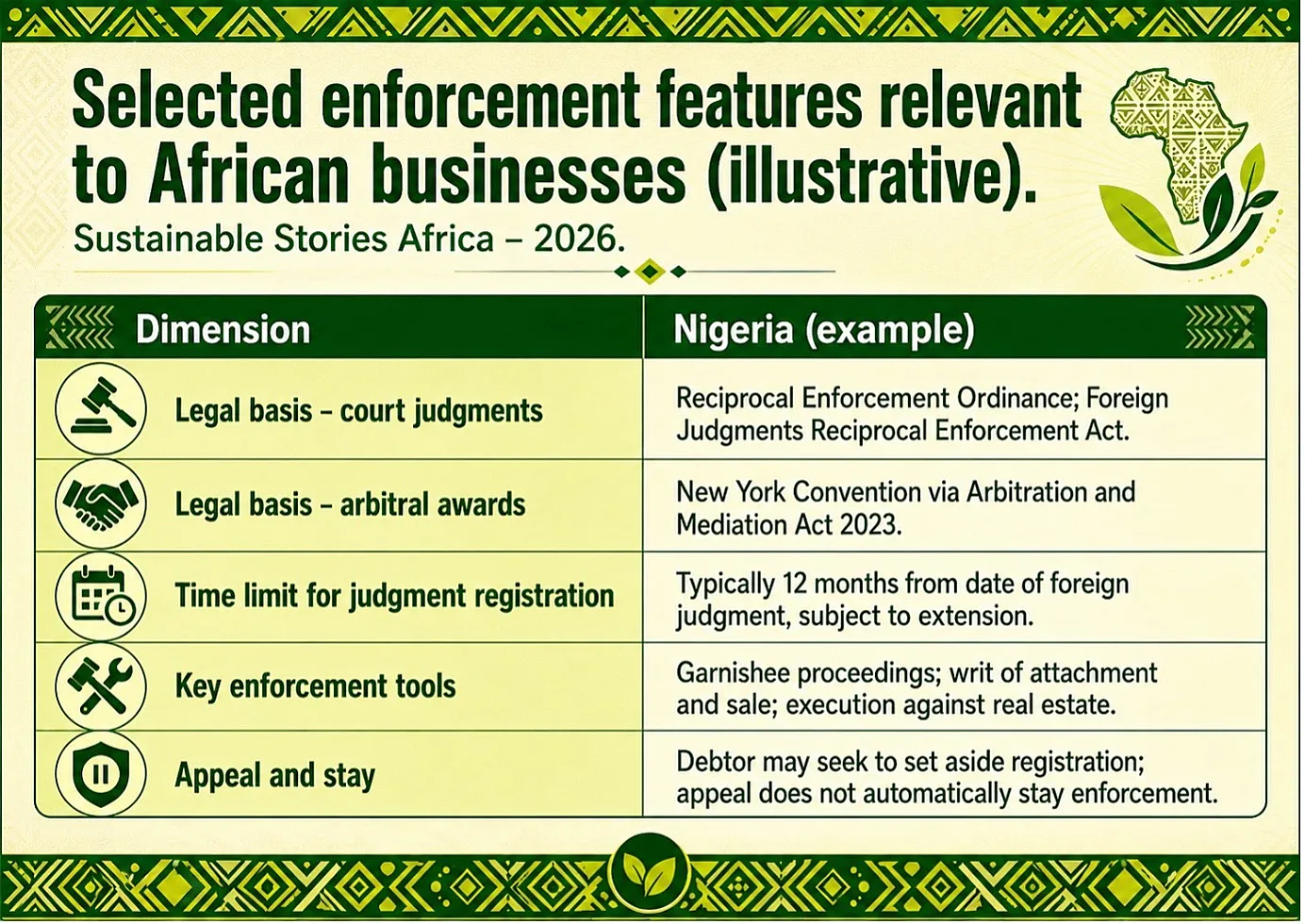
Across the guide's jurisdictions, the pattern is consistent but uneven. Common law hubs offer powerful worldwide freezing orders and broad disclosure tools; other systems restrict interim measures to locally situated assets.

For African firms operating across multiple markets, this patchwork creates both exposure and strategic opportunity.
Well-advised companies can structure their affairs to anticipate and manage enforcement moves before disputes arise
What African businesses stand to gain
The complexity of cross-border enforcement is not only a threat; it is an incentive for African firms to upgrade governance, contract discipline and risk culture.
Businesses that internalise these lessons become more attractive partners in global value chains, not simply better-defended ones.

Three practical gains follow.
- First, proactive enforcement awareness pushes boards to treat jurisdiction and arbitration clauses as strategic tools, not boilerplate, signalling legal sophistication to ESG-focused investors and lenders.
- Second, clear asset mapping, separating operating assets, ring-fenced SPVs and pledged collateral, reduces exposure when disputes arise and supports smarter liquidity planning.
- Third, transparent dispute management and honest disclosure of litigation exposure protect reputational capital with workers, communities and regulators.
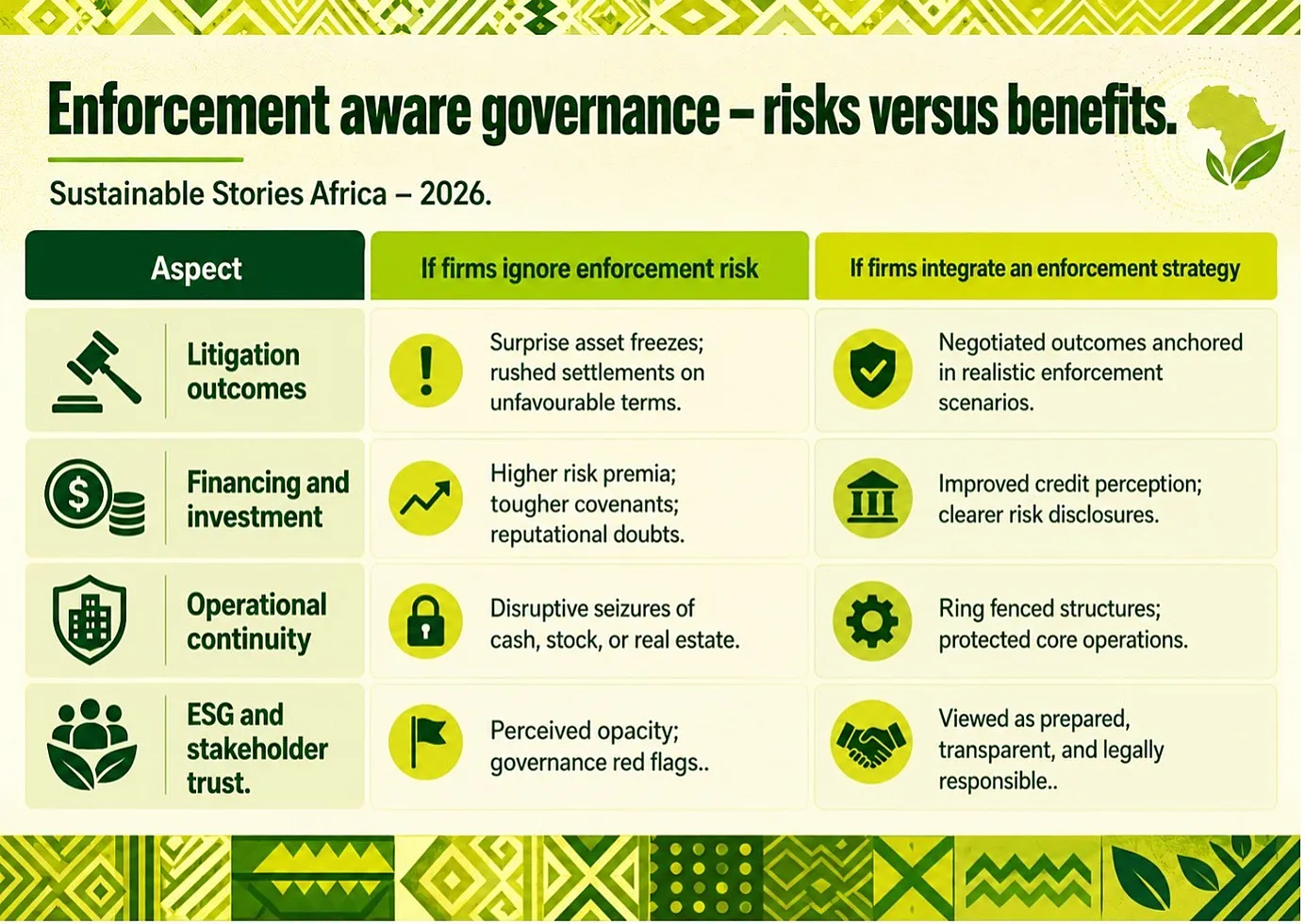
For African firms that have scaled rapidly in fintech, logistics, energy and manufacturing, enforcement literacy is no longer defensive preparation. It is a measurable competitive advantage in global markets.
A Four-Stakeholder Action Plan for Cross-Border Enforcement Readiness
Translating enforcement awareness into institutional practice requires coordinated action across four stakeholder groups.
For boards and senior management:
- Treat enforcement risk as a standing agenda item in every significant cross-border transaction
- Require clear memos on enforcement venues, judgment registrability and asset implications
- Integrate enforcement insights into enterprise risk management and ESG reporting
For in-house and external counsel:
- Design dispute resolution clauses with enforcement outcomes in mind, not procedural convenience
- Map asset locations and ownership structures to anticipate counterparty enforcement strategies
- Deploy garnishee proceedings, attachments and interim injunctions defensively, not only offensively
For banks, investors and DFIs:
Embed enforcement scenario analysis into credit approvals and covenant design for multi-jurisdictional borrowers
Support portfolio companies with access to cross-border disputes expertise across markets, including Nigeria, Mauritius and South Africa
For regulators and policymakers:
- Modernise local enforcement frameworks, registration timelines, public policy criteria and ESG interfaces, to ensure predictability
- Build judicial capacity in asset tracing, cross-border cooperation and complex financial structures
PATH FORWARD – From Legal Footnote To Strategic Compass
The Law Over Borders guide shows that African businesses can no longer treat foreign judgments and arbitral awards as distant risks.
Boards should place enforcement risk alongside credit, operational and ESG risks, using it to shape stronger contracts, smarter asset structures and more credible global partnerships.
The path forward is to embed enforcement thinking into deal design, risk management and stakeholder reporting, while seeking cross-border legal advice and advocating transparent, predictable local frameworks for resilient participation in global trade.