
Nigeria’s financial-sector recapitalisation has created a rare abundance of capital across banking, pensions and insurance. However, capital raised is not the same as capital productively deployed.
The next test is whether institutions channel this balance-sheet strength into infrastructure, climate resilience, small businesses and household protection, or merely into consolidation that enriches a narrow circle of incumbents.
Capital Has Changed Hands
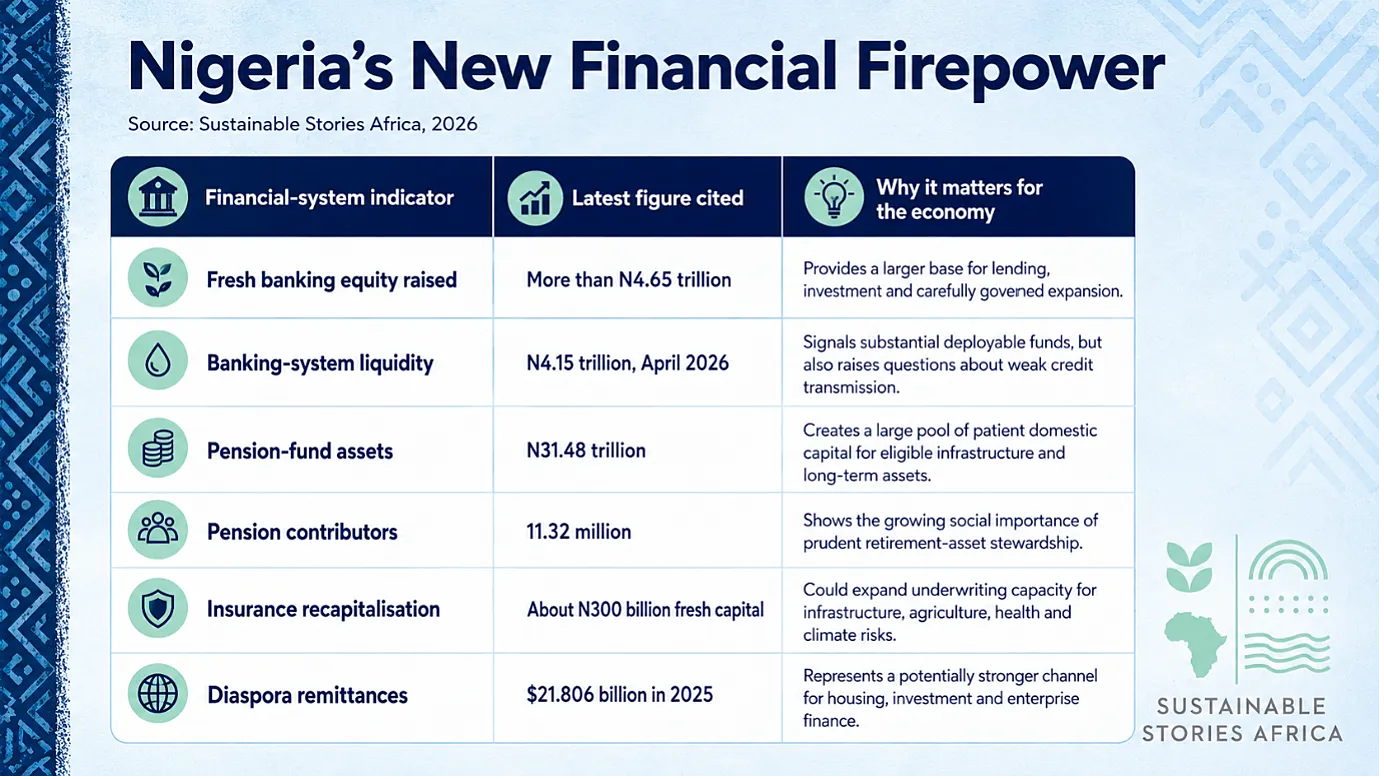
Nigeria has entered a defining period for financial intermediation. The country’s banks reportedly raised more than N4.65 trillion in fresh equity during the recapitalisation exercise, while pension assets reached N31.48 trillion and insurance recapitalisation added an estimated N300 billion in new capital.
These are not routine sectoral figures. They represent a fundamental shift in the capacity of Nigerian financial institutions to lend, invest, insure and absorb risk. However, the public value of this reset will not be measured by the size of bank balance sheets or the number of deals announced.
- It will be measured by whether a farmer can obtain climate insurance, whether a manufacturer can finance inventory, whether a state can deliver investable infrastructure, and whether pension savings can earn sustainable long-term returns.
The original brief by “Blood In The Water” by Nakachi Consulting and Blackstone Private Equity Limited frames the moment as an aggressive contest between financial-sector winners and losers.
That diagnosis captures the urgency; however, it should not become the governing philosophy.
Nigeria needs competitive institutions, certainly; it does not need a financial system where concentration, opaque acquisitions and speculative deployment outrun consumer protection, governance and real-economy lending.
A Bigger Balance Sheet
The central argument is straightforward: recapitalisation should be treated as a national development instrument, rather than simply as a corporate survival exercise.
The recapitalisation requirements reportedly set minimum paid-up capital thresholds of N500 billion for international commercial banks, N200 billion for national banks and N50 billion for regional banks, with the process requiring fresh equity rather than reliance on retained earnings.
- This distinction matters because it has brought new investors into the sector and, potentially, more scrutiny of how institutions create value.
However, the brief notes that loan-to-deposit ratios at major banks have fallen;
- A decline at Access Holdings from 50.7% to 38.6%
- GTCO’s ratio stood at 25%.
- System liquidity was reported at N4.15 trillion in April 2026, sharply higher than three years earlier.
That is the contradiction policymakers, boards and investors must address.
- Nigeria has more deployable capital, yet productive sectors still face high borrowing costs, difficult collateral conditions and limited long-term finance.
Recapitalisation cannot create well-funded institutions that remain hesitant to finance the economy that sustains them.
The Missing Connection
The most important opportunity lies in connecting this capital to Nigeria’s unresolved development gaps.
The brief estimates Nigeria’s infrastructure gap at roughly $100 billion annually and suggests that reallocating just 5% of pension assets, about N1.57 trillion, could meaningfully support infrastructure financing.
That proposition deserves urgent attention, not as a call to gamble with retirement savings, but as an argument for building a credible pipeline of investable projects.
Pension funds cannot responsibly finance poorly prepared roads, hospitals, renewable-energy systems or water projects.
- They need projects with transparent feasibility studies, reliable revenue models, risk allocation, environmental and social safeguards, independent audits and appropriate credit enhancement.
- Without those foundations, calls to “unlock pension capital” become another slogan attached to unbankable projects.
Insurance presents an equally consequential opportunity.
- Gross premium income was reported to have risen from N1 trillion in 2023 to N1.562 trillion in 2024, with an estimated N2.3 trillion for 2025, even as insurance penetration remained below 1% of GDP. The gap points to a market failure as much as a market opportunity.
Millions of Nigerian households, small businesses and farmers remain exposed to floods, health shocks, crop losses, fire, cyber fraud and business interruption without meaningful risk cover.
The financial system should see this not as an invitation to sell expensive policies that do not pay claims, but as a mandate to build trusted, affordable and digitally accessible protection.
Nigeria’s informal economy also requires a different credit imagination.
- The brief estimates that 55% of economic activity is informal and places the SME working-capital gap at $617 billion.
- Traditional collateral-led lending will not close that gap.
- Banks, fintechs and insurers must develop responsible models based on verified transaction data, supply-chain relationships, invoice finance and tailored guarantees, while ensuring that digital credit does not become a highway to unsustainable household debt.
Finance That Serves Society
Nigeria can build a stronger financial system without repeating the worst habits of finance-led growth: excess concentration, short-termism and gains detached from social outcomes.
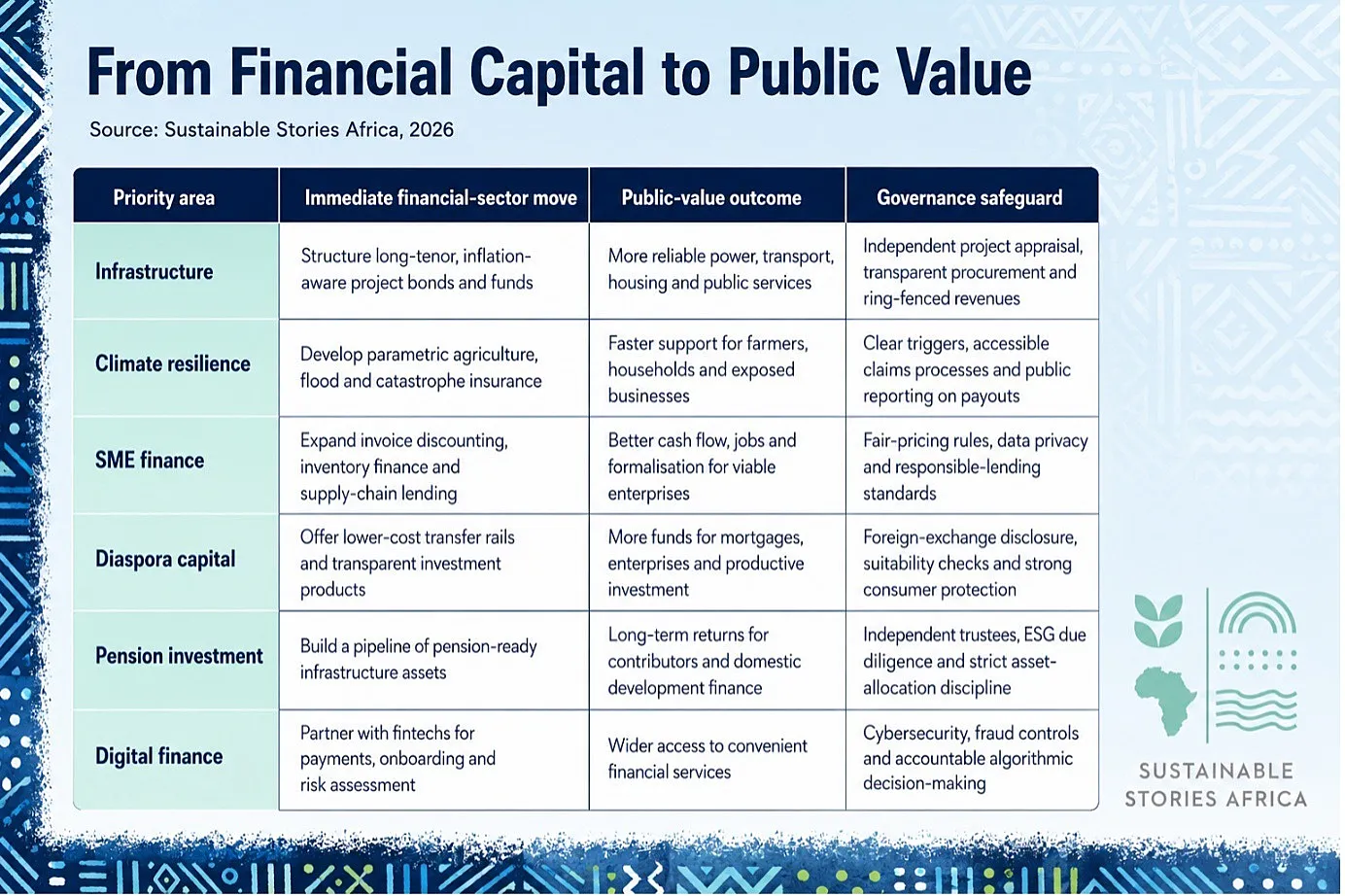
A well-governed financial reset could produce several connected benefits:
Infrastructure with domestic roots –
- Pension-backed and bank-financed projects could help fund power, transport, water, health and digital infrastructure while reducing dependence on volatile foreign borrowing.
Better risk protection –
- Recapitalised insurers could expand cover for agriculture, infrastructure, health, cyber risks and climate-related losses.
More inclusive enterprise credit –
- Alternative data and structured working-capital products could bring viable micro, small and medium-sized businesses into formal finance.
Lower-cost diaspora finance –
- Sub-Saharan Africa’s average remittance cost was cited at 8.46%, compared with a 6.36% global average, leaving substantial scope for digital channels to deliver better value.
Deeper regional capacity –
- Stronger Nigerian institutions could finance trade and investment across Africa, provided cross-border growth is matched with sound governance, local accountability and regulatory cooperation.
The prize is not simply a larger Nigerian financial sector.
- It is a more resilient economy where savings finance productive assets, risk is shared fairly, and businesses can grow beyond survival mode.
Put Governance First
The first responsibility belongs to regulators.
- The Central Bank of Nigeria, National Insurance Commission, National Pension Commission and Securities and Exchange Commission should coordinate supervision around financial stability, consumer welfare, climate exposure, cybersecurity and related-party risk.
- The source brief anticipates a shift towards more risk-based regulation, including greater attention to digital, climate and cyber risks.
Second, boards must resist the temptation to interpret recapitalisation as a licence for indiscriminate acquisitions.
- Consolidation can strengthen weak institutions, improve technology and deepen regional capacity.
- However, mergers pursued solely for scale can create institutions that are too complex to manage, too politically connected to discipline and too distant from ordinary customers.
Third, pension trustees and fund managers must insist that infrastructure investments meet the highest tests of fiduciary responsibility.
- Contributors’ savings are not patient capital simply because they have long tenors; they are protected capital.
- Every project must demonstrate value, resilience, transparent risk allocation and credible returns.
Fourth, banks and fintechs should make responsible SME finance a strategic priority.
- The opportunity is not in charging distressed firms punitive rates.
- It is in designing products that match the real rhythm of commerce: purchase orders, invoices, inventory cycles, seasonal sales and verified cash flows.
Finally, insurers must compete on trust.
- Nigeria’s protection gap will not close through corporate announcements alone.
- It will close when policyholders understand what they are buying, can afford it, and receive prompt and fair claims settlements when hardship occurs.
Path Forward – Finance Beyond Financial Winners
Nigeria has raised the capital. It must now build the rules, project pipeline and institutional discipline that turn capital into broad-based prosperity.
The next phase should reward lenders, insurers, pension managers and fintechs that finance productive enterprise, protect vulnerable households and uphold transparent governance, rather than merely those that grow fastest on paper.