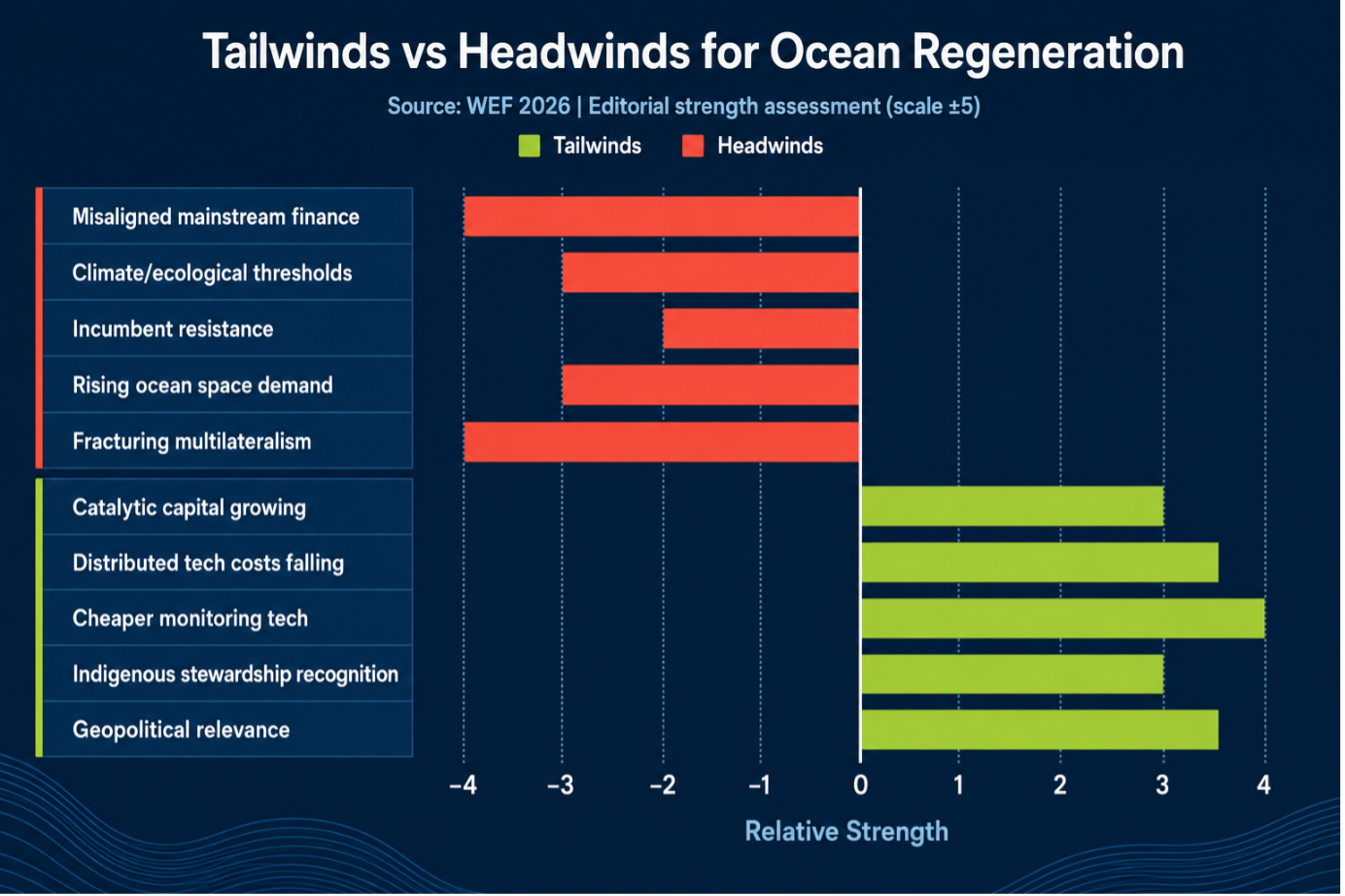
The WEF's June 2026 report identifies five tailwinds and five headwinds shaping the Regenerative Blue Economy. For Africa, the message is urgent: today's choices could unlock trillion-dollar regenerative industries, or entrench decline for ecosystems supporting hundreds of millions.
Africa is no bystander — it holds vital marine ecosystems, mangrove coasts, and major fisheries, alongside highly exposed coastal communities. With the forces mapped, Africa must now chart its own regenerative path before the window closes.
Africa Must Choose Regeneration Before the Headwinds Win
The ocean does not wait for political consensus. The ecological tipping points that the WEF identifies as the most dangerous headwind — approaching limits in coral reef systems, Arctic sea ice, and coastal fisheries, beyond which management quality alone cannot secure recovery — are real, approaching, and accelerating. Africa's coastal and marine economies are directly in their path.
Chapter 4 of the WEF Insight Report maps the strategic forces shaping the regenerative blue economy transition — five tailwinds creating momentum and five headwinds threatening to reverse it. Together, they define the context within which Africa must make its blue economy choices in the next five years.
The Headwinds Are Not Theoretical
Of the five headwinds the WEF identifies, three are particularly acute for African ocean economies.
Fracturing multilateralism:
- Progress on ocean regeneration depends on cooperation across fisheries, shipping, biodiversity, and climate regimes, but alignment is globally under strain.
- For Africa, whose major fisheries are contested by distant-water fleets from Asia and Europe, and whose marine biodiversity commitments depend on BBNJ implementation and GBF delivery, the weakening of multilateral cooperation is an existential threat to the governance frameworks on which regeneration depends.
Rising demand on ocean space and resources:
- Offshore energy development, port expansion, coastal real estate, and industrial aquaculture are intensifying pressure on Africa's marine and coastal zones.
- Without marine spatial planning, which most African nations have not yet implemented at seascape scale, this competition will be settled by the most powerful economic actors, marginalising coastal communities and further degrading ecosystems.
Misaligned mainstream finance:
- Capital still favours extractive activity. Regenerative projects face long horizons, diffuse returns, and inconsistent standards, compounded, according to the WEF, by a retreat from net-zero commitments in some institutional investor communities.
- For African ocean investments, which typically carry additional currency risk, regulatory uncertainty, and capacity constraints, the misalignment of mainstream finance is the single most significant structural barrier to scale.
The Tailwinds Africa Must Catch Now
The WEF also identifies five tailwinds that, if properly harnessed, can propel Africa's regenerative blue economy forward.
Growing geopolitical relevance of the ocean:
- The ocean is increasingly framed globally as a climate solution, a security asset, and a trade enabler, drawing in energy, defence, and foreign affairs ministries alongside environmental agencies.
- For Africa, this means ocean investments can now be positioned as resilience plays and national security assets, not only CSR activities, unlocking broader ministerial ownership and budget alignment.
Recognition of Indigenous and small-scale stewardship:
- The growing global consensus around tenure rights, community representation, and evidence of effective local stewardship is placing equity, rights, and public health at the centre of ocean governance.
- Across Africa, where customary fishing rights, sacred coastal sites, and community-managed marine areas predate formal governance systems, this tailwind validates existing practice to create legal pathways to formalise community custodianship at scale.
Cheaper monitoring and enforcement:
- The cost of satellite tracking, drone-based surveillance, and AI-powered ocean monitoring has fallen dramatically, making transparency more accessible even to remote and resource-constrained communities.
- For African nations where, for example, enforcing fishing agreements and MPAs has historically been limited by budget constraints, this is a transformative development, one that can now be funded as public infrastructure rather than requiring external technical assistance.
Catalytic capital expanding:
- Philanthropic capital, maturing blue bond markets, debt-for-nature swaps, and blended finance structures are beginning to open space for restoration and community-led enterprise.
- The Seychelles' debt-for-nature pioneer, DP World's blue bond, and the Ocean Conservation Trust's community finance models are all instructive precedents for what African nations can access if they build the governance frameworks that make capital deployment viable.
What Africa Stands to Win with Regeneration
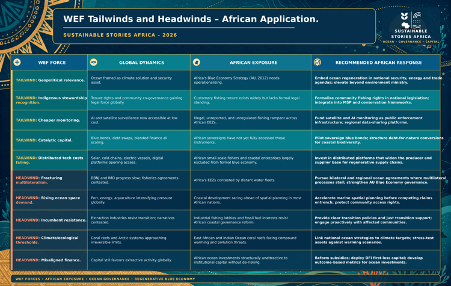
Africa's Five Strategic Priorities for Regenerative Leadership
The WEF makes its priorities explicit: governments, businesses, civil society, and financial institutions must each shift from fragmented, project-based approaches to integrated, place-based strategies operating at seascape scale.
For Africa, this means five concrete strategic priorities:
- Operationalise the African Union's 2050 Africa's Integrated Maritime Strategy (2050 AIMS) with a regenerative blue economy mandate, embedding ecosystem restoration, community tenure, and climate targets into national Sustainable Ocean Plans.
- Establish West African, East African, and Southern African seascape governance platforms, modelled on the Birds Head Seascape and PNA models, that connect community stewardship, national planning, and regional coordination through binding agreements.
- Access the catalytic capital infrastructure now available: sovereign blue bonds, debt-for-nature swaps, blended finance facilities, and IPLC-focused finance windows, before borrowing cost differentials widen further and market access windows narrow.
- Invest in ocean monitoring and enforcement as national security infrastructure, using satellite tracking, AI-powered vessel surveillance, and community-based monitoring to recover value currently lost to IUU fishing across African EEZs.
- Treat human capacity as core infrastructure, not a supplementary training budget. Every regenerative blue economy initiative in Africa must carry an explicit capacity development component alongside its ecological, financial, and technological goals.
Path Forward – The Window Is Open, But Not for Long
The WEF's conclusion is unambiguous: the window for action is narrowing even as the tools mature.
Some headwinds, notably climate and ecological thresholds, impose hard limits that governance alone cannot resolve.
Coral reefs, coastal fisheries, and mangrove systems approaching tipping points will not wait for Africa's national strategies to be finalised.
The continent's blue economy choices in the next five years will define whether its ocean-dependent communities inherit a regenerating ocean or a managed decline.
The WEF has shown that the tools, frameworks, and precedents for regeneration already exist.
Africa now needs the political will, institutional capacity, and financial architecture to deploy them, at the speed and scale the ocean demands.