SSA Editorial Note: Figures for 2021–2024 in the growth chart are illustrative estimates modelled on Danida Fellowship Centre's confirmed 2025 figure of 1,300 trained professionals; only 2025 data is independently verified.
Africa's ESG storytelling crisis isn't a lack of ambition; it's a lack of trained hands to tell the continent's own sustainability story on its own terms.
Danida Fellowship Centre has spent five years quietly building that capacity, from energy journalists at COP30 to women leaders and urban planners across the continent.
This matters now because as African markets face tightening ESG disclosure rules from export partners, the ability to narrate local sustainability realities, rather than import foreign templates, will determine whose story gets funded, financed, and believed.
A Fellowship Rewrites Africa's Story
For five years, a quiet Danish institution has been doing something most ESG conversations in Africa overlook: training people, rather than just funding projects.
Danida Fellowship Centre, a self-governing body under Denmark's Ministry of Foreign Affairs, has moved more than 1,300 professionals through learning activities in 2025 alone, with nearly a fifth focused squarely on the energy transition.
This is not another donor press release about grants disbursed. It is a five-year record of journalists, urban planners, women leaders, and researchers across Kenya, South Africa, Brazil, India, Nigeria and beyond equipped to interrogate, translate, and narrate sustainability in African terms, rather than imported ones.
That distinction matters more in 2026 than it did in 2021. As disclosure regimes tighten and climate finance flows hinge on credible local reporting, the question is no longer whether Africa has an ESG story.
It is whether Africa has enough trained storytellers, planners, and negotiators to tell its story convincingly to capital markets and citizens alike.
The Capacity Gap Nobody Talks About
Here is the uncomfortable truth: Africa's ESG deficit is less about missing frameworks and more about whether it has enough trained hands to apply them in the right context.
Danida Fellowship Centre's own 2025 data show that close to one-fifth of all learning activities were dedicated to energy transition skills, a deliberate correction to a continent-wide shortage of professionals who can bridge global climate finance logic with local implementation realities.
The claim at the heart of this piece is simple: sustained, unglamorous capacity-building, rather than another flashy pledge, is what actually moves Africa's ESG and energy narrative from donor-authored to African-owned.
Danida Fellowship Centre's five-year trajectory is one of the clearest test cases of this thesis on the continent.
Five Years of Quiet Compounding
The numbers tell a story of steady, compounding investment rather than a single dramatic intervention.
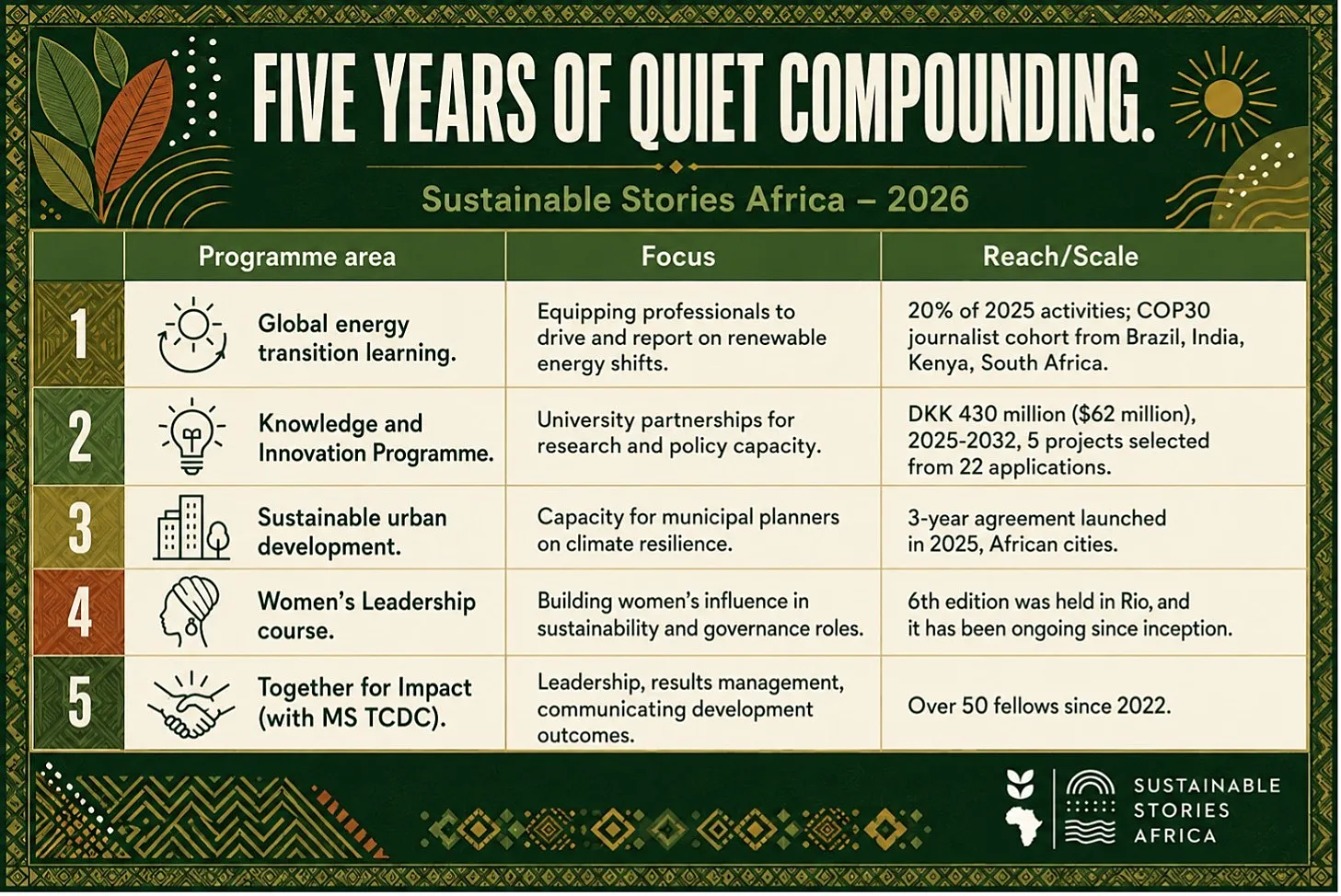
In 2025, Denmark launched the DKK 430 million ($62 million) Knowledge and Innovation Programme, a university partnership running through 2032, alongside a new three-year agreement to train urban planners and municipal practitioners across African cities.
Real examples ground the abstraction. At COP30 in Belém, four African journalists, from Kenya's KTN News, South Africa's Business Day TV, and elsewhere, were trained through the fellowship's programme and interviewed Denmark's Head of Global Cooperation on renewable energy, specifically probing how grid variability challenges translate to Kenya's context.
That is African-led sustainability journalism, rather than a translated press release.
Similarly, the Building Stronger Universities partnership helped Zanzibar's State University drive research that is reshaping the island's tourism sector toward sustainability.
In Tanzania and Kenya, the "Together for Impact" partnership with MS TCDC has trained over 150 development practitioners since 2022 in leadership, results management, and communicating development outcomes, skills that sit at the exact intersection of governance and storytelling that ESG reporting demands.
What Africa Gains From Homegrown Narrators
Imagine an Africa where energy and other journalists don't just relay foreign climate reports but interrogate grid variability with the same fluency as their Danish counterparts. This is precisely what happened at COP30.
That is the gain on offer: sustainability stories, governance reforms, and investment cases framed by people who understand both the technical language of ESG and the lived texture of African markets.
The alternative, continued reliance on externally authored narratives and templates, carries real costs.
- Investors misprice risk when local context is missing; policymakers adopt disclosure frameworks that don't fit local realities; and citizens disengage from sustainability conversations that feel imposed rather than owned.
Denmark's own energy chief made the point explicit: "Technology alone doesn't make energy flow; people do".
The same holds for ESG narratives; frameworks alone don't make sustainability stories credible; trained storytellers do.
What Policymakers, Financiers, and Newsrooms Must Do Now
The agenda that follows this evidence is concrete and actionable across several fronts.
- African governments should formally integrate fellowship and capacity outputs into national ESG and energy transition strategies, rather than treating training as a side benefit of donor relations.
- Regulators drafting ESG disclosure rules should consult the practitioners trained through programmes like Danida Fellowship Centre's urban development and energy tracks, since they hold ground-level implementation knowledge regulators often lack.
- Newsrooms and media houses across Africa should actively recruit and deploy a growing cohort of trained energy and sustainability journalists; the COP30 delegation is a template worth replicating at scale, rather than a one-off.
- Financiers and development partners should expand co-funding for university partnerships like the Knowledge and Innovation Programme, since research-to-policy pipelines are where credible local ESG data ultimately originates.
- Universities and civil society should push harder on youth leadership tracks, given that youth-focused fellowship cohorts are already linking climate justice advocacy to economic policymaking.
Path Forward, Not Just Pledges
The priority now is scale without dilution: Denmark's DKK 430 million university programme and its urban resilience agreements must translate into measurable policy shifts across partner cities, not just completed training modules.
African institutions, meanwhile, should treat these fellowships as infrastructure investments in narrative sovereignty, embedding trained alumni into newsrooms, ministries, and financial institutions so the continent's ESG story is finally told, verified, and owned from within.