Based on The World Cup As A Strategy by Daré Awoyinfa
The Sustainable Stories Africa editorial team and board review of Daré Awoyinfa’s paper: one conclusion stands out: Qatar 2022 accelerated national development, but it also deepened reliance on state-led mega-events.
For Africa, the lesson is not to copy the spectacle.
Countries should link sports bids to public transport, labour protection, local enterprise, climate accountability and long-term community use, so tournament spending creates durable institutions rather than expensive monuments.
A Tournament Tested The Development Model
Daré Awoyinfa’s paper, The World Cup As A Strategy, asks whether the 2022 FIFA World Cup advanced Qatar National Vision 2030. His answer is measured:
- The tournament was Qatar’s most powerful development accelerator; however, its gains often followed the plan’s wording more closely than its deeper aim of a diversified, self-sustaining economy.
Awoyinfa writes from unusual proximity.
- He grew up in Qatar, played in Al Rayyan’s youth system and served as a ball boy at Lusail Stadium during the Argentina-Croatia semi-final.
- That experience gives his argument texture without removing the need for scrutiny.
For African governments considering major sporting events, the paper offers a useful test.
- A tournament should deliver public value that survives the closing ceremony.
That means measuring transport, jobs, worker safety, local procurement, emissions, participation and maintenance before celebrating tourism numbers or global attention.
A Tournament Became A National Accelerator
Qatar’s central achievement was a strategic sequence.
- Qatar National Vision 2030 was published in July 2008;
- Qatar won the World Cup bid in December 2010.
- The tournament therefore served an existing national programme instead of becoming the programme itself.
That distinction should shape every African bid.
Too often, a bid begins with prestige and seeks a development story afterwards.
- The stronger model starts with public problems already defined through a national or city plan, then asks whether a tournament can accelerate solutions.
- Qatar used the deadline to open the Doha Metro, expand hotels and tourism capacity, complete Lusail and elevate aviation and international visibility.
Those assets were connected to social and economic goals that predated the event.
Acceleration can still harden a new dependency.
- Awoyinfa’s sharpest conclusion is “success on the letter of the Vision, but complication for its spirit.”
- Qatar reduced some reliance on hydrocarbons by growing tourism and event hosting; however, repeated tournaments may make growth dependent on the next global spectacle.
African countries should read that as a warning: changing the source of concentration does not create resilience.
Qatar Built Influence Infrastructure And Scrutiny
Qatar’s evidence is strongest where infrastructure and visibility reinforce each other.
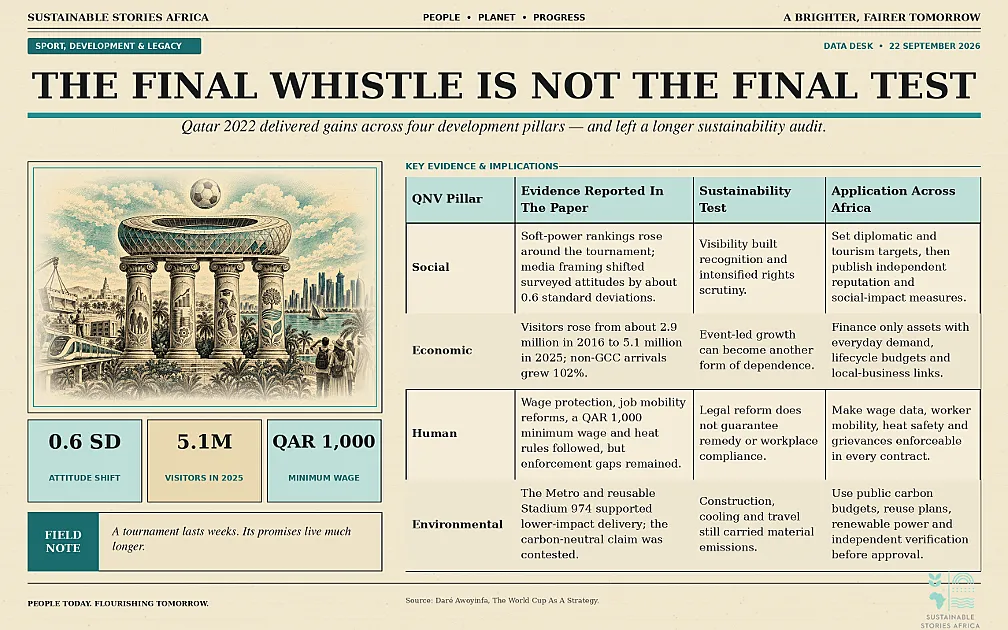
- Visitor arrivals rose from about 2.9 million at the pre-tournament peak in 2016 to 5.1 million in 2025, an increase of roughly 76%, according to the figures assembled from Qatar Tourism reports and World Bank data.
- Non-Gulf Cooperation Council arrivals grew 102%.
- Hamad International Airport averaged 775 flights a day in 2025, compared with 683 in 2019.
The World Cup helped turn a fixed deadline into coordinated delivery.
The social return was also significant.
- Brand Finance and Elcano rankings show an upward trend in Qatar’s soft-power position around the tournament.
- A PLOS ONE study across eight European countries found that media framing shifted attitudes toward Qatar by about 0.6 standard deviations.
- The same visibility that built recognition also magnified scrutiny of labour rights, sexuality laws and governance.
Global attention became both an asset and an accountability mechanism.
The human-development record is mixed but material.
- Qatar introduced electronic wage protection in 2015, agreed to International Labour Organisation cooperation in 2017, largely removed exit-permit requirements for private-sector workers in 2018, and in 2020 allowed workers to change jobs without an employer’s no-objection certificate.
- A QAR 1,000 monthly minimum wage and stronger heat protections followed.
However, ILO reporting still identified implementation gaps. Reform announced under tournament pressure is not the same as protection experienced by every worker.
Environmental gains were similarly partial.
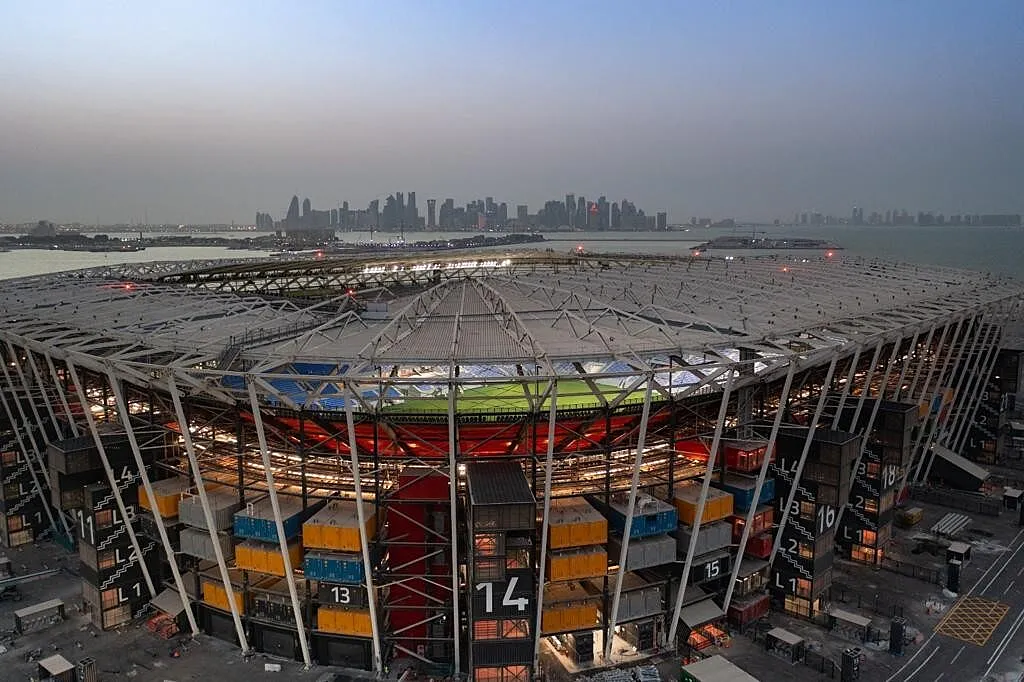
- The Metro reduced car dependence for spectators, and Stadium 974 was designed for disassembly.
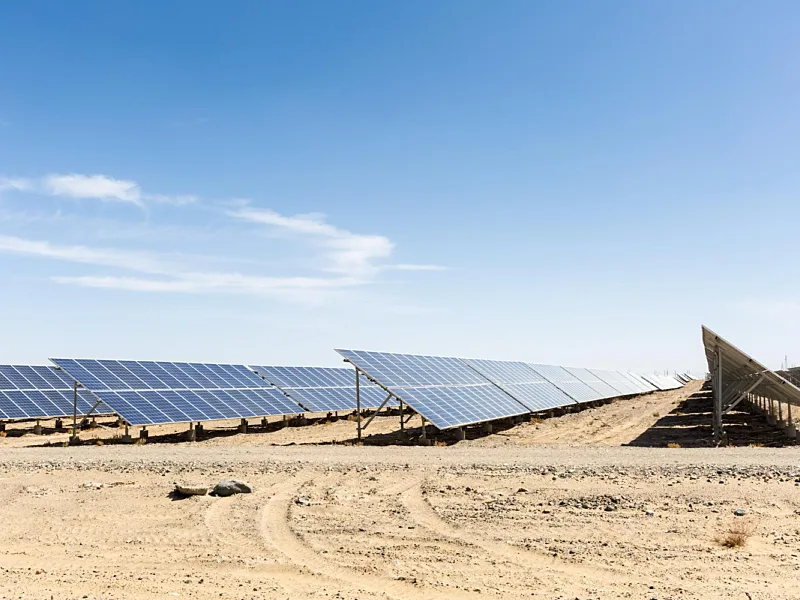
- Some venues used solar power and water-saving systems.
However, construction, cooling and concentrated air travel carried material emissions, while Carbon Market Watch contested the tournament’s carbon-neutral claim.
An event can support greener infrastructure without making the event itself sustainable.
For African countries, the opportunity cost is decisive.
- Public borrowing for a stadium or airport extension competes with spending on power, water, schools, health systems and climate resilience.
- That does not automatically rule out a tournament.
- It raises the evidence threshold.
Governments must show that the same asset would still rank highly without the event, that the financing terms are affordable, and that residents who bear the cost will use the result.
A deadline is valuable only when it accelerates the right projects.
Africa Can Convert Spectacle Into Systems
What would an African success look like?
- It would not be judged first by television pictures or the number of visiting dignitaries.
- Five years later, residents would still be using reliable transit;
- Young athletes would have safe community facilities;
- Local firms would have stronger balance sheets;
- Workers would retain enforceable rights;
- Venues would operate without draining public budgets.
That outcome is possible when governments treat the event as a temporary deadline for permanent systems.
- Rail lines should follow established mobility demand. Housing built for visitors or athletes should have a post-event social or commercial use.
- Training contracts should leave certified local skills.
- Tourism campaigns should connect visitors to multiple regions and seasons, reducing dependence on repeated tournaments.
- Public-health programmes should turn national excitement into regular participation, as Qatar attempted through the Healthy FIFA World Cup initiative.
A sustainability lens also changes the geography of benefit.
- Contracts and visitor spending should reach firms and communities beyond the host enclave.
- Existing venues, temporary seating and regional co-hosting can reduce new construction.
- Accessible ticketing, public transport and community programming can widen participation.
These choices are less spectacular than a new landmark stadium, but they determine whether citizens experience the event as a public investment or a televised expense.
The reward is larger than a reputational lift.
- A well-designed event can compress coordination that normally takes years, improve state capacity and attract private investment into assets with genuine demand.
- Weak design produces a different balance sheet: underused stadiums, displaced priorities, opaque debt, short-lived jobs and a carbon burden that citizens continue to finance.
Governments Must Govern The Legacy First
Before approving a bid, African governments should publish a development and sustainability case that survives without the event.
- Each capital project should disclose its ordinary users, lifecycle cost, operating owner and post-event revenue plan.
- Independent auditors should test demand assumptions and make the findings public.
Labour rules must be written into procurement.
- Contracts should require electronic wage records, freedom to change jobs, heat-risk protocols, safe accommodation, accessible grievance channels and rapid compensation where harm occurs.
- These protections should cover domestic and migrant workers from the first construction package, rather than arrive after international criticism.
Climate governance needs the same specificity.
- Organisers should set a public carbon budget covering construction, power, cooling, transport and spectator travel.
- Claims about neutrality should separate actual reductions from offsets and undergo independent verification.
- Stadium reuse, modular construction and renewable power can reduce impact, but only if procurement data and post-event use remain transparent.
Local economic value also needs enforceable targets.
- Bids should define what local firms can supply, how small businesses will access contracts, which skills will be transferred, and how tourism revenue will reach communities beyond host districts.
- Development banks and pension funds should finance only assets that show demand beyond the tournament window.
Finally, governments need a public legacy scorecard.
- It should track ridership, venue use, maintenance costs, local procurement, worker complaints and remedies, sports participation, visitor diversification and verified emissions for at least five years.
- Parliament, civil society, journalists and affected communities should review results annually.
- Prestige is temporary; public accountability converts a deadline into development.
Path Forward – Build Institutions Before Bidding For Attention
African countries should approve mega-events only when they advance a published development plan, carry funded post-event uses and meet enforceable labour, local-content and carbon standards.
Independent review must begin before bidding, not after construction starts.
Qatar 2022 shows how a tournament can accelerate infrastructure, tourism and reform. It also shows that speed can reproduce dependency.
Africa’s strongest legacy will come from assets, rights and institutions that work long after global attention has moved on.