Food lost between farms and markets, or discarded in shops, restaurants and homes, carries a cost far beyond the meal.
It diminishes farmers’ incomes, strains household budgets and wastes the land and water used to produce it.
Reflecting on hunger, Nigeria’s supply chains and the pressure on forests, I argue that reducing food loss and waste should be central to how we pursue food security and sustainable development.
Food We Lose Also Costs Forests
The food we never eat should concern us as much as the food we struggle to produce.
Every harvest lost before it reaches a market, and every meal discarded afterwards, represents a missed opportunity to feed people and protect the resources future harvests depend on.
September 29, the International Day of Awareness of Food Loss and Waste, brought that connection into focus.
At the Global Goals Summit, held on the sidelines of the 81st United Nations General Assembly, two questions stayed with me.
- Which of our shared goals should we retain for sustainable development?
- And what would success look like beyond economic growth?
As we considered those questions in groups, the discussion kept returning to hunger.
- The goal to retain beyond 2030 was Zero Hunger.
- A measure of success beyond economic growth was the level of hunger in the land.
For me, those answers also raised a question about the food we lose and the forests that help sustain us.
Hunger Exposes The Cost Of Waste
The world remains off track to achieve Sustainable Development Goal 2, Zero Hunger, by 2030.
- Earlier United Nations projections warned that more than 600 million people could still face hunger by then if prevailing trends persisted.
- Warnings that progress was slipping backwards made our summit discussions especially difficult to set aside.
How can such hunger coexist with so much food waste?
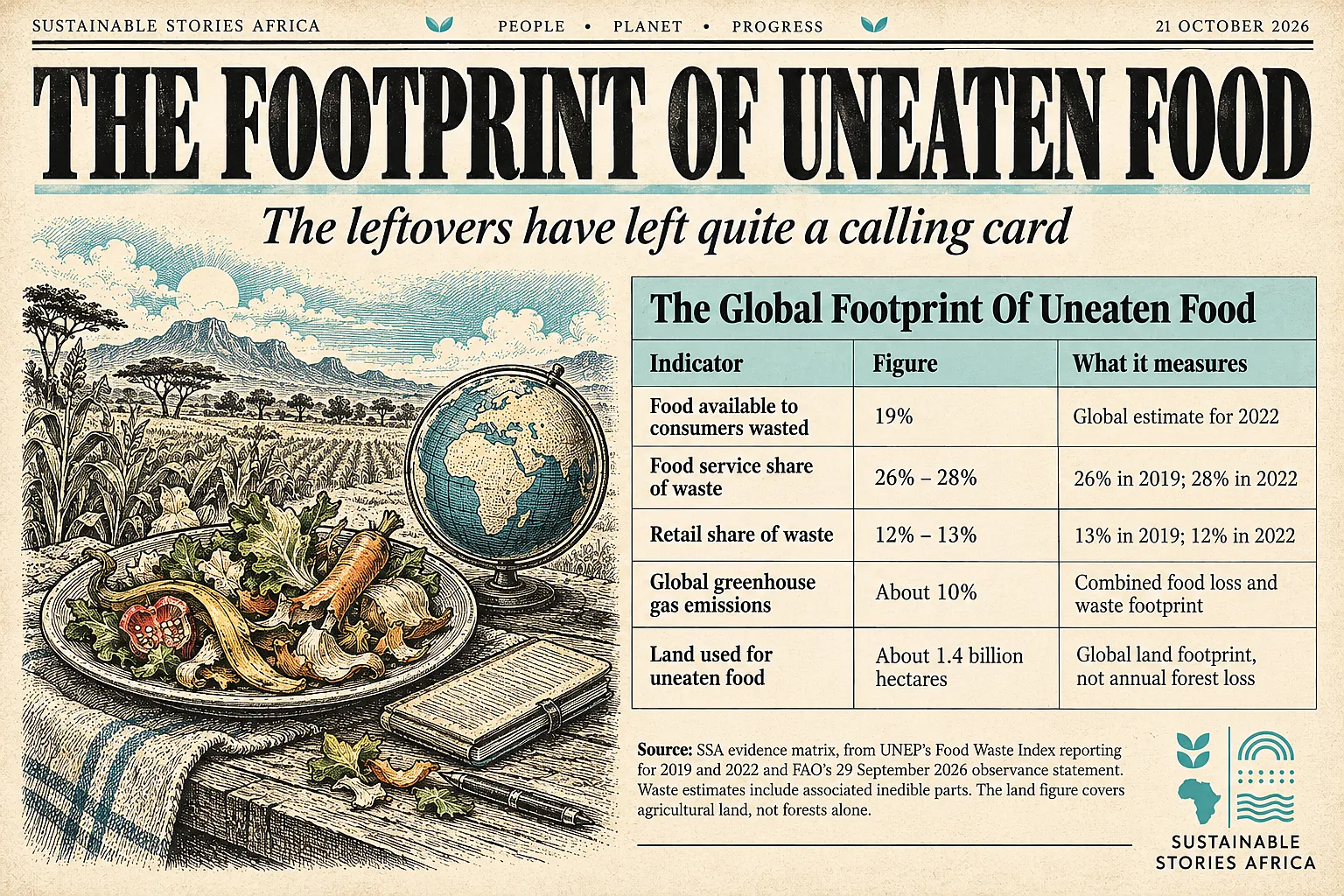
- UNEP’s Food Waste Index Report 2024 estimated that 19% of food available to consumers was wasted in 2022.
- Its release also highlighted that as many as 783 million people faced hunger that year. These are dated estimates, but the contradiction they describe remains troubling.
In Nigeria, food rots after harvest while prices and food insecurity remain high.
The international observance recognises how closely these issues connect.
- In December 2019, the UN General Assembly proclaimed September 29 the International Day of Awareness of Food Loss and Waste.
- The Food and Agriculture Organisation of the United Nations (FAO) and the United Nations Environment Programme (UNEP) jointly lead the initiative because it brings together food security, agricultural economics and environmental protection.
Its practical anchor is SDG Target 12.3. By 2030, countries should halve per capita food waste at retail and consumer levels and reduce food losses along production and supply chains.
Both commitments matter: preventing loss before food reaches a shop and preventing waste after it arrives require attention at different points.
Nigeria Loses Food Before Markets Benefit
Food loss occurs from harvest up to, but excluding, retail.
- It includes deterioration during post-harvest handling, transport, storage and processing.
- For Nigeria, that distinction matters because so much of the problem occurs before households can access the food.
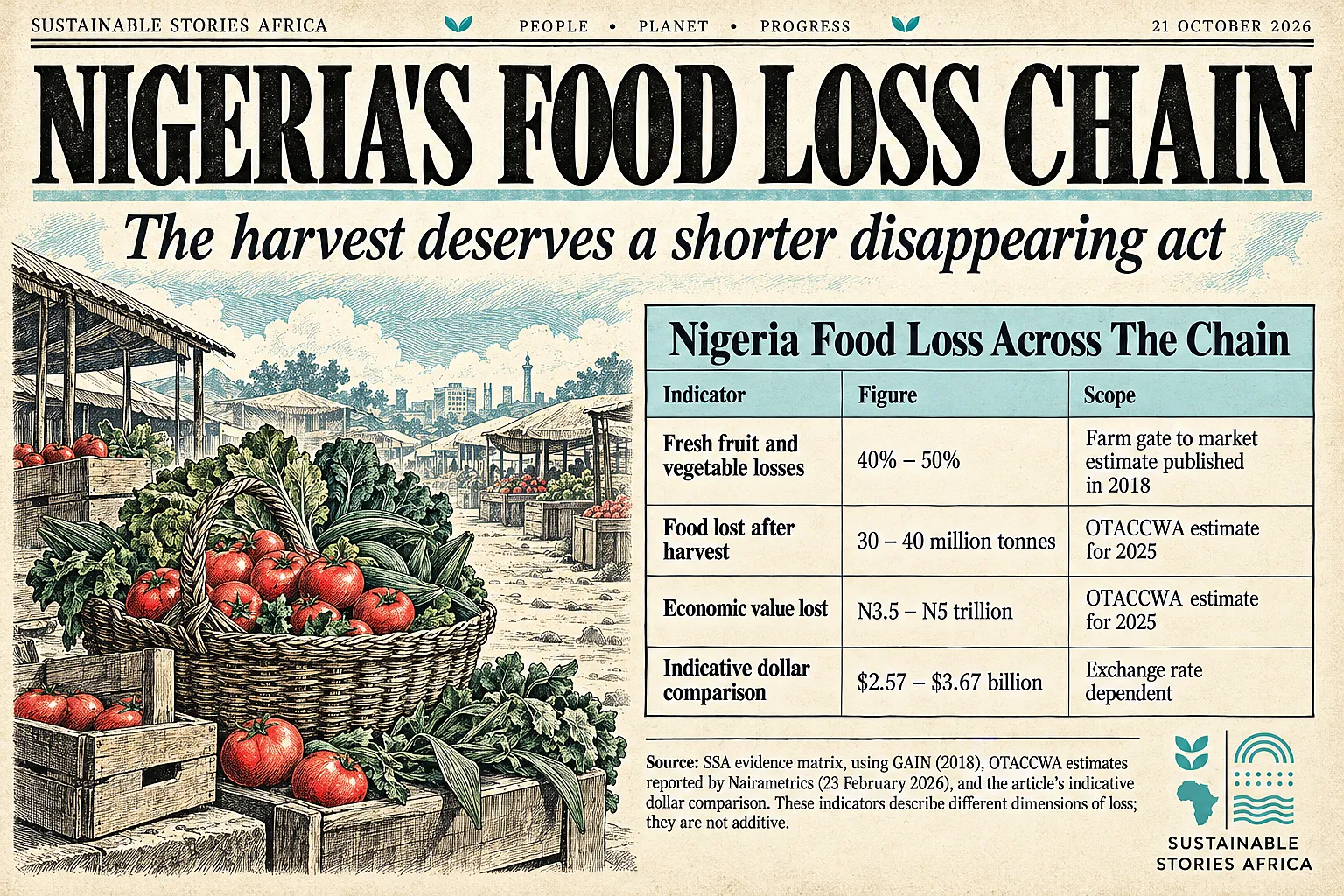
A 2018 cold-chain capacity mapping report from the Global Alliance for Improved Nutrition estimated that 40% – 50% of fresh fruits and vegetables were lost between the farm gate and market.
- It illustrates the scale of the perishable-produce problem, including losses during transit and handling.
- Nigeria’s larger post-harvest challenge also affects tomatoes, yams and grains, especially along routes that move food from the north to the south.
Poor handling, weak road networks and unreliable electricity undermine those journeys.
- Unstable power also weakens cold-chain logistics.
- Produce transported in open-air trucks is exposed to direct sunlight and humidity, with consequences for the quantity and quality that survive the trip.
The Organisation for Technology Advancement of Cold Chain in West Africa estimated that Nigeria lost 30 – 40 million tonnes of food in 2025, worth N3.5 – 5 trillion.
- An indicative dollar comparison puts that value at about $2.57 – $3.67 billion, depending on the foreign exchange rate used.
Behind these figures are farmers who lose income from produce they pay to grow.
- Reduced supplies reaching cities put further pressure on prices, while households face harder choices about what they can afford.
The costs spread across the food system; they do not end with the farmer or trader who first absorbs the loss.
Uneaten Food Places Pressure On Forests
Food waste occurs in retail, food service and in our homes.
- UNEP’s successive estimates put restaurants and caterers at roughly 26% – 28% of consumer-level food waste, and supermarkets and other retailers at about 12% – 13%.
- These ranges reflect different reporting years, rather than one combined measurement.
Responsibility therefore extends beyond the farm gate to businesses and consumers.
There is also a climate cost.
- Food loss and waste account for roughly 10% of global greenhouse gas emissions.
- When discarded food decomposes in dumpsites and landfills, it can release methane, a potent greenhouse gas.
The damage continues after the food has lost its value as nourishment.
UNEP framed the 2026 observance around the transformative potential of reducing food loss and waste for forests and sustainable agrifood systems.
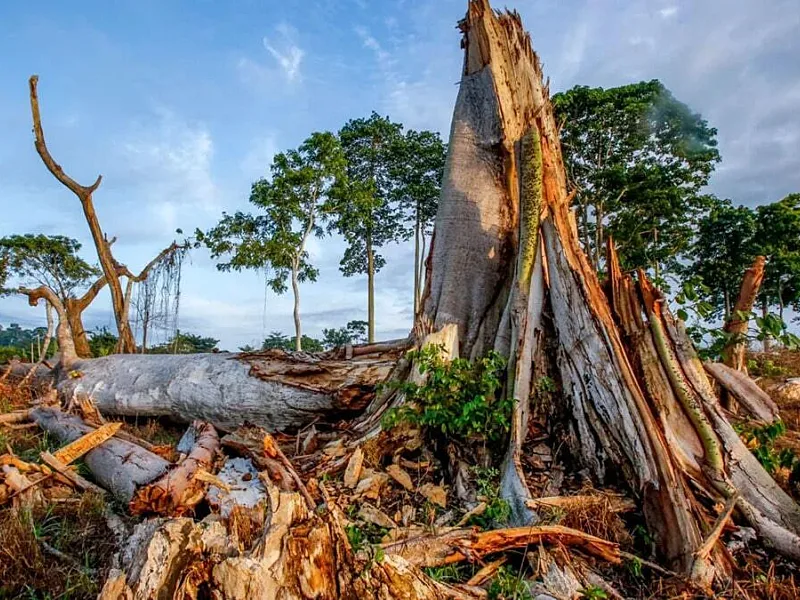
- The connection becomes clearer when we consider FAO’s estimate that about 1.4 billion hectares of land are used to produce food that is never consumed.
- Agricultural expansion for crops and livestock is a leading driver of deforestation.
Every tonne lost before retail or wasted afterwards carries an opportunity cost for land, water and forests.
- We clear land, partly from forests, to produce food that may never reach a table.
- In doing so, we place additional pressure on already threatened ecosystem services.
Reducing those losses could help us better manage land use, already farmed and ease the pressure to expand production to replace what disappears.
- Food saved from avoidable loss could also alleviate hunger.
The benefit I see is a food system that retains more of what farmers produce while demanding less unnecessary sacrifice from nature.
Keep More Food Within Human Reach
Many of us sang this grace before meals in primary school:
Some have food but cannot eat,
Some can eat but have no food,
We have food, and we can eat,
Glory be to thee, O Lord. Amen.
The second line deserves a closer look.
- Poverty may explain some hunger, but it should not stop us from asking what avoidable barriers stop food from reaching the table.
- We should also ask what those losses cost the forests and other resources used to produce that food.
Our priority should be finding sustainable ways to scale solutions that already reduce food loss.
- In Nigeria, that means treating handling, roads, reliable power and cold-chain logistics as essential parts of feeding people.
- Asking farmers to produce more while the journey to market remains so wasteful leaves a central weakness unresolved.
Alongside that work, supermarkets, restaurants and households should encourage responsible consumption and develop ways to redistribute surplus food that would otherwise be discarded.
- Prevention and redistribution address different points in the same chain.
- Both can help keep food available for its intended purpose.
Technology-enabled solutions should build on these practical needs and grow sustainably.
- What matters is whether they keep more food from spoiling or being thrown away.
I regard reducing food loss and waste as one of the most affordable ways to feed more people, lower emissions and protect forests.
That is why it deserves a more central place in our development choices.
Path Forward – Save Food And Ease Forest Pressure
We should scale the solutions that already prevent food loss, encourage responsible consumption and make surplus redistribution practical.
Technology should help those efforts reach more people and address the barriers that keep food from the table.
For me, the question raised at the summit remains urgent: what does progress mean if hunger persists?
Keeping more food in use offers a practical measure of development that values people’s nourishment alongside farmers’ incomes and the forests we need to protect.