
Why successful implementation could strengthen economic growth, social resilience and sustainable welfare in Nigeria
The Insurance Sector Strengthening Program (ISSP) is a five-year initiative fully endorsed by NAICOM and being developed with the Commission’s team to expand insurance access, strengthen professional capacity and bring women, young people and MSMEs into Nigeria’s risk-protection system.
Its promise is bigger than premiums.
If transparent governance, useful products and fair claims anchor delivery, insurance can protect livelihoods, strengthen enterprise investment and widen social resilience.
If implementation becomes a publicity exercise, the targets will merely decorate another reform document.
Insurance Reform Must Reach Everyday Nigerians
Insurance is often discussed as a financial-sector metric.
- For a trader whose shop burns
- A farmer facing crop loss
- A family managing a medical shock
- A small manufacturer replacing damaged equipment:
It is a question of whether one setback destroys years of work.
The ISSP is a five-year initiative endorsed by NAICOM and developed with the Commission’s team to expand insurance access, strengthen professional capacity and bring women, young people and MSMEs into Nigeria’s risk-protection system.
ISSP is working with the Commission’s team as a dedicated vehicle to support the development of NAICOM’s full market development division. Its five-year structure comprises three years of development followed by a two-year handover to NAICOM, designed to embed capacity, institutional ownership and long-term sustainability.
The direction is persuasive; however, success will depend less on the size of its headline targets than on the quality of delivery.
- Nigeria needs a programme that makes policies understandable, claims reliable and regulation credible.
- Growth must be measured not only by premiums sold, but by people and enterprises genuinely brought into a “Social Safety Net”.
Low Coverage Carries A National Cost
In Nigeria, insurance penetration is currently at 0.5% of GDP, compared with an African average of 3.2%, and only 5% of Nigeria's estimated 220 million people have cover.
Other warning signals include:
- 78% lack basic insurance knowledge.
- Women account for 32% of policyholders
- Nigerian’s aged 18 - 35 years represent less than 20% of customers/consumers
- Only 8% of MSMEs are insured.
Those figures are startling; this is why ISSP provides a structural and strategic model to help alleviate the insurance challenges across Nigeria.
Nigeria's insurance problem is not simply low awareness.
- It is a combination of fragmented distribution, limited product innovation, professional capacity gaps and a persistent deficit of trust
When protection fails to reach households and businesses, shocks remain on family balance sheets, enterprise cash flows and, eventually, the public purse.
That is why the ISSP should be treated as economic and social infrastructure, rather than as an advertising campaign for policy sales.
- A trusted insurance system can help people take productive risks, protect working capital, secure credit and recover faster.
- A distrusted system can expand enrolment briefly while deepening public scepticism when exclusions are unclear, or claims are delayed.
The Proposal Connects Reach With Reform
ISSP's six pillars are sensibly connected:
- Advocacy and policy
- Awareness and education
- Capacity building
- Gender inclusion
- Youth engagement
- MSME and value-chain development
The ISSP proposal links all six pillars of the Nigeria Insurance Industry Reform Agenda 2025.
With NAICOM’s full endorsement already secured, the Commission and the ISSP team are working together on data access, policy coordination, oversight, official communication and regulatory support for pilot innovations.
The delivery side is equally ambitious.
- ISSP would design and manage implementation, mobilise private partners, train professionals, run awareness programmes, report impact and transfer international knowledge.
- Outcomes include increasing penetration to 10% of GDP by 2030, by attracting 5 million new policyholders, connecting 250,000 MSMEs to insurance, training 6,000 professionals, achieving 40% female participation and raising the youth customer share of the insurance sector to 30%.
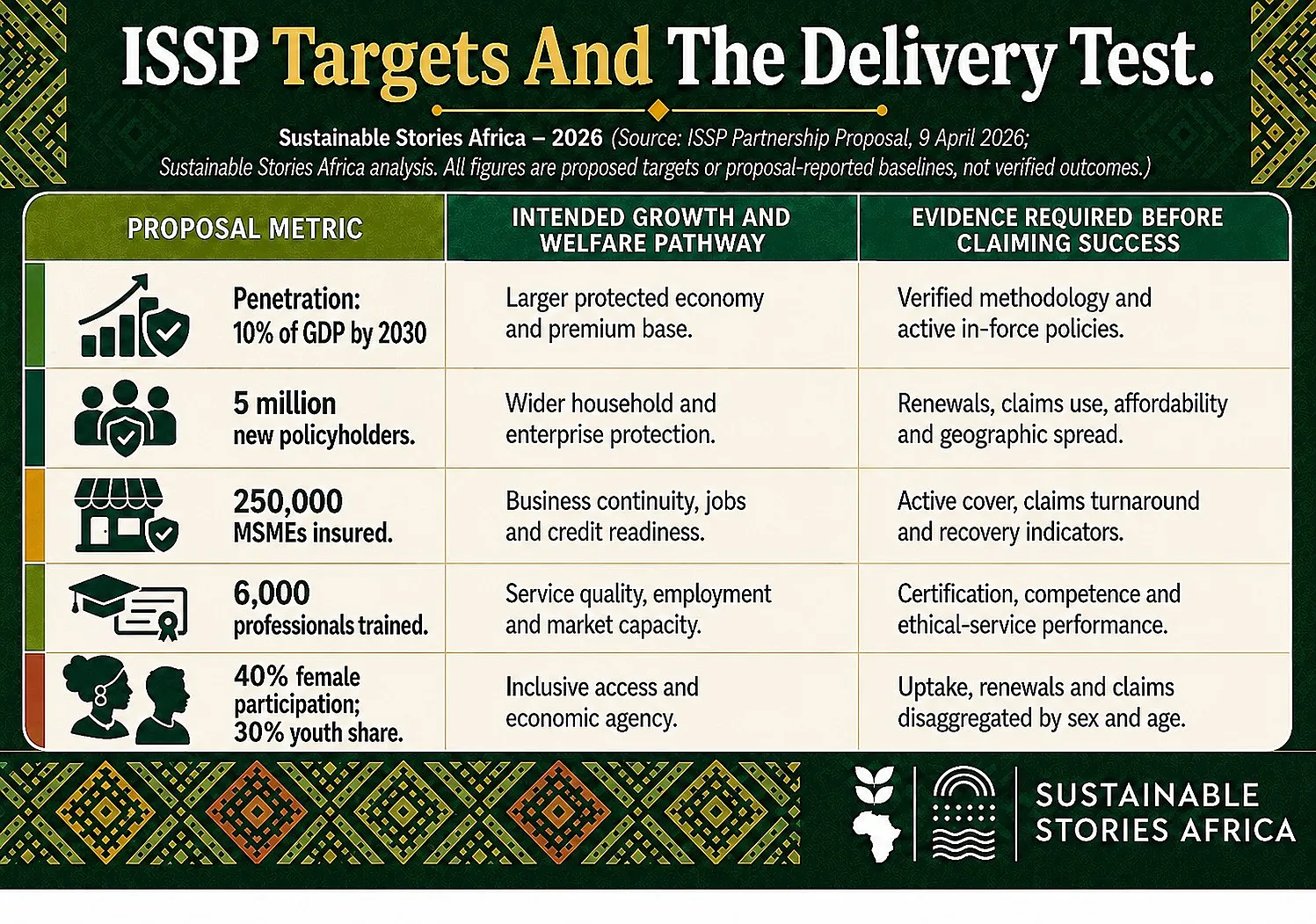
The phased plan is practical:
- The first three years will focus on programme development and supporting NAICOM to develop its full market development division.
- The final two years will focus on a structured handover to NAICOM, embedding the systems, skills and institutional ownership required for sustainability
This targets 25 million Nigerians for literacy, 5 million for general reach, and 5 million new policyholders under the collaboration model.
Awareness, learning, acquisition, active policies and claims need distinct indicators, and the 2028 penetration target must align with the five-year horizon.
Protection Can Widen Nigeria's Prosperity Base
If implemented well, ISSP's true prize is not merely a larger insurance industry but a more investible and resilient economy.
- MSMEs with appropriate cover can survive fire, theft, accident, illness and disruption without closing, shedding workers or liquidating productive assets.
- Stronger risk protection builds lender and investor confidence and supports longer-term capital formation.
The welfare case equally matters.
- Insurance cannot replace public health, pensions or disaster response
- It can complement them, preventing a medical bill, death, flood or business loss from pushing vulnerable households backwards to increased poverty.
Inclusion will also reshape product design and gender inclusion goals in line with SDG 5.
- Women entrepreneurs need cover reflecting informal and small-business realities, not a "pink-labelled" standard policy.
- Young workers require mobile-first, flexible protection suited to irregular income, while farmers and climate-exposed communities need clear triggers, exclusions and claims processes defined before disaster strikes.
This is where sustainable welfare becomes tangible:
- Resilience means a household staying solvent, an enterprise reopening, a worker keeping their job, and a community recovering without falling into poverty.
- If ISSP delivers this at scale, higher penetration becomes a consequence of public value, rather than an end in itself.
Execution Must Turn Ambition Into Evidence
NAICOM and ISSP should open with an independently reviewed baseline and costed results framework, with every target carrying a clear definition, denominator, data source, owner and reporting date.
- The headline penetration ratio must sit alongside recognisable measures: active policies, renewal rates, affordability, claims paid, settlement time and customer satisfaction.
Regulatory independence must be protected.
- NAICOM’s endorsement and governance of the programme should preserve regulatory independence and avoid the promotion of specific firms.
- The steering structure should include consumer representatives, women, young people, MSMEs and state-level voices, alongside disclosed procurement and conflict-of-interest rules.
Scale should be earned, rather than assumed.
- The first year should pilot products across a diverse mix of states and livelihoods, expanding only when independent reviews confirm affordability, understanding and fair claims outcomes.
Claims performance must become the programme's strongest advertisement;
- With plain-language policies, local-language materials, accessible complaint routes and published data on rejections and delays.
Training 6,000 professionals should build genuine competence;
- Rather than just certificates, covering product suitability, conduct, digital tools and data protection, with continuing development tied to measurable service gains.
Finally, the proposed sustainable insurance development fund
- Needs transparent sources, governance and procurement rules, prioritising evidence-generating pilots over cost-socialising structures.
The proposal's monthly-to-annual review cadence is essential; however, disclosure should track outcomes:
- 5 million sign-ups mean little if policies lapse or customers remain unprotected.
Path Forward – Build Trust First, Then Scale Sustainably
With NAICOM's endorsement secured, priority shifts to a documented, time-bound implementation and handover framework.
First outputs should include an audited baseline, a costed plan, a governance charter, consumer-protection rules and clear milestones spanning the three-year development phase and two-year handover to NAICOM. ISSP must then demonstrate evidence-based progress, including useful products, fair claims, trained professionals, resilient MSMEs, and the institutional capacity NAICOM needs post-handover, published and independently tested.
Insurance can thereby become both a growth engine and a pillar of Nigeria's sustainable welfare.