Denmark, Scandinavia and the ownership test for Africa’s next development partnership
Denmark and its Nordic peers have built a credible record in African development finance, climate investment, humanitarian support and institution-building.
Their next test is not whether more money reaches the continent, but whether African communities shape what that money builds.
SSA’s view is clear: capital that delivers power, ports, and/or farms that leaves landholders, workers and local enterprises without voice merely modernises extraction.
The stronger partnership converts finance into ownership, skills, local value and accountable institutions.
Africa Needs Partnership Beyond Nordic Generosity
Denmark’s engagement with Africa is neither new nor negligible. For more than 40 years, the country has met or exceeded the United Nations benchmark for development assistance. In 2025, its official development assistance reached an estimated $3.4 billion, or 0.72% of gross national income, according to the OECD.
Its 2024 strategy, Africa’s Century, seeks a broader relationship built around trade, investment, green growth, technology, diplomacy and people-to-people exchange.
That is a necessary break from a relationship framed mainly around aid.
However, Sustainable Stories Africa believes the decisive shift is still unfinished.
A partnership becomes equal not when a donor changes its language; rather, it is when African institutions own priorities, local enterprises capture contracts, communities influence decisions and citizens retain a durable share of the value created.
Attention: Capital Alone Cannot Deliver Equal Partnership
Denmark and its Scandinavian neighbours deserve recognition for sustaining development commitments while global aid is contracting.
Sweden provided an estimated $6 billion in official development assistance in 2025, equivalent to 0.85% of GNI. Norway provided $5.7 billion, or 1.03% of GNI, the highest ratio among OECD Development Assistance Committee members.
That consistency matters in a year when total ODA fell 23.1%.
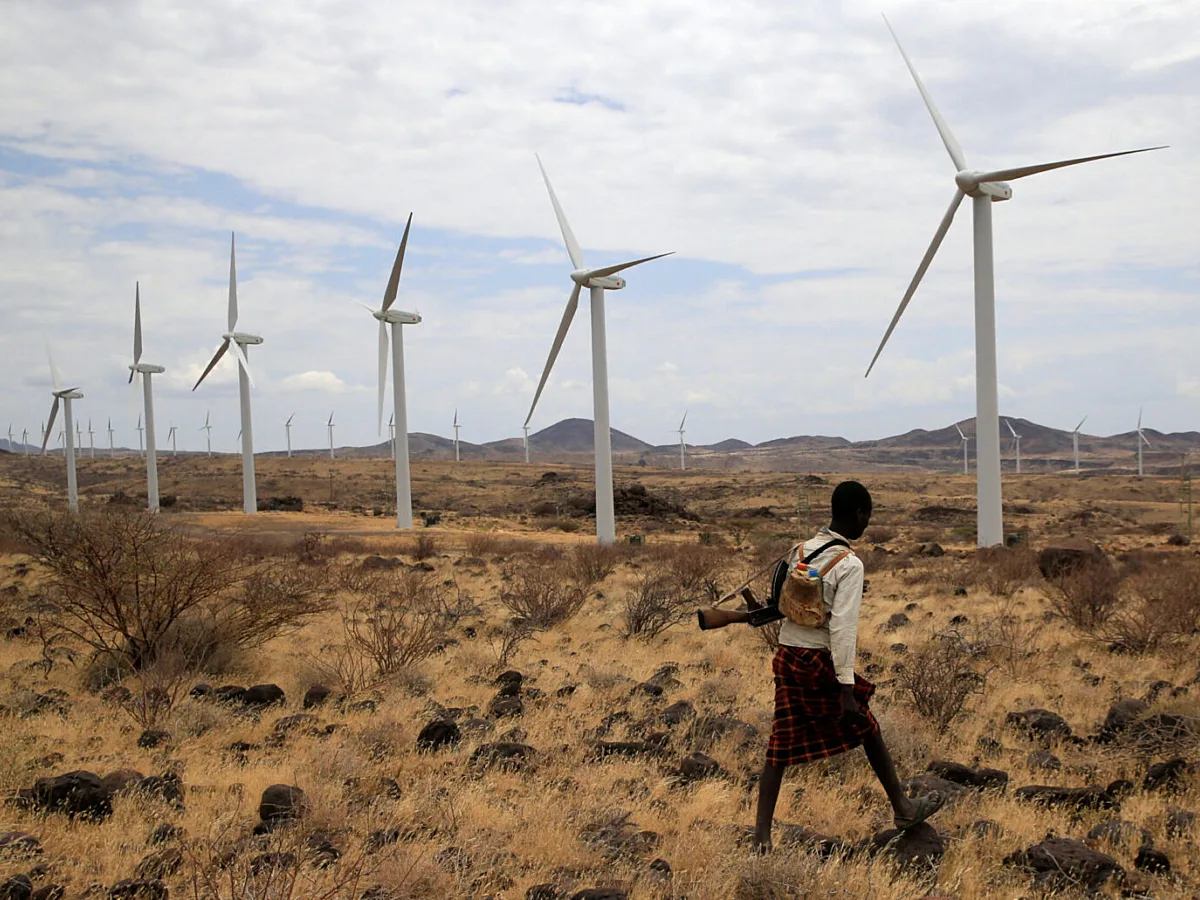
However, generosity is an input, rather than an outcome. As SSA has argued, Africa’s renewable projects need community ownership, not compensation without voice or value.
A related SSA analysis says women, youth, informal workers and Indigenous leaders must be treated as co-architects rather than beneficiaries.
That principle should apply beyond electricity, to agriculture, health, digital infrastructure, logistics, water and critical minerals.
The distinction is practical.
- A one-off payment for land can be exhausted.
- A clinic donated without maintenance capacity can deteriorate.
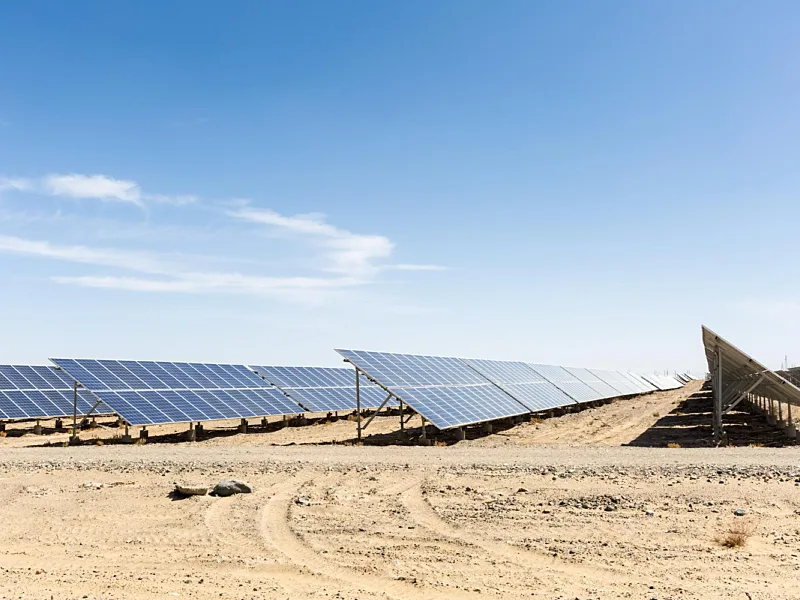
- A solar farm may add megawatts while the host settlement remains poorly supplied.
Ownership, by contrast, can mean equity, voting rights, revenue sharing, local procurement, affordable access, technical capability and a credible remedy when promises are broken.
This is where Nordic ambition should be tested. The question is no longer whether Scandinavian capital can enter Africa. It is whether that capital can leave behind stronger African balance sheets, institutions and bargaining power.
Nordic Institutions Built Real African Reach
Denmark's development architecture combines multiple institutions: Danida for humanitarian cooperation, Impact Fund Denmark (formerly IFU) for equity, loans and infrastructure finance, and EIFO for export and investment support.
Public-sector agencies like the Danish Energy Agency and Danish Meteorological Institute add technical expertise, with Denmark's strategy highlighting cooperation with Ghana on climate information, energy partnerships and sustainable trade.
Investment momentum is evident. Impact Fund Denmark invested a record DKK1.4 billion in Africa's private sector in 2025 and opened offices in Lagos and Johannesburg.
Prior initiatives include lower-carbon cement in Ghana, locally roasted Kenyan coffee, and MYDAWA's healthcare expansion across Kenya and Uganda.
Sweden and Norway reinforce this Nordic push. Swedfund’s 2025 portfolio reached roughly SEK14 billion, with over two-thirds concentrated in sub-Saharan Africa.
Norfund directed 64% of committed capital, about NOK5.33 billion across 34 transactions, to the region, deploying local-currency debt and first-loss structures in Kenya, Nigeria, Tanzania and Côte d'Ivoire.
Joint Nordic institutions extend impact further: the Nordic Development Fund reported €675 million in accumulated climate finance, 68% allocated to Africa, while Nefco programmes have helped 4.5 million sub-Saharan Africans access clean energy or modern cooking solutions.
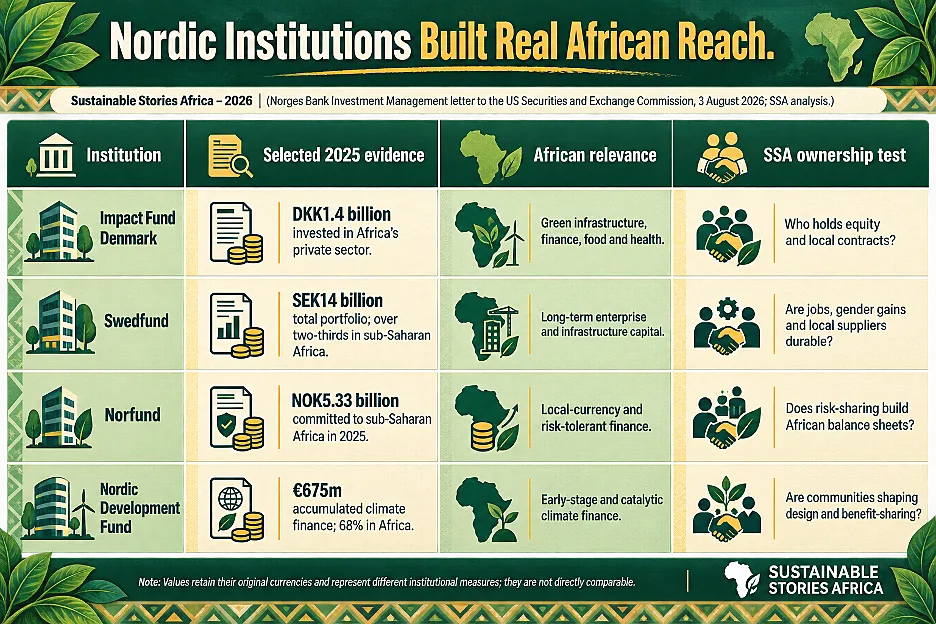
Despite strong figures, gaps persist: Danish-African trade remains shallow (1.5% exports, 0.8% imports, 2021 – 2023), and only 6.1% of Danish bilateral ODA reached developing-country CSOs in 2024, compared to Sweden's 10%, signalling insufficient localisation of authority and capital.
From Financed Projects To Shared Prosperity
A better model positions Nordic finance as valuable precisely because it absorbs risks that conventional capital avoids, then leverages that additionality to expand African ownership.
- Community ownership doesn't demand every resident become a technical operator or bear unlimited liability.
The Institute for Human Rights and Business notes it can take various forms: full, majority or minority stakes, cooperative governance, or local profit-sharing, structured according to each country's laws and financial capacity.
Consider a Danish-backed renewable project where a community trust holds a financed equity stake, local technicians train for operating roles beyond construction, women- and youth-led enterprises access procurement opportunities, and revenue funds electricity, water or schools under community-set rules.
Investors gain social licence and reduced disruption risk; communities gain income-producing assets and negotiating power.
The same logic applies to agriculture and minerals: Nordic capital should finance African processing, storage, logistics and regional trade, rather than just extraction.
Denmark's AfCFTA support will matter most when African firms climb value chains and expand sales across African and European markets.
Make Ownership A Financing Condition
Five reforms would strengthen this model.
- First, Nordic DFIs should publish an African ownership scorecard per project, disclosing local equity, board seats, procurement, jobs, gender participation, community revenue and exit plans, since megawatts and capital mobilised don't reveal who gained power.
- Second, Danida, Impact Fund Denmark, Sida, Swedfund, Norad, Norfund, NDF and Nefco should finance participation itself: local-currency credit, guarantees, advisory grants and first-loss capital for trusts, cooperatives and SMEs, so ownership requirements don't become unfunded compliance burdens.
- Third, consultation must precede locked-in decisions, with accessible information, independent advice, negotiated benefit agreements and grievance mechanisms; free, prior and informed consent for Indigenous peoples should be a governance requirement, not a formality.
- Fourth, projects should align with Agenda 2063, AfCFTA and locally determined climate priorities; Africa need not accept partnerships framed around geopolitical rivalry or mineral extraction alone.
- Finally, African governments must enforce transparent benefit rules, protect land rights and disclose contracts that prevent elite capture.
The goal is better-designed ownership, not less.
Path Forward – Ownership Must Anchor Partnership
Denmark and its Nordic peers have earned credibility through decades of aid, patient capital and practical institution-building.
They can now set a higher standard: finance that measures African agency as seriously as financial return and carbon reduction.
Africa should welcome the partnership; however, it should negotiate its terms.
The enduring benchmark is simple: projects must leave communities with voice, enterprises with capability, governments with revenue and African investors with assets that continue to compound after foreign capital exits.
Selected Sources
- Sustainable Stories Africa, Africa’s Just Transition Demands Community Agency, Not Technocratic Climate Promises, 27 February 2026.
- Ministry of Foreign Affairs of Denmark, Africa’s Century: Strategy for Strengthened Danish Engagement with African Countries, August 2024.
- OECD, Development Co-operation Profiles: Denmark, 2026.
- Impact Fund Denmark, Record Level for Investments in 2025, 17 April 2026.
- OECD, Development Co-operation Profiles: Sweden, 2026.
- Swedfund, Annual and Sustainability Report 2025: CEO Perspective, 2026.
- OECD, Development Co-operation Profiles: Norway, 2026.
- Norfund, Additionality in Norfund’s 2025 Investments, 15 May 2026.
- Nordic Development Fund, 2025 portfolio indicators, accessed 12 August 2026.
- Nefco, 2025 impact indicators, accessed 12 August 2026.