
African Proverb: The youth walk faster, but the elderly know the road
Meaning: Youthful exuberance cannot replace experience.
By 2050, one in four people globally will be African, and the continent’s working-age population is expected to double.
However, Africa’s future will depend not only on the size of its youth population but also on how well young people are prepared to lead, build, and transform.
With more than 70% of Africans young and numbers projected to reach 540 million by 2030, the continent must turn demographic potential into dignity, opportunity, meaningful participation, decent work, quality education and a sustainable future.
Africa’s Youth Dividend Faces a Test
Africa's future will be shaped not just by how many young people it has, but by how well it prepares them to lead, build and transform in a world yet to recognise the power they wield.
Two truths can coexist:
- The continent needs speed, but it also needs experience.
- Layered together, these may form a winning formula, provided the weight given to older generations familiar with existing paths doesn't overshadow young people's capacity to forge new ones toward the same destination.
An old saying holds that what an elder sees while seated cannot be seen by a young person even from a treetop.
Today, the retort is that the young person now has binoculars: technology and innovation are challenging ideologies once left unquestioned for lack of contrary evidence.
By 2050, one in four people globally will be African, with the continent's working-age population set to double.
- This is not simply a population explosion but a shift in demographic composition.
- Young people already account for more than 70% of Africa's population, with numbers expected to reach 540 million by 2030.
However, outdated policies persist, prompting the question: is Africa's youth population truly a dividend, or a demographic time bomb?
International Youth Day 2026 affirmed that despite differing national realities, young people's aspirations converge:
- Dignity, opportunity, meaningful participation, decent work, quality education and a sustainable future.
When the Advantage Becomes a Liability
Youth unemployment in Africa is among the highest globally, but the full impact is often transferred to underemployment and informal work.
- Thousands of graduates are churned out annually from institutions of higher learning with no real prospect of employment.
- Corporations can only hire so many people and often have to upskill and reskill these graduates due to the educational system’s failure to prepare them adequately for the world of work, but that’s another story.
The Nigerian dream, for instance, has become an aspiration for greener pastures outside the shores of the continent, as we have not been intentional about giving them a reason to stay and hope for the future.
For those who are left behind, the unutilised human capital remains a drag on productivity and GDP growth, thus making what should have been an advantage a liability.
Increasing crime rates and tools in the hands of political and religious extremists are tilting the scales heavily toward the demographic time bomb.
The Triple-E Gap: Energy, Employment, and Education
Today, we have a triple-E gap interplay.
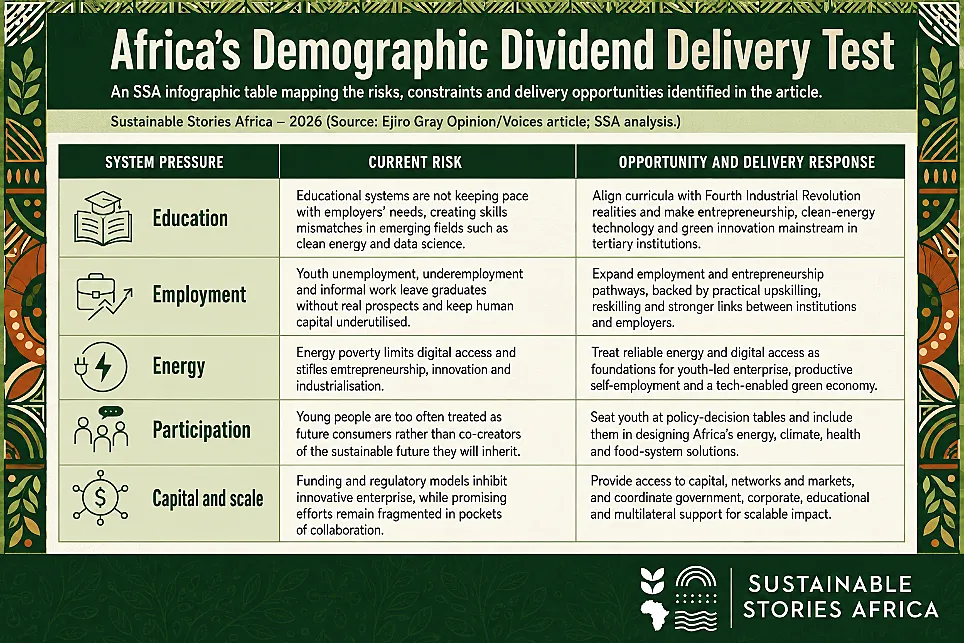
- Our educational systems are crawling at a snail's pace to meet up with the realities of employers’ needs and the skills being taught, leading to a clear skill mismatch between the demand and supply of graduates, particularly in emerging fields such as clean energy and data science.
- Energy poverty, on the other hand, has created limitations to digital access, thereby stifling entrepreneurship, innovation and consequently, industrialisation efforts; what would have been avenues for veritable self-employment alternatives.
Achievements in the latter area have been through sheer doggedness and resilience of the indefatigable.
Interrogating Our Current Response: Are We Bold Enough?
All of the above steer me to some specific questions that I believe need urgent answers and solutions.
- Are our educational models aligned with a fourth industrial revolution?
- Are we leveraging the strength of our youth demography as co-creators of Africa’s sustainable energy future, or do we just see them as future consumers in light of population explosion forecasts?
- Are our youth seated at the table of policy-making for a world which they are supposed to inherit?
From Risk to Opportunity: Demographic Opportunity Must Be Engineered
What if Africa rewrote the rules?
- Could its youth become the engine powering a tech-enabled green economy, helping the continent leapfrog in energy security and infrastructure development?
- Could they be empowered as entrepreneurs tackling climate, health and food-system gaps, and how might individual efforts be consolidated into more holistic impact?
Governments, corporates, educational and multilateral institutions must reform the educational, regulatory and funding models that have long inhibited innovative, sustainable enterprise.
Perhaps the real question is whether sustainable development in Africa can be built at all without building it with and for the generation that will inherit it.
- Institutions like the University of Lagos are already correcting the skills mismatch between curricula and real-world demands, partnering with private-sector players such as the Sahara Group to mainstream entrepreneurship, clean energy and green innovation within tertiary education.
- Initiatives like the Sahara Group Foundation's Making a Difference Around Africa (MADAA), which optimises and scales sustainability-focused businesses leveraging Africa's natural resources, offer glimpses of this shifting narrative.
Learning from these examples, Africa must convert population growth into productivity to drive Africa’s GDP growth, applying systems thinking across the Triple E: education, employment (including entrepreneurship) and energy, all linked to the broader economy.
Implementation must move beyond quota systems toward real empowerment, granting access to capital, networks and markets to those best positioned to create value with a multiplier effect on others.
Path Forward – Africa's Youth: Advantage, Not Afterthought
In the final analysis, Africa is in a race against time, with youth empowerment demanding much more than ceremonial hashtags.
It requires real and coordinated action in the frame and manner of a people who recognise this demography to be their greatest competitive advantage.
The continent’s future will be shaped not just by how many young people we have, but by how well we prepare them to lead, build, and transform in a world that is yet to recognise the power it wields.