
Strong sales and a credible expansion plan may no longer be enough to secure finance.
Lenders increasingly want to know how a business manages the environmental, social and governance risks that could undermine its performance.
For Nigerian SMEs, ESG readiness is a practical business concern.
It starts with identifying material risks, strengthening everyday practices and documenting the evidence, while recognising that readiness does not guarantee funding.
Profitability Is Only Part of Creditworthiness
You may argue that your business is profitable.
However, is it financeable?
- Strong sales, a viable product and a good expansion plan can still leave you facing rejection if you cannot answer critical questions about how you run the business.
- As credit assessments evolve, SMEs need to pay attention to sustainability governance.
Imagine two SMEs approaching a bank to fund expansion.
- Both are profitable, their revenues are growing, and their plans point to promising markets.
- One can show how it manages environmental and people-related risks alongside other operational issues.
- The other focuses primarily on financial performance.
If you were the lender, which would inspire greater confidence?
- The question is increasingly whether the business can sustain its performance.
- That is why ESG, which stands for environmental, social and governance, belongs in the financing conversation.
How ESG Obligations Reach Smaller Businesses
Tightening regulation and stakeholder demands, including those within large corporate supply chains, are driving this interest.
- The pressure may come from your customer’s lender, passed along the supply chain, or from your own lender’s shareholders.
- If you supply a multinational, a listed company or a large unlisted business, its ESG obligations can increasingly affect what it requires of you.
Consider the Nigerian Sustainable Banking Principles (NSBP).
- Commercial banks and development finance institutions now integrate them into their operations.
- SMEs that depend heavily on bank credit and institutional financing can therefore feel the effects of these requirements.
An SME owner may reasonably wonder why a bank bothers with sustainability at that scale.
- However, how you structure the business today affects its resilience tomorrow.
- A viable product and current profits do not show whether growth can last.
The three ESG pillars help explain the questions a lender may ask.
Environmental risks concern how waste management, resource use, energy consumption and flooding affect operations.
- Poor waste practices may pollute water bodies or threaten the health and safety of nearby communities.
- Pollution, waste or energy use may expose the business to shutdowns or rising operating costs.
- If those risks materialise, what happens to your ability to service a loan and deliver the growth you have promised?
Social risks arise from the conditions under which you do business.
- Unsafe working conditions and occupational health problems may create liabilities, as can employee disputes and customer complaints.
- Frequent strikes, accidents, or community conflict can cause shutdowns and lost production.
- Customer data breaches also matter, even if you believe the business is too small to attract regulatory attention.
Governance asks whether you can demonstrate financial accountability, risk management and responsible decision-making, backed by documentary evidence.
- Could mismanagement or collapse follow if you were away for two weeks or more?
- For SMEs, governance can be decisive because oversight weaknesses can allow environmental and social problems to develop.
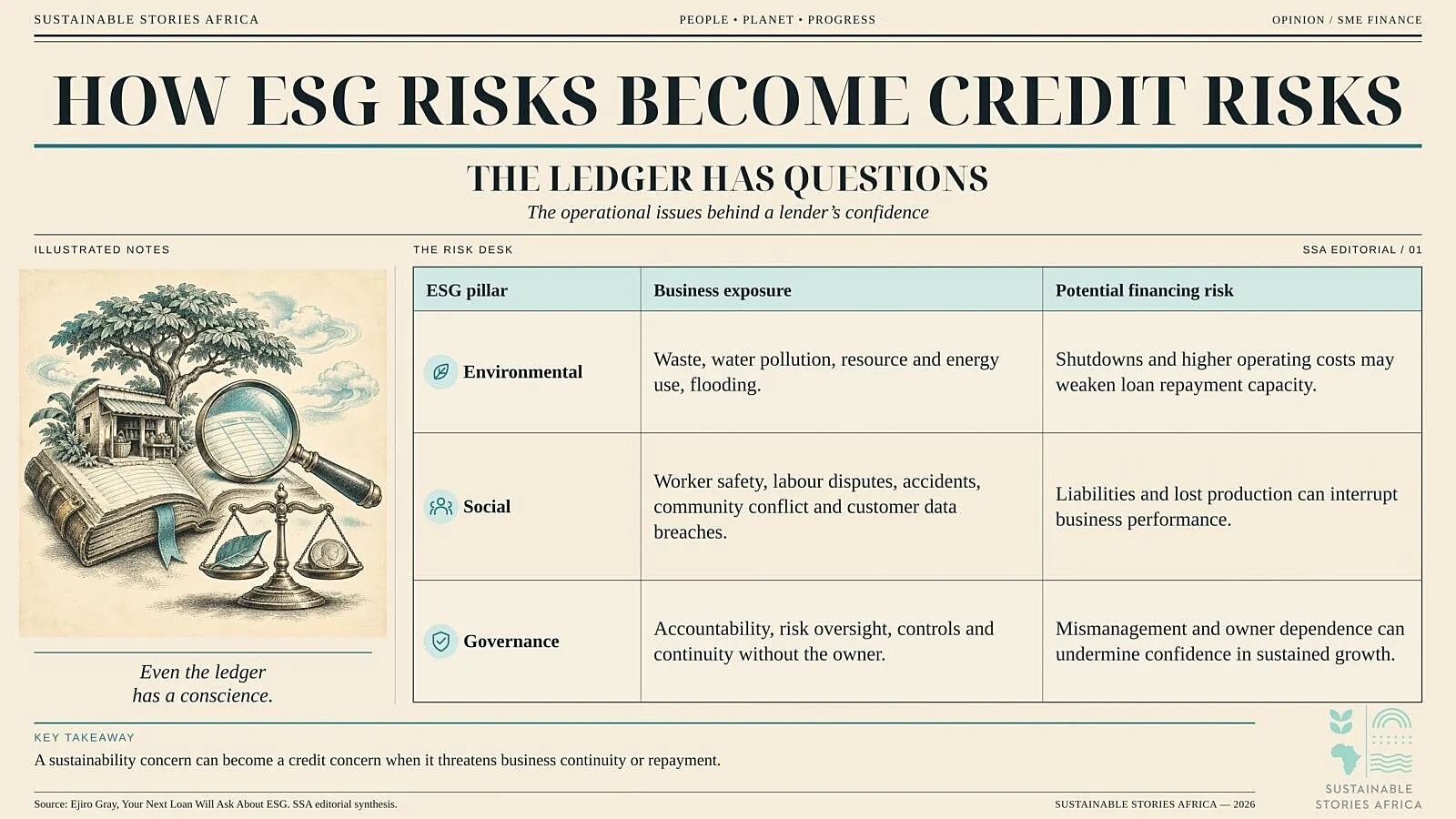
These issues also carry financial consequences.
- An issue you dismiss as a sustainability concern may appear to a lender as a present credit risk.
- Could your business be losing financing opportunities because of risks you have never considered, documented or addressed?
Recognise the Practices You Already Have
You may already be integrating sustainability into your business without identifying it as ESG.
- For many SMEs, the first step is to recognise, strengthen and document existing practices.
For example, a logistics company maintain safe, insured vehicles, trains its drivers, monitors their performance and documents its processes.
- These are sustainability practices.
- They can reduce potential liabilities and improve operational efficiency, potentially lowering the business’s risk profile and cost of capital.
The challenge is often demonstrating those practices consistently through verifiable evidence.
- The starting point for an SME need not be a sustainability report.
- Begin by identifying the five most important issues in your sector across the ESG pillars.
For an agri-processing business, these may include waste management, responsible sourcing of raw materials, water use, energy efficiency and worker safety.
A technology company may need to focus on data privacy, software licensing and cybersecurity.
Develop simple, workable policies and basic practices for the relevant issues, then monitor and document implementation.
Five Steps Before Your Financing Conversation
Before your next conversation with a lender or investor, I would focus on five practical steps.
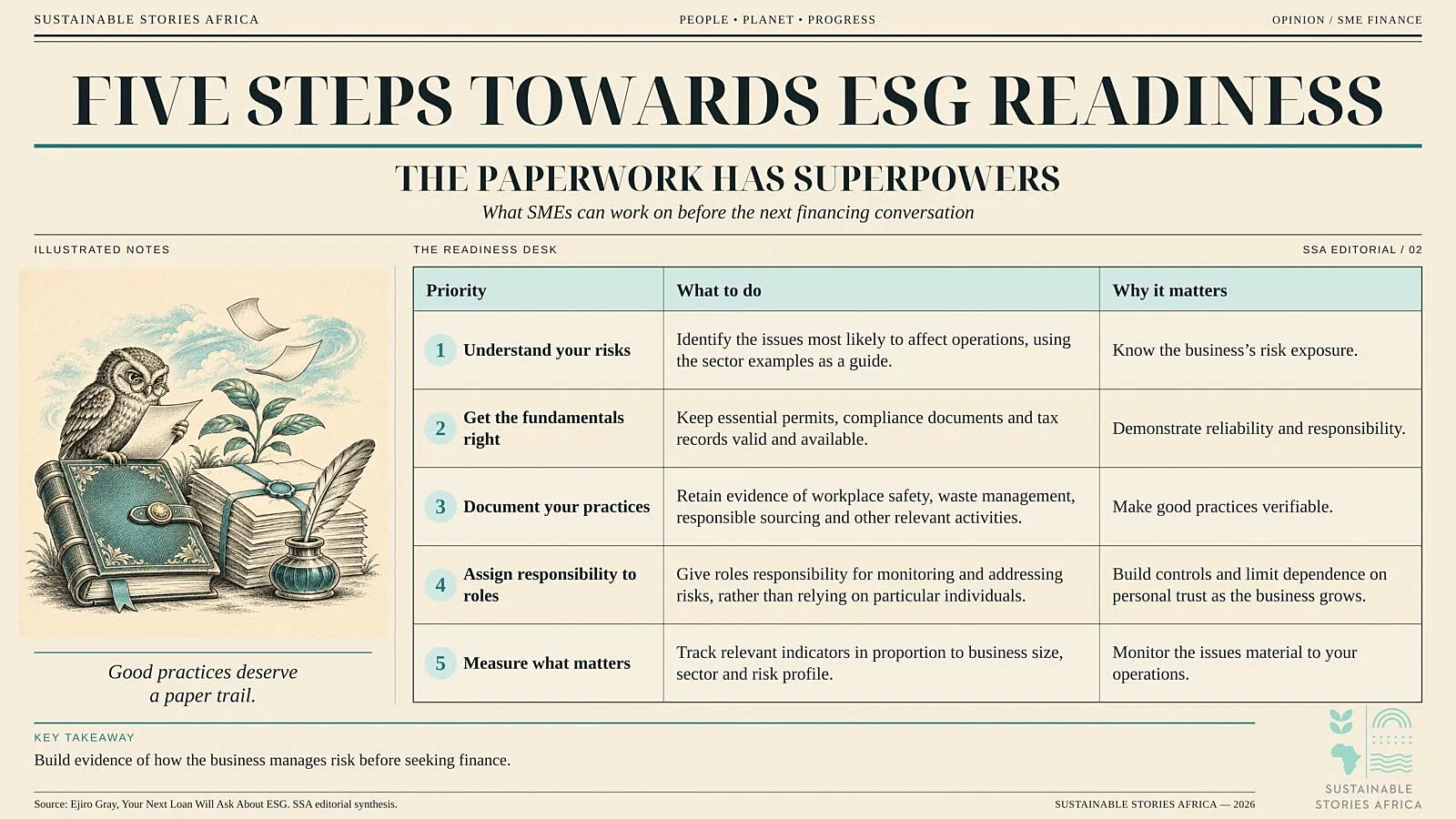
Lender and investor requirements vary with business priorities, funding sources and risk appetite.
- ESG readiness therefore does not automatically translate into access to finance.
- However, it is increasingly influencing how risk is assessed and where finance flows.
SMEs should build these practices into the business early.
- Waiting until the company reaches a comfortable size could constrain growth and access to the larger corporate customers needed to expand capacity.
Path Forward – For More Resilient SMEs
Better governance, efficient resource use and stronger risk management can improve operational efficiency and resilience, whether or not you need external finance immediately.
If a lender, major customer or potential investor asked tomorrow how your business manages risks to its future, could you provide verifiable answers?
Build the controls, assign responsibility and keep the evidence so that you can respond with confidence.