A Question of Missing Entries and the Assets Hiding in Plain Sight
Nigeria knows how to count buildings, debt, production and investment. It is less practised at counting the forests, wetlands, soils, watersheds and biodiversity that make economic activity possible.
When these assets are depleted, GDP can still rise while the underlying wealth base shrinks. Natural capital accounting can expose that contradiction and bring nature into planning, lending, risk and investment decisions.
Introduction
The Nigerian song "Questions" by Gaise Baba and Tobi Toun captures the spirit of this debate:
"There are questions troubling my mind Many answers leading to more questions Will we ever get the conclusion..."
Company A knows what it owns and what it owes.
- Its buildings, inventory, receivables and debt all have their place on its balance sheet.
Country B does much the same on a larger scale, recording infrastructure, production, investment, debt and GDP through its national accounts.
We have become adept at counting what we commonly recognise as economic value.
- The harder question is what happens to the forests, wetlands, soils, watersheds and biodiversity on which the economy depends, but which it has not learned to count.
If those assets remain missing from the record, a country can misread its own balance sheet.
The Balance Sheet Is Missing Nature
What happens when an economy consumes an asset without recognising it?
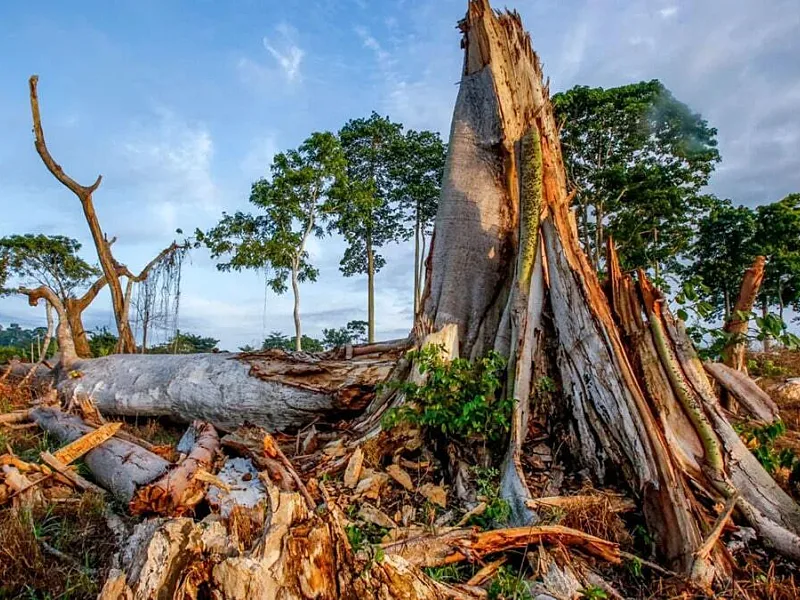
- A forest can be cleared and its timber sold, and that transaction will contribute to measured economic activity.
However, the same accounts may not show the value of the flood protection, soil stability, water regulation, carbon storage, biodiversity and livelihoods that disappeared with it.
Conventional GDP can record income from exploiting nature without adequately showing the corresponding reduction in natural wealth.
- The central question is therefore uncomfortable: are we generating income, or quietly liquidating capital to create it?
Without the condition and value of natural assets, we cannot tell whether Nigeria is becoming wealthier or merely converting long-term wealth into short-term GDP.
Nigeria's Natural Assets Support Economic Activity
Consider what is hidden in plain sight.
- What is a mangrove in the Niger Delta worth before it is cleared?
- What is a wetland in Lagos worth before it is built over?
- What is healthy soil in the Middle Belt worth before yields decline, or the Niger-Benue Basin before water scarcity makes its value obvious?
- What is Cross River's biodiversity worth before its loss affects ecological systems, fisheries, agriculture and tourism?
Nature is infrastructure, and many productive sectors depend on it.
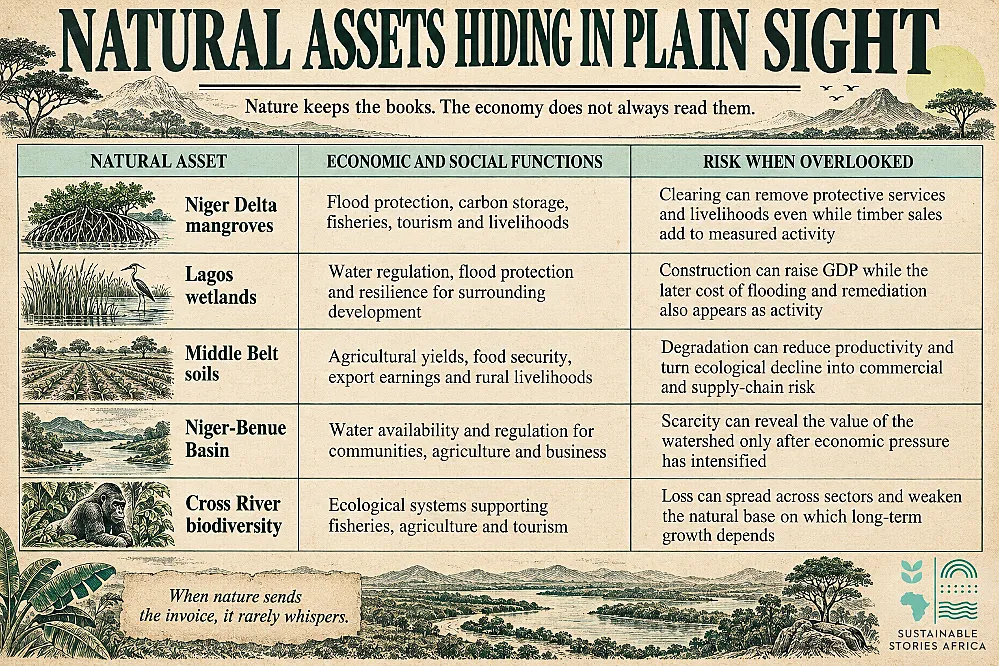
When Nigeria clears a forest, extracts minerals or develops a wetland, the resulting timber, mining or construction activity can raise GDP.
- Nigeria may later spend billions addressing flooding, erosion or declining agricultural productivity, and that expenditure can also raise GDP.
- In that narrow sense, GDP can count both the disease and the cure as economic wins without recognising the asset lost in the first place.
The African Development Bank estimates that natural resources, including renewables and ecosystem services, generate around 62% of Africa's GDP.
Agriculture alone employs more than half the workforce in many countries and remains central to export earnings, food security and rural livelihoods.
Nature and development are not mutually exclusive; one supports the other.
That dependence should change the questions asked by financial and corporate institutions:
- Should banks know how nature-dependent their loan facilities are?
- Should insurers price ecosystem degradation?
- Should boards understand which parts of their value and supply chains depend on natural systems they neither own nor currently value?
- Should investors distinguish between a company generating returns sustainably and one consuming the natural capital underpinning those returns?
Development Can Work With Natural Capital
Nature risk is business risk and, eventually, economic risk.
- An asset does not have to appear on a company's balance sheet or in a country's national accounts to affect financial performance.
- This does not mean that every forest, wetland or ecosystem should be recognised as a conventional asset under corporate financial-accounting rules.
- It is an economic proposition: the natural stock on which decisions rely should be visible in those decisions.
Africa still has an opportunity that many advanced economies have lost.
- It can build differently by recognising nature as an often-invisible foundation of economic growth before losses become too expensive to reverse.
The choice is not between nature and development.
- It is between development that protects its productive base and development that consumes it.
One unanswered Nigerian question remains:
- Who owns the upside, and who absorbs the depletion?
- When environmental damage appears as no liability, the liability does not disappear.
- It moves elsewhere, undocumented and unaccounted for, but with visible consequences.
- Cocoa and coffee farmers face declining soil quality and pressure on water systems.
- Aquatic resources for fishing and tourism are under stress.
These changes are becoming commercial and supply-chain risks.
Ethiopia, Rwanda, Uganda and Zambia are exploring how natural-capital information can inform national planning, statistics and investment decisions.
Nigeria has also begun developing natural-capital accounts with support from the World Bank's Global Program on Sustainability.
The country has national land accounts, and ecosystem accounts for Kaduna and Nasarawa states.
- The question now is whether this work will influence infrastructure approvals, land-use planning, corporate risk management and bank lending.
Identifying a natural asset, measuring the services it provides, identifying who benefits and quantifying at least some of its economic value can change how capital is allocated.
Nature-positive enterprises often sit in a missing middle: too advanced for grants, yet difficult for mainstream investors to understand and price.
Making ecological value visible can help investors assess what these enterprises protect as well as what they earn.
Make Natural Value Count in Decisions
Development and natural capital do not have to be opposing choices.
Given how far behind our accounting remains, Nigeria can treat natural systems as complements to grey infrastructure and make their contribution explicit in economic planning.
- Compare the cost of conserving a watershed with the cost of building additional water-treatment infrastructure.
- Treat mangrove restoration as coastal-resilience infrastructure that can complement grey infrastructure.
- Ask banks to assess where natural capital materially protects the underlying business behind a loan.
- Require insurers and boards to understand ecosystem degradation and nature dependencies across value and supply chains.
- Help investors distinguish durable returns from returns generated by consuming the natural capital that supports them.
- Consider biodiversity in asset valuation where it is material to economic performance.
These steps would not replace roads, drainage, power, water treatment or other built infrastructure.
They would improve the decisions made alongside them by revealing natural assets before their loss appears as a bill elsewhere in the economy.
Path Forward – Count Nature Before the Costs Rise
Natural capital accounting will matter only if it shapes infrastructure approvals, land-use planning, corporate risk management and bank lending.
Nigeria has begun identifying the missing entries; the next test is whether institutions will use them.
I will close with one more question: If nature really is an economic asset, what would Nigeria do differently if we finally started treating it like one?
As the words commonly attributed to Albert Einstein remind us, "The important thing is not to stop questioning."