
Most African migrants do not leave the continent. In 2024, 25.1 million lived elsewhere in Africa, compared with 20.7 million outside it; Africa’s newest labour statistics also show a workforce that is young, mobile and concentrated in regional economies.
That reality demands a policy reset. Regional skills partnerships should connect training to real vacancies, recognise qualifications across borders, protect benefits and steer mobile talent into Africa’s green, digital and productive transformation.
Africa’s Jobs Market Already Crosses Borders
Africa’s migration debate is too often narrated from the Mediterranean, as though the defining movement is a departure for Europe.
The newest evidence in the seven documents reviewed says otherwise: in 2024, 25.1 million African international migrants lived elsewhere on the continent, against 20.7 million outside it.
Africa is not merely a source of workers for distant economies. It already has its own labour-mobility system.
That system, however, is mostly unmanaged as a development asset.
- Workers cross borders more easily than their certificates, pensions, protections and training records do.
- Employers face shortages while migrants’ skills go unrecognised; regions celebrate free movement while national labour systems remain fragmented.
SSA’s view is that regional skills partnerships are now economic infrastructure.
- Properly designed, they can turn mobility from an individual coping strategy into a shared platform for decent work, resilient value chains and a just green transition.
- Without them, Africa will keep moving people without moving enough productivity, rights or opportunity.
Africa’s Migration Story Begins Inside Africa
The most defensible current headline is not that Africans are massing at Europe’s borders.
It is that African mobility remains predominantly African.
The UN DESA-based mapping paper finds that the 25.1 million Africans living in another African country in 2024 exceeded the 20.7 million living beyond the continent by 17.4%.
In sub-Saharan Africa, 64% of migrants lived elsewhere in the region. Most major intra-African corridors link neighbouring states, reflecting proximity, lower costs, established social ties, labour demand and regional free-movement arrangements.
Africa’s labour statistics reinforce the employment connection.
- In 2022, the continent hosted an estimated 26 million international migrants, 20.4 million of working age and about 13.1 million migrant workers.
- Young migrant workers aged 15 - 35 numbered 6.1 million.
These figures show a regional mobility system closely tied to work and livelihoods.
Public aspirations point in the same direction, with an important caveat.
Afrobarometer found that 47% of respondents across 24 countries had considered emigrating in 2024; among them, 49% cited better work and 29% cited economic hardship or poverty.
However, consideration is not movement, and only 22% named another African destination.
Jobs Already Move Faster Than Institutions
Africa's intra-continental migrant workers form the backbone of essential sectors—agriculture, trade, construction and hospitality; however, they remain poorly matched to skills systems and social protections.
AUC/OECD data show 57% of African migrants with secondary education or less moved within the continent in 2020, with 34.5% employed in agriculture, 22.3% in services and trade, and 19.6% in elementary occupations (2017–2021).
Recent labour data reveal that 60.3% held medium-skilled jobs, 21.6% held high-skilled jobs, and 16.5% held low-skilled jobs; however, only Ethiopia, Liberia and Tunisia reported migrant education data in 2020, exposing a critical information gap.
Protection gaps compound the challenge.
- Women, averaging about 37% of migrant workers, face disproportionate exposure to informal, precarious work.
- Only 19.1% of Africa's population held social-protection coverage in 2023, with migrant coverage likely lower still.
- Of roughly 74 bilateral social-security agreements, only 22% exist between African countries, versus 72% with Europe—misaligning protection with actual movement patterns.
Analysts caution against conflating older estimates (such as the 2017 IOM finding that over 80% of African migration was intra-continental) with current stock data, given differing definitions and the absence of informal/seasonal movement.
Skills Circulation Can Build Resilient Economies
Africa's demographic trajectory raises the stakes.
The working-age population is set to grow from 849 million in 2024 to 1.556 billion by 2050, 85% of the global increase; however, 82% of workers remain informal.
Without more productive systems, greater mobility risks simply redistributing precarity across borders.
Regional skills partnerships offer a stronger path.
- Pooling training capacity, targeting genuine shortages and building shared standards could align labour with Africa's value-chain ambitions.
- Digital jobs will demand mostly basic and intermediate skills by 2030, while renewable energy and sustainable infrastructure could generate over nine million jobs by 2030 and three million more by 2050.
Countries need not build specialised centres alone; shared curricula, apprenticeships and certification are possible.
Talent loss remains a challenge:
- In 2020, 74% of highly educated African migrants left the continent, 98% choosing high-income destinations.
- Rather than restricting movement, the priority should be credible African career paths that circulate skills, benefiting both origin and destination markets.
Remittances ($97.5 billion in 2022) help, but cannot replace decent jobs, portable rights or domestic productive capacity.
Action | Build Regional Partnerships Around Six Guarantees
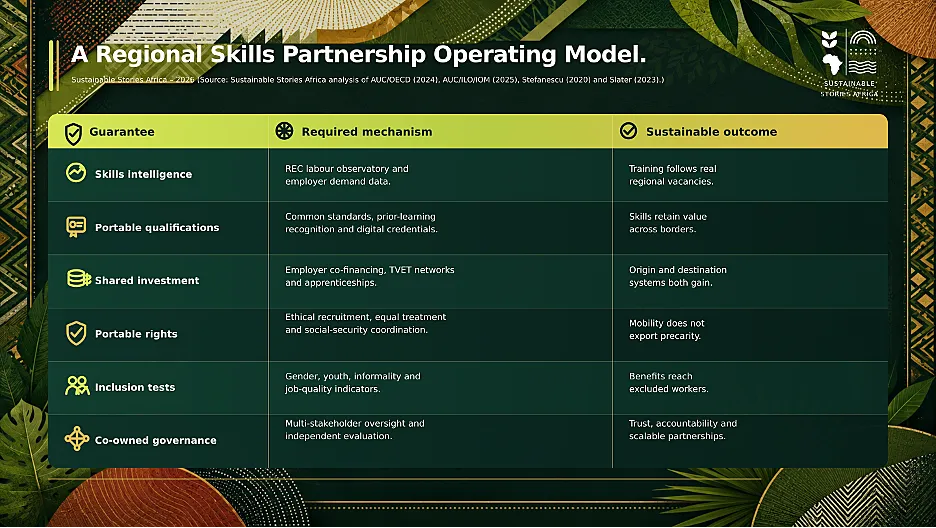
A sustainable regional skills partnership requires six interlocking pillars:
Shared skills intelligence:
- Regional economic communities should maintain live labour-market observatories tracking vacancies, wages, training capacity and demand across agri-food, care, construction, logistics, mining, digital services and renewable energy, ensuring informal work and climate displacement remain visible, not statistical afterthoughts.
Portable qualifications:
- The African Continental Qualifications Framework must become functional infrastructure through compatible standards, mutual recognition, prior-learning recognition and verifiable digital credentials, so skilled workers aren't reclassified as "unskilled" after crossing borders.
Shared training investment:
- Governments, employers, TVET institutions and worker organisations should co-design curricula and finance apprenticeships, with destination employers helping expand origin-region training capacity.
- Existing models like EASTRIP and AUDA-NEPAD centres of excellence offer a foundation, not a finished system.
Rights that travel:
- Partnerships need transparent contracts, ethical recruitment, grievance channels and portable social security covering pensions, injury, maternity and unemployment benefits, accounting for informal and seasonal work.
Inclusion and sustainability tests:
- Success should track job quality, wage gains, women's participation and qualification recognition, rather than just border crossings.
Co-ownership and adaptive governance:
- African countries must be equal designers, with three-to-five-year implementation horizons proving more realistic than short-term pilots.
Path Forward – Let African Talent Build African Prosperity
Africa does not need to stop mobility; it needs to govern it as productive infrastructure.
Regional economic communities should launch sector-based skills compacts that make qualifications, benefits and labour-market data travel as reliably as workers do.
Success is not how many people cross a border. It is when mobility produces decent jobs, stronger African value chains, safer climate transitions and real options to return, circulate or stay.
Africa’s labour market is already regional. Its skills policy must finally become regional too.
Documents Reviewed and Direct References
- Biehler, N., Landmesser, E. and Majewski, R. (2025). Mapping African Migration: Insights from UN DESA Data on Patterns, Trends, and Misconceptions.
- African Union Commission, International Labour Organisation and International Organisation for Migration (2025). Report on Labour Migration Statistics in Africa - Fourth Edition (2022).
- African Union Commission and OECD (2024). Africa’s Development Dynamics 2024: Skills, Jobs and Productivity. .
- Slater, J. (2023). Designing Labour Migration Policies That Work for the EU and African Countries.
- Ardittis, S. (2017). African Migration to Europe: How Can Adequate Data Help Improve Evidence-Based Policymaking and Reduce Possible Misconceptions?
- Afrobarometer (2024). International Migrants Day: Almost Half of Africans Have Considered Emigrating, Afrobarometer Survey Shows.
- Partnerships for Mobility at the Crossroads: Lessons Learnt From 18 Months of Implementation of EU Pilot Projects on Legal Migration.