At N525 a share, the Dangote Petroleum Refinery offer opens public ownership in a strategically important African industrial asset.
It also asks investors to accept a valuation shaped by unusually strong recent margins, concentrated control and a vast expansion still to be funded.
National importance does not settle investment value.
The offer deserves attention, but confidence should rest on reconciled financials, transparent related-party governance and a credible bridge from today's cash flows to tomorrow's 1.4 million-barrel-a-day ambition.
Public Ownership Needs Private Sector Proof
Dangote Petroleum Refinery and Petrochemicals FZE opened its base public offer on September 14, 2026.
The offer places 4.1 billion new ordinary shares at N525 each, targets N2.1525 trillion in gross proceeds and allows entry with 10 shares, or N5,250
- It is a rare chance for retail investors to own part of a major African refining asset.
The strategic case is strong, but the investment case is not self-proving.
- A post-offer equity value of roughly N65.2 trillion prices in more than today's refinery.
- It also prices future margins, expansion execution, capital discipline and minority-shareholder protection.
Those claims deserve evidence equal to the scale of the asset.
Great Asset Can Still Be Expensive
The refinery matters.
- Its operating capacity of about 650,000 barrels per day can reduce Nigeria's dependence on imported refined products, support regional exports and create a platform for petrochemicals.
- Public ownership can also bring more disclosure to a business whose decisions affect fuel supply, foreign exchange and industrial policy.
None of those benefits tells an investor what one share is worth.
That distinction is easy to lose when an offer is promoted as a national event.
The 1914 Reader analysis opens with a quoted view that the shares are currently Shariah-compliant.
- That may answer an important religious screen for some investors, but it is not a valuation opinion.
Conversely, the language of a people's IPO describes access.
- It does not show whether N525 offers an adequate return for the risks assumed.
The correct position is neither automatic celebration nor automatic rejection.
- Investors should recognise the quality and national relevance of the asset, then test the price with the same discipline they would apply to any large public company.
The refinery and the share are connected, but they remain different investment questions.
The Price Carries Major Execution Assumptions
Recent performances explain much of the excitement.
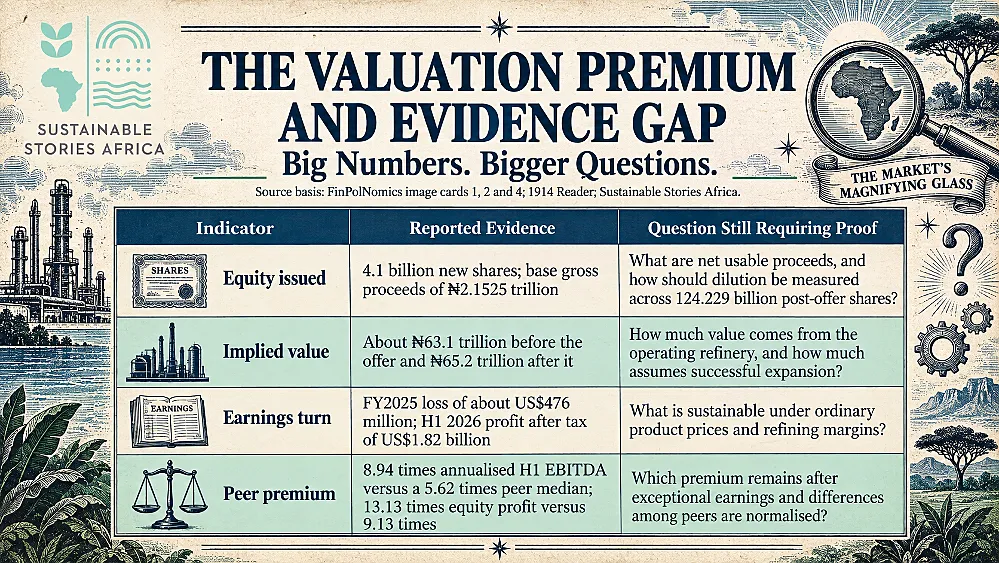
The FinPolNomics cards (Finponomic-Dangote-1, Finponomic-Dangote-2, Finponomic-Dangote-3, and Finponomic-Dangote-4) report a $476 million loss for the 2025 financial year and $1.82 billion in profit after tax for the first half of 2026.
- The prospectus analysis cited by 1914 Reader puts first-half pretax profit at $2.106 billion.
That is a strong turnaround, but stable full-capacity operation began in March 2026, when unusually favourable product markets were also supporting refining margins.
The source analysis attributes 98.4% of the pretax profit improvement to a $2.35 billion rise in gross profit.
- Petrol volumes almost doubled, diesel volumes increased 62%, and selling prices rose sharply.
Investors therefore need a bridge that separates repeatable gains from throughput and efficiency from gains produced by exceptional crude and product spreads.
- A headline profit is useful; a normal-cycle earnings range is more useful.
Reconciliation is equally important.
- The cited prospectus presentations give two operating cash-flow figures for the same first-half period, $1.513 billion and $1.273 billion.
- Cash purchases of property, plant and equipment appear as $162.2 million in one presentation and $33.4 million in another.
Both routes may ultimately reconcile, but investors should not have to build that bridge themselves.
Valuation adds a second layer.
- The 1914 Reader peer test places Dangote at 8.94 times annualised first-half EBITDA against a 5.62 times peer median, a 59% premium.
- Its equity value to annualised first-half profit is 13.13 times against 9.13 times, a 44% premium.
These are diagnostic comparisons, not forecasts, but they show buyers are likely paying in advance for further growth and execution.
That future is capital-intensive.
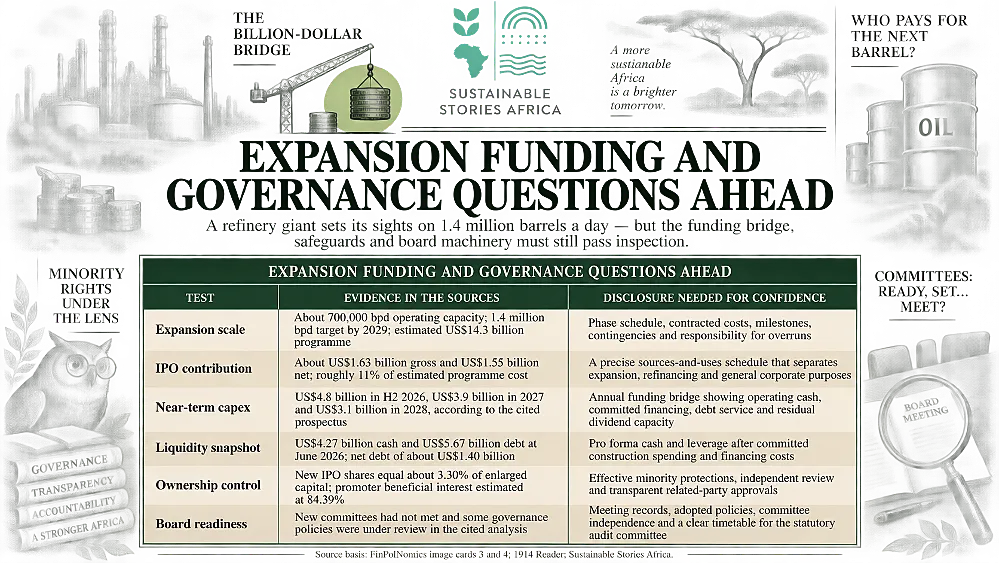
- The attached cards take planned expansion at 1.4 million barrels per day by 2029 and estimate the cost at about US$14.3 billion.
- Base IPO proceeds of roughly $1.63 billion cover only about 11% of that amount; net proceeds are estimated closer to $1.55 billion.
The balance must come from operating cash, existing liquidity, debt, private capital or other financing.
Public Capital Can Deepen Industrial Accountability
Handled well, this offer could set a valuable precedent.
- It can broaden participation in a large productive asset, deepen Nigeria's equity market and make a systemically important business answerable to public reporting standards.
- The listing can also support a wider industrial story built around domestic refining, regional exports and petrochemical output.
Those gains become more credible when investors can trace how cash, risk and control move.
Governance is therefore part of the value proposition, not a compliance appendix.
- The cited analysis describes significant dealings within the wider Dangote group, including a $3.99 billion loan repayment to Dangote Industries Limited and an intercompany derivative that offset losses on external commodity derivatives.
- Related-party transactions can be commercially valid, but their pricing, approval and economic effect must be visible to shareholders who own only the refinery company, in line with the generally applicable “Transfer Pricing Standards”.
This is also where the sustainability argument becomes concrete.
- Energy security and local industrial capacity have real social value.
- However, sustainable prosperity requires disciplined capital allocation, credible oversight and fair treatment of minority investors.
- If public capital strengthens those practices, the IPO can improve the institution as well as finance the asset.
If governance remains largely promised rather than demonstrated, the listing will have widened ownership without widening influence.
Turn Excitement Into Disciplined Investor Questions
The issuer, regulators, advisers and investors each have a practical role.
The immediate task is to replace narrative confidence with information that can be checked. Five disclosures would materially improve the decision:
- Reconcile the financial presentations.
- Publish one numerical bridge for operating cash flow, capital expenditure, finance income, finance costs and derivative offsets, with page references to the audited statements.
- Stress-test recurring earnings.
- Show profit, cash flow and leverage under lower gross refining margins, different utilisation rates, crude-price moves and product-price changes. State clearly which assumptions management controls.
- Map funding through 2029.
- Set out opening cash, IPO proceeds, committed facilities, planned debt, yearly capital spending, debt service and the cash remaining for dividends.
- Gross proceeds and net proceeds should not be used interchangeably.
- Demonstrate minority protection.
- Publish the related-party policy, approval thresholds, independent-director roles and committee timetable.
- Report material group transactions in a format that shows their effect on refinery profit and cash.
- Make research accountable.
- Advisers should use the correct post-offer share count, disclose assumptions and commercial interests, date every model and preserve correction notices.
- Investors should treat national importance, Shariah compliance and price suitability as separate tests.
For retail investors, the minimum ticket of N5,250 makes participation easier, not analysis less necessary.
For pension funds and other fiduciaries, strategic importance cannot replace a documented view of risk, liquidity and long-term return.
A public offer earns public trust when each material assumption is open to challenge.
Path Forward – Evidence Must Carry the Public Offer
Public ownership can strengthen the refinery by bringing public-company discipline.
The immediate priorities are reconciled financial statements, a funding bridge through 2029, tested margin sensitivities and operating evidence from independent board committees.
Investors should treat Shariah compliance, national importance and investment value as separate tests.
If the issuer and advisers answer each with verifiable evidence, the offer can deepen Nigeria's capital market without asking citizens to substitute loyalty for due diligence.