Corporate sustainability reporting is expanding, including across the OECD’s combined Middle East and Africa region
However, the deeper numbers show why Africa should resist confusing disclosure with performance: assurance remains uneven, human rights due diligence is thin, and energy-sector Scope 3 reporting is particularly weak.
For African boards and regulators, the next ESG frontier is accountability, credible data, effective oversight and capital allocation that proves sustainability is changing corporate behaviour rather than merely producing reports.
Africa must move beyond ESG disclosure
Africa’s corporate sustainability debate is entering a more difficult phase.
- The question is no longer whether companies publish ESG information.
- It is whether that information changes decisions, investment, accountability and outcomes.
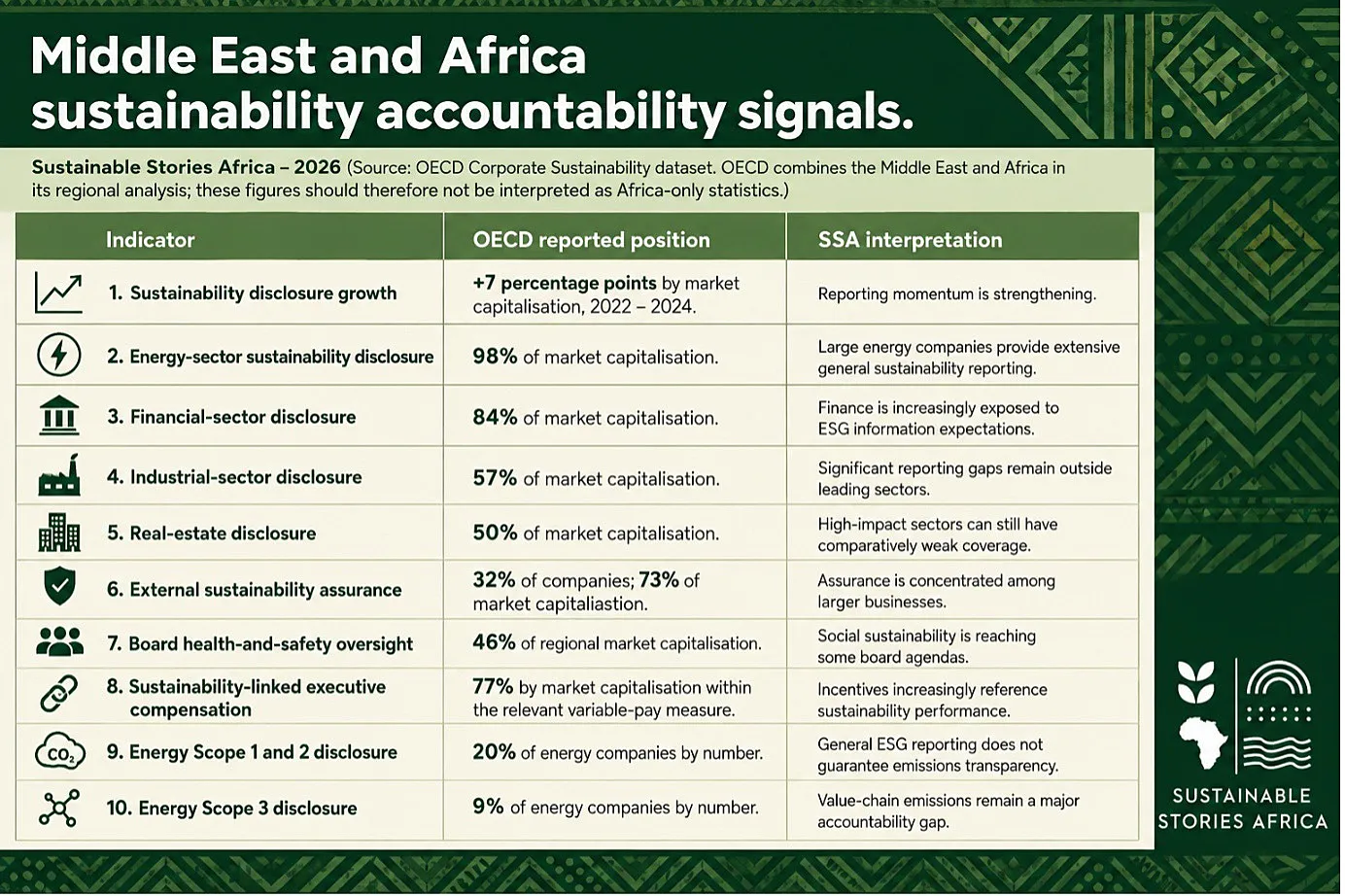
The OECD’s Global Corporate Sustainability Report 2025 offers compelling evidence. Almost 12,900 companies disclosed sustainability-related information, representing 91% of global listed market capitalisation.
Disclosure by market capitalisation increased seven percentage points between 2022 and 2024 in the OECD’s combined Middle East and Africa category.
That progress matters. However, Africa should draw a harder lesson from the report:
- Sustainability reporting is only valuable when credible information reaches boards and investors and influences strategy.
- A glossy report is not evidence of a sustainable company.
Disclosure growth can hide accountability gaps
The OECD dataset covers 44,152 listed companies with a combined market valuation of $125 trillion.
However, almost 12,900 companies providing sustainability information make up less than one-third of the companies by number, but represent 91% of market capitalisation.
That distinction deserves attention in African markets.
- Large listed companies are far more likely to possess the resources, systems, advisers and investor pressure necessary to produce sophisticated disclosures.
- Smaller listed businesses can remain outside the reporting mainstream even when their employment, supply-chain or environmental footprints are locally significant.
The same problem appears when looking at sectors.
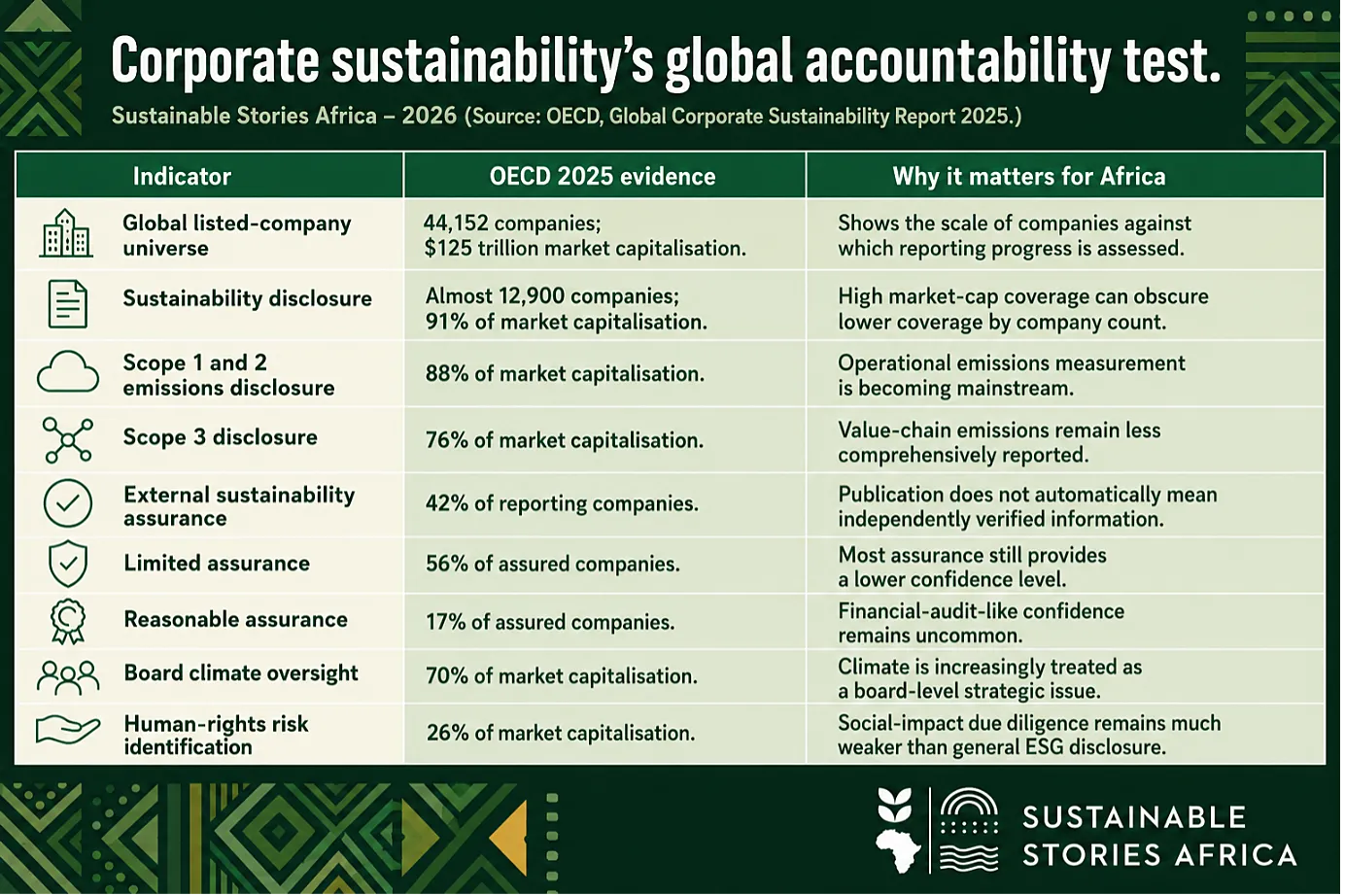
- In the OECD’s combined Middle East and Africa category, companies representing 98% of the energy sector’s market capitalisation disclosed sustainability information.
- The figure was 84% for financial companies and 83% for technology.
However, coverage dropped to 57% for industrials, 50% for real estate and just 48% for consumer cyclicals.
This is important because the African sustainability transition cannot be built around banks, energy groups and a few large listed companies alone.
Industrial firms, property companies, consumer businesses, suppliers and smaller enterprises collectively determine employment, resource consumption and community outcomes.
Africa’s reporting gains remain unevenly distributed
Assurance exposes another fault line.
- Across the combined Middle East and Africa region, 32% of companies that obtained sustainability disclosures were externally assured, and the companies represented 73% of regional market capitalisation.
Again, size changes the picture. And assurance itself varies in strength.
- Globally, 56% of companies with assured sustainability information relied on limited assurance, while only 17% reported reasonable assurance for at least one piece of information. In the Middle East and Africa, 61% relied on limited assurance.
For African capital markets, this distinction will become increasingly important.
- Investors cannot confidently price climate, social or governance risks if sustainability information receives dramatically less scrutiny than financial information sitting alongside it.
The OECD also identifies growing use of global reporting frameworks.
- More than 6,500 companies use GRI Standards, over 4,800 use TCFD recommendations and almost 3,500 use SASB Standards.
- Some 582 companies reported using IFRS S1 and S2 through full or partial alignment.
Framework convergence is helpful. However, adopting a standard cannot be a substitute for building the underlying governance, measurement and control systems that make the disclosure trustworthy.
Better governance turns reporting into value
Perhaps the report’s strongest lesson for Africa is that sustainability becomes economically useful when it moves from communications departments into corporate governance.
- Globally, companies representing 70% of market capitalisation reported board oversight of climate-related issues in 2024, up from 53% in 2022.
- Two-thirds by market capitalisation had a board-level committee whose mandate included sustainability risks.
Executive incentives are changing too.
- Among companies with relevant variable compensation, 67% by market capitalisation linked executive pay to sustainability factors.
- The combined Middle East and Africa region reported sustainability-linked executive compensation covers 77% of market capitalisation within that measure.
These are potentially significant governance changes; however, only when remuneration metrics are substantive.
Linking executive pay to ESG cannot become another disclosure exercise in which easily achievable indicators replace difficult questions around emissions, worker welfare, communities, environmental impacts or capital investment.
Human rights demonstrate why.
- Companies representing 81% of global market capitalisation disclose human-rights policies.
- However, only 26% report their processes for identifying salient human-rights risks.
- Half report supply-chain health-and-safety training, but only 14% track whether those interventions actually improve health-and-safety outcomes.
The gap is striking: companies are much better at declaring policies than demonstrating consequences.
Boards must connect metrics with decisions
Nowhere is the reporting-versus-action tension clearer than energy.
The sector has the world’s highest sustainability-disclosure rate, covering 94% of global market capitalisation.
However, the OECD finds that the Middle East and Africa have the lowest disclosure of greenhouse gas emissions by number of energy companies: only 20% disclose Scope 1 and 2 emissions, and 9% disclose at least one Scope 3 category.
Scope 3 matters because emissions arising from the use of products sold can dwarf energy companies’ operational footprints.
State ownership adds another governance dimension. Listed state-owned enterprises account for almost one-third of the emissions disclosed by listed energy companies globally.
For African governments that own important energy and infrastructure businesses, sustainability governance therefore cannot be imposed on private companies while public enterprises receive lighter scrutiny.
Boards also need to examine whether corporate advocacy matches stated climate ambitions.
- Globally, only 7% of listed energy companies publicly disclose their positions on climate-related public policy
- While 6% assess whether their climate policies align with those of industry associations to which they belong.
Capital allocation may be the most important test of all.
Between 2015 and 2024, listed energy companies’ net operating cash flow increased 32%.
According to the OECD, this supported a tripling of dividends and share repurchases, while net cash used in investing activities increased by less than 5%.
That comparison should matter to African investors and boards.
- A company can publish a detailed sustainability report, announce climate targets and create an ESG committee while its capital allocation continues to tell a different strategic story.
African regulators should therefore push the sustainability conversation towards decision-useful disclosure and credible assurance.
Boards should demand clear connections between material ESG risks, strategy, executive incentives, investment budgets and performance.
Investors, meanwhile, should interrogate outcomes rather than reward reporting volume.
Path Forward – Making African sustainability disclosure genuinely consequential
Africa’s next sustainability phase should prioritise comparable reporting, stronger assurance, board ownership of material ESG risks and transparent links between targets, executive incentives and capital expenditure.
Regulators should pursue interoperability without allowing compliance to become the objective.
Companies, especially energy businesses and SOEs, must disclose the emissions, human rights impacts and lobbying positions that materially shape outcomes.
Success should be measured not by published reports, but by whether disclosure changes decisions, investment and accountability.