What the 2025 Africa Sustainable Development Report reveals about the continent's delivery gap
Africa is advancing on 12 of the 17 Sustainable Development Goals; however, only 2 of 46 measurable targets reviewed in the 2025 Africa Sustainable Development Report are on track to meet the 2030 objectives.
The contradiction exposes a delivery crisis, not a shortage of plans.
Unless finance, institutions, decent work and data become enforceable national priorities, fast growth will continue to coexist with fragile lives, widening inequality and depleted natural capital.
Africa’s Progress Is Failing Its Promise
Africa does not lack ambition.
The 2030 Agenda and Agenda 2063 offer a coherent destination: longer and healthier lives, equality, dignified work, protected oceans and partnerships capable of financing change.
The 2025 Africa Sustainable Development Report, produced jointly by the African Development Bank, African Union Commission, United Nations Economic Commission for Africa and United Nations Development Programme, shows that the route remains dangerously underbuilt.
The report records genuine gains.
- Life expectancy has risen, skilled birth attendance has expanded, women hold more parliamentary seats, and protected marine areas exceed the earlier 10% benchmark.
- It also estimates that Africa was home to 12 of the world’s 20 fastest-growing economies in 2025.
However, progress that doesn’t reach households, workers or ecosystems is not transformation.
Africa’s sustainability debate must therefore move from celebrating policy alignment to testing delivery:
- what is funded, who benefits, what changes, and whether institutions can prove it with timely data.
Growth Cannot Hide the Delivery Failure
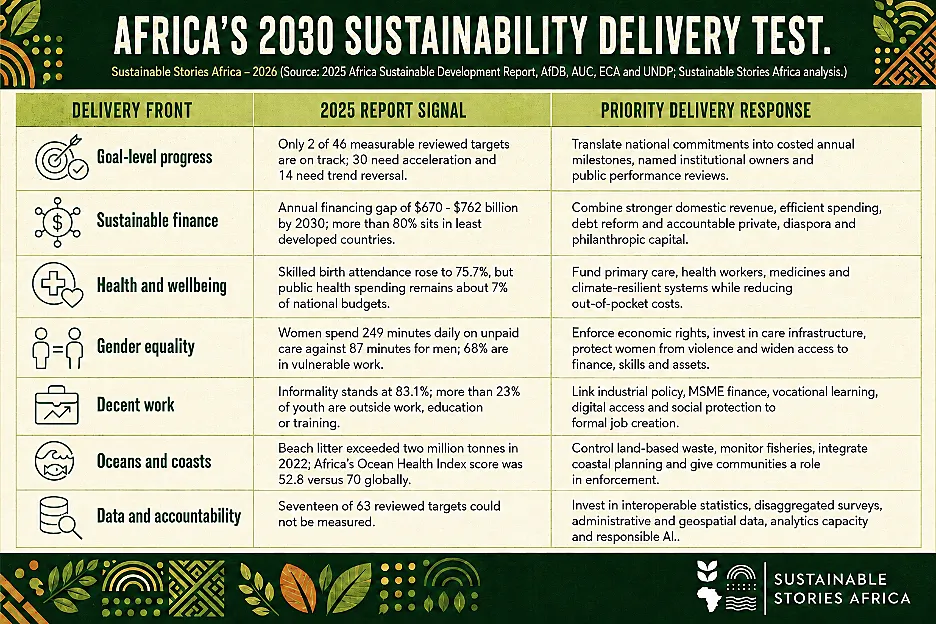
The report's most important number is 2.
Of 63 targets assessed across health, gender equality, decent work, life below water and partnerships, only 46 could be measured, and just 2 were on track for 2030:
- Conserving coastal and marine areas and strengthening statistical capacity.
- Thirty required faster progress, 14 needed a reversal of negative trends, and 17 remained unmeasurable.
That dashboard should end the habit of confusing motion with momentum.
- Countries may launch policies, host summits, and report aggregate growth while citizens still pay out-of-pocket for healthcare, women remain trapped in vulnerable work, and coastal communities absorb pollution. Activity is not delivery.
Nor can headline growth carry the argument alone.
- Africa's average annual GDP growth per capita fell from 2.7% in 2021 to 0.7% in 2023.
- Informal employment reached 83.1% of workers, against a global average of 57.9%, while over 23% of young people were not in employment, education or training.
These five goals are not separate silos:
- Weak finance constrains health systems, unequal care burdens restrict women's paid work, poor skills limit productivity, and weak institutions undermine governance.
Africa's central challenge is building institutional capacity to make these links visible and act on them.
Progress Exists, but Inequality Still Dominates
Health illustrates the contradiction.
- Since 2015, life expectancy has risen by three years, maternal mortality has fallen by 7.4%, and skilled birth attendance has climbed from 61.8% to 75.7%.
- However, public health spending remains around 7% of national budgets, well below the 15% target.
- Workforce shortages, uneven medicine access, high out-of-pocket costs, conflict and climate shocks continue to weaken outcomes.
Gender equality tells a similar story.
- Women held 26% of parliamentary seats in 2023, up from 19% in 2015.
- Only 15 countries had strong legal frameworks supporting equality.
- In 2022, 68% of women were in vulnerable employment compared with 57% of men.
- Women spent an average of 249 minutes daily on unpaid care work, nearly three times the 87 minutes recorded for men.
Representation without economic power remains an incomplete victory.
The blue economy is similarly caught between promise and pressure.
- Marine protected areas covered 15.9% of Africa's marine space, exceeding the earlier 10% target, yet more than two million tonnes of litter polluted
- African beaches in 2022, and the continent's Ocean Health Index score of 52.8 lagged far behind the global average of 70.
Finance connects every deficit:
- The annual SDG financing gap is estimated at $670 – $762 billion by 2030, with over 80% concentrated in least developed countries
- FDI fell 3.4% to $52.6 billion in 2023.
Delivery Can Convert Potential Into Dignity
The prize for getting delivery right isn't a better international scorecard.
- It's a woman entering paid work because care services exist
- A young person whose technical training leads to formal employment
- A family reaching primary healthcare without selling assets
- A fishing community whose income survives because pollution and illegal harvesting are controlled.
There are working signals.
- Rwanda's Economy Digitalisation Programme uses data from agriculture, retail, tourism, education, transport and telecommunications to improve public and private decision-making, showing how commodity-price dashboards and digitised transport planning can turn evidence into practical improvements rather than abstract statistics.
The same logic can guide wider transformation.
- AfCFTA can scale regional value chains if infrastructure and non-tariff barriers are addressed.
- Natural-capital accounting can sharpen growth decisions.
- Circular production, renewable energy and sustainable food systems can create jobs while reducing exposure to imported shocks.
Properly governed blue-economy investment can protect ecosystems and expand livelihoods simultaneously.
Most importantly, credible delivery rebuilds trust
- Citizens see budgets change outcomes, investors distinguish bankable reform from slogans, and governments catch underperformance before crisis.
The alternative is a continent that grows statistically while inequality and ecological loss deepen.
Build Institutions That Finance Measurable Results
First, governments should establish national delivery compacts;
- Integrating the SDGs and Agenda 2063 into budgets rather than parallel policy documents.
Each compact should define catalytic priorities, annual targets, responsible institutions, financing sources, and public reporting dates, allowing legislatures, audit institutions and civil society to interrogate performance and trigger correction processes.
Second, finance must be mobilised and governed as one system.
- Better tax administration, reduced leakage and transparent procurement should sit alongside debt restructuring and more affordable long-term capital.
Private investors, pension funds and diaspora capital can help, but blended-finance structures must preserve public value and avoid shifting losses onto citizens.
Third, countries should concentrate scarce capital on systems that unlock several goals at once:
- Primary healthcare, technical education, digital infrastructure, renewable power, food systems and the blue economy.
Spreading resources thinly across disconnected projects may improve reporting but won't change development trajectories.
Fourth, inclusion should be designed into delivery.
- Budgets and data should be disaggregated by sex, age, disability, income and location.
Procurement opens markets to women-, youth- and locally owned enterprises, and coastal and rural communities participate in resource governance rather than merely receiving decisions.
Finally, Africa should use South-South cooperation and AfCFTA institutions to scale its policies and negotiate finance from a stronger common position, regional solidarity as delivery infrastructure, rather than diplomatic accessory.
Path Forward – Make Every Commitment Measurable and Funded
Africa’s next sustainability milestone should not be another declaration.
It should be a funded delivery compact that names priorities, assigns institutions, publishes annual targets and exposes underperformance early enough for correction.
The continent still has growth, youth, natural wealth and innovation on its side.
Converting them into durable progress now requires disciplined finance, stronger institutions, inclusive participation and data that turns promises into public accountability.