Africa’s energy transition is often framed as a financing challenge. While capital remains essential, it cannot compensate for weak governance, poor stakeholder engagement or businesses that fail to earn public trust. ESG is no longer a corporate buzzword; it is becoming a strategic advantage for African energy companies seeking to attract investment and deliver sustainable growth.
Africa Must Build Trust Before Scale
Every conversation about Africa’s energy future seems to end with the same conclusion: the continent needs more investment.
That is true, but it is only half the story.
The latest Tracking SDG7: The Energy Progress Report 2026 shows that around 655 million people worldwide still lack access to electricity, with Sub-Saharan Africa accounting for the overwhelming majority of that deficit. The financing gap is significant, but money alone will not deliver universal energy access.
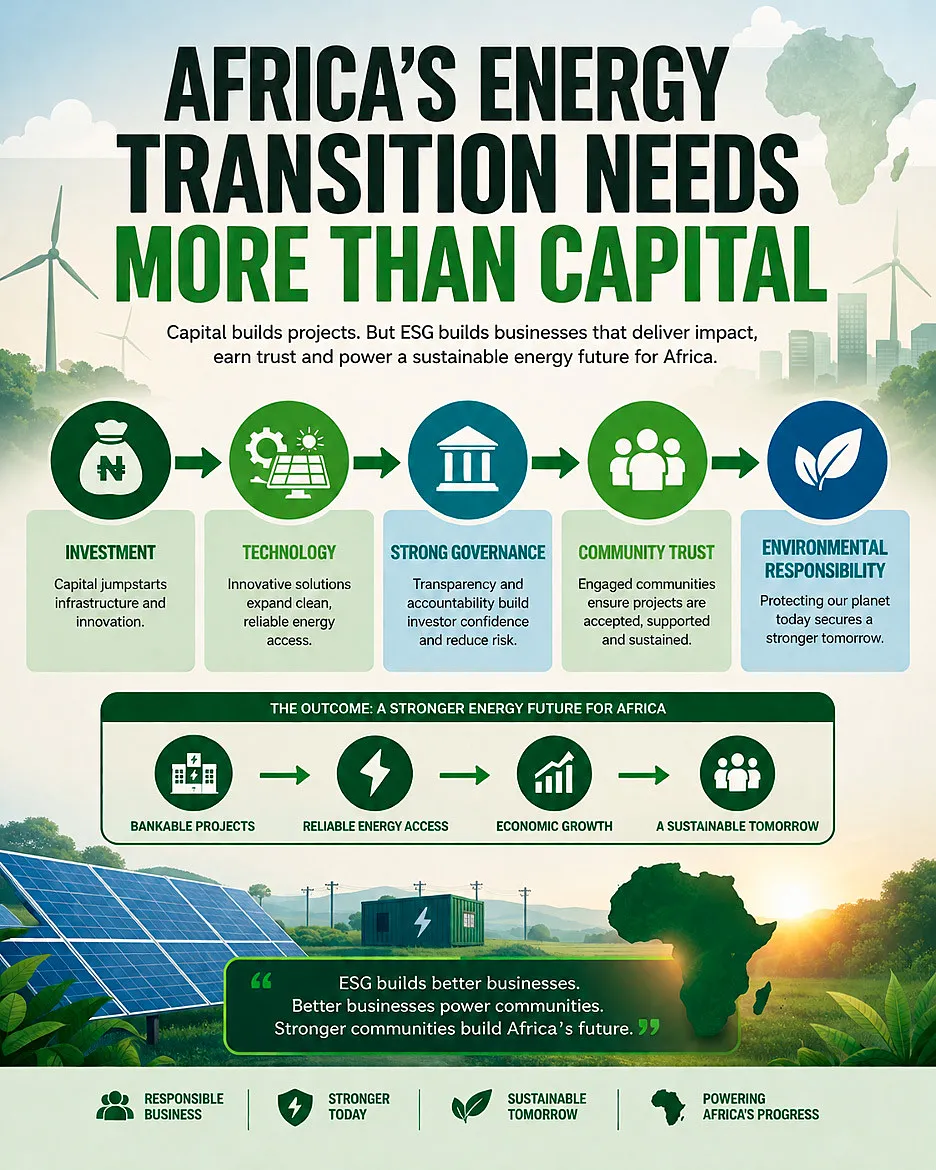
Capital flows into businesses, institutions and projects. If those organisations are poorly governed, disconnected from the communities they serve or unable to manage environmental and social risks, even well-funded projects can fail.
This is why Environmental, Social and Governance (ESG) should no longer be viewed as another sustainability framework. For Africa’s energy sector, it is becoming a business strategy.
Capital Alone Will Not Deliver Energy Access
The conversation around energy transition often focuses on technology and finance. Solar panels, battery storage, mini-grids and concessional funding dominate policy discussions.
Yet many projects encounter obstacles that have little to do with technology.
Community opposition can delay construction. Weak governance can discourage investors. Poor environmental management can increase regulatory scrutiny and operational costs. These are not isolated challenges; they are business risks.
As Damilola Ogunbiyi, Chief Executive Officer of Sustainable Energy for All (SEforALL), has emphasised, achieving universal energy access requires stronger implementation and collaboration alongside increased investment. Her message reflects a broader reality: Africa does not simply need more projects; it needs institutions and businesses capable of delivering them effectively.
That is precisely what ESG seeks to strengthen.
Rather than asking whether a company is profitable today, ESG asks whether it is resilient enough to remain profitable tomorrow.
Africa Is Already Showing What Works
The argument for ESG as a business strategy is no longer theoretical. Across Africa, renewable energy companies are proving that responsible business practices can drive both commercial success and sustainable development.
Nigeria offers a strong example.
Companies such as Arnergy have expanded access to reliable solar power while attracting international investment through scalable, customer-focused business models. Likewise, Daystar Power has shown that combining clean energy solutions with strong governance and operational excellence can create lasting business value. Its acquisition by Shell in 2022 underscored how African renewable energy companies with credible business fundamentals are increasingly attractive to global investors.
These examples point to a broader lesson. The companies leading Africa’s energy transition are succeeding not simply because they deploy innovative technologies, but because they build trust with investors, customers and communities.
That is the real value of ESG. It is not another reporting obligation; it is a practical framework for building resilient businesses capable of powering Africa’s sustainable growth.
ESG Is a Competitive Strategy
African businesses should not embrace ESG simply because investors expect it.
They should embrace it because better governance reduces risk. Stronger stakeholder relationships improve project delivery. Responsible environmental practices protect long-term assets. Transparent leadership builds investor confidence.
In today’s business environment, trust has become an economic asset.
Companies that demonstrate accountability are more likely to attract finance, secure partnerships and earn the confidence of regulators and customers alike.
Those that ignore these realities may still raise capital, but they are increasingly likely to pay a higher price for it.
What Needs to Change
The responsibility begins with business leaders.
Boards should integrate ESG into strategic decision-making rather than delegating it solely to sustainability or communications teams. Investors should reward companies that demonstrate responsible governance and measurable impact, not just ambitious promises. Governments should create clear and practical regulatory frameworks that encourage transparency while supporting businesses, especially SMEs, to improve their sustainability practices.
Ultimately, ESG should not be seen as an external requirement imposed by international markets.
It should be recognised as a practical framework for building stronger African businesses.
Path Forward
Africa’s energy transition will not be determined solely by the amount of capital mobilised or the number of renewable energy projects announced.
It will depend on whether businesses can earn the trust of investors, communities and regulators while delivering reliable, affordable and sustainable energy.
That is why ESG matters.
Not because it is fashionable, but because it helps build the kind of businesses Africa’s energy future depends on.