
Why credible, African-led evidence is now essential to accountability, policy and capital.
By Uade Ahimie – Updated for republication, July 17, 2026
Africa’s climate and development story is still too often framed elsewhere, through crisis, compliance and risk, while African evidence, innovators and communities remain supporting characters.
That imbalance now carries financial consequences. As disclosure standards tighten and climate capital stays scarce, African markets must build trusted, data-led narrative infrastructure that turns local outcomes into investable evidence, public accountability and agency.
Africa’s Green Transition Needs African Authors
On a November evening in 2024, a reunion at an ESG finance event at Lagos’ Oriental Hotel became an argument about absence. Africa’s sustainability transition was accelerating; however, too many of its defining stories were reported late, stripped of context or narrated mainly through the priorities of institutions outside the continent.
That gap is no longer merely editorial. It influences which projects look investable, whose expertise counts, how risk is priced and whether citizens can test corporate and government claims.
In a market increasingly governed by climate disclosures, transition plans and evidence of impact, narrative has become part of economic infrastructure.
Our position is therefore direct: Africa must tell its own sustainability story, rather than escape scrutiny or replace facts with optimism, but to place African data, lived experience and ambition at the centre of the record.
Narrative sovereignty must mean better evidence, stronger accountability and a fairer route from local solutions to global capital.
Narratives Now Shape Africa’s Capital
Africa's next green future contest will be fought not only in boardrooms and power markets, but in datasets, headlines, sustainability reports and the language used to describe African risk. Capital follows confidence, and confidence follows trustworthy evidence.
- Reducing a solar mini-grid to a "small development intervention" obscures its value as productive infrastructure.
- Reducing a farmer's resilience to anecdote hides the system behind it: forecasts, adapted seeds, insurance and local knowledge.
- Emissions disclosures without context on jobs, water and transition trade-offs become compliance theatre.
Africa's weak control over its sustainability narrative is an economic and governance liability. The answer isn't green public relations, but an evidence-to-influence system linking credible journalism, comparable disclosure, community testimony and investable project data.
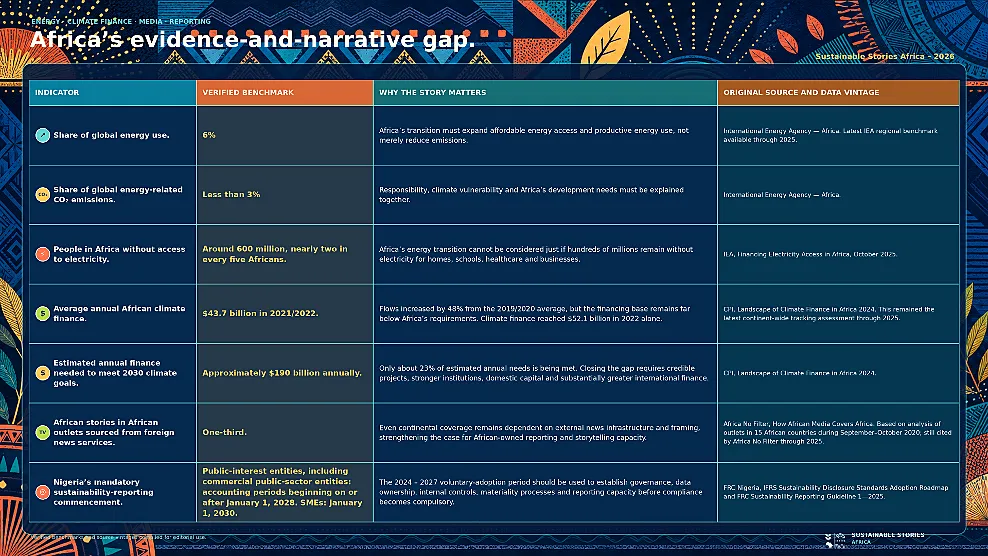
The numbers justify urgency: Africa accounts for just 6% of global energy use and under 3% of energy-related CO2 emissions (IEA); however, climate finance flows averaged only $43.7 billion in 2021/2022, up 48% from 2019/2020, but still far short of the $277 billion needed annually for 2030 climate goals.
Evidence Exposes Africa’s Double Deficit
Africa faces two consequential deficits: too little sustainability finance and too little control over the information shaping that finance. One measures capital; the other measures visibility, context and trust.
Africa No Filter's study of 60 outlets across 15 countries found roughly a third of African stories carried by continental outlets were sourced from foreign news services.
Though dated to 2020, its warning endures; constrained budgets can make Africans consumers of narratives about themselves.
Sustainability magnifies this, as technical language and scattered evidence often leave irrigation projects, financing and community outcomes undocumented in a single coherent account.
That fragmentation sparked a 2024 Lagos debate between Tuoyo Amuka-Pemu and me, joined by Victory James Ugwudike's strategic communications expertise and Bankole Oloruntoba's development finance background.
Together, we founded Sustainable Stories Advocates Limited in April 2025 and commenced operations of the Sustainable Stories Africa platform on September 1, 2025, to investigate delivery, translate complex frameworks and make African performance legible to citizens and capital providers.
This matters as reporting rules are formalised. By September 2025, 37 jurisdictions were adopting ISSB standards, with Nigeria's roadmap mandating reporting from January 2028 for Public Interest Entities (PIEs), demanding governance and reliable metrics, rather than glossy narratives.
Better Stories Build Better Markets
Imagine the alternative: a solar project reported through connections, tariffs, uptime and avoided diesel costs, rather than ribbon-cutting; an agriculture programme linking hectares to income, soil and water risk; a bank explaining how climate risk reshapes credit without excluding small businesses through green premiums.
These stories are stronger because they're more complete, rather than more positive. They give investors a basis for diligence, regulators a basis for supervision, and communities a basis for consent or challenge.
Better narrative infrastructure can convert overlooked projects into credible pipelines, distinguish genuine transition from greenwashing, and recast Africans as engineers, entrepreneurs and voters shaping the response, rather than passive climate victims.
Without it, projects stay invisible, imported indicators crowd out local questions, and capital mistakes miss evidence for missing opportunity.
Sustainable Stories Africa combines journalism, report reviews, and data-led explainers so one strong story can open policy debate, improve disclosure and support investment.
Build a Continental Evidence-to-Influence System
Africa does not need a single authorised storyteller. It needs a stronger ecosystem of independent, capable and connected storytellers working from verifiable evidence. Five practical shifts can build it.
First, governments must publish usable sustainability data.
- Climate plans and infrastructure programmes need open project registers, delivery milestones, procurement information and outcome scorecards. Material data should be disaggregated while protecting legitimate privacy.
Second, regulators must pair standards with readiness.
- IFRS S1 and S2 adoption should include sector guidance, training, digital tools, assurance pathways and support for smaller value-chain businesses.
- Unreliable compliance helps nobody.
Third, boards must connect sustainability to decisions.
- Metrics should link to strategy, capital allocation, risk appetite and performance. Companies should disclose setbacks and trade-offs.
- Trust grows when reporting explains what management has changed.
Fourth, financiers must fund the missing middle.
- Capital should cover project preparation, baseline data, monitoring, local-language engagement and independent evaluation.
- These are infrastructure costs that make outcomes credible and projects repeatable.
Fifth, media and civil society must collaborate without surrendering independence.
- Newsrooms need specialist desks, cross-border networks, shared data and distribution in African languages.
- Universities and professional bodies can deepen expertise. Citizens must appear as rights-holders and co-authors, not colour around institutional claims.
This chain is the operating model.
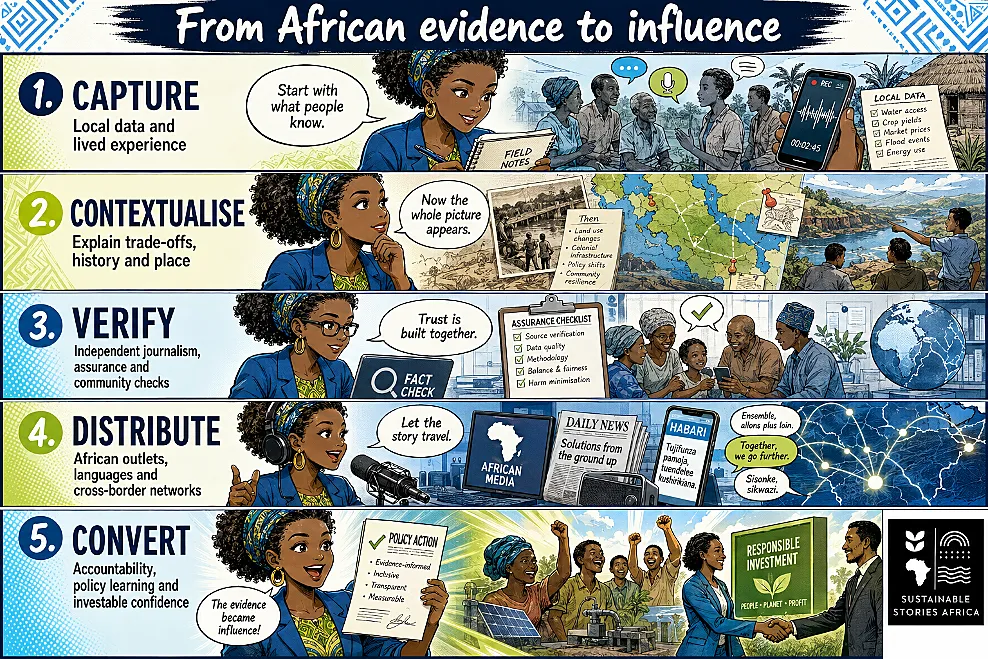
- Break it at capture, and there is no evidence.
- Break it; we have context and numbers that mislead.
- Break it; verification and trust collapse.
- Break it; distribution and solutions remain invisible.
- Break it; conversion and storytelling never change decisions.
Path Forward – Africa Must Author Tomorrow
Africa’s sustainability narrative must become shared infrastructure: locally grounded, independently verified, globally intelligible and relentlessly accountable. Governments should open data, companies should report decisions and outcomes, financiers should fund evidence, and media should connect projects to people.
Sustainable Stories Africa will keep building that bridge through journalism, analysis, reviews, dialogue and multimedia. The objective is not a kinder headline. It is a truer record—one strong enough to move policy, capital and public agency.