A solar connection, a cold room and a collection point for used cooking oil might seem like different stories.
Across Africa, they share a growing connection: companies seeking capital to turn everyday problems into workable businesses.
The companies featured in African-Startups’ October funding roundup reveal ambition across energy, agriculture, healthcare and finance.
Their next challenge is to translate financing into services people can use, and results that can withstand scrutiny.
Capital Meets The Waiting For Electricity
“Every month a project is delayed is another month a community goes without power.”
For Afnan Hannan, chief executive of Okra Solar, the distance between a financing agreement and an electricity connection is measured in waiting.
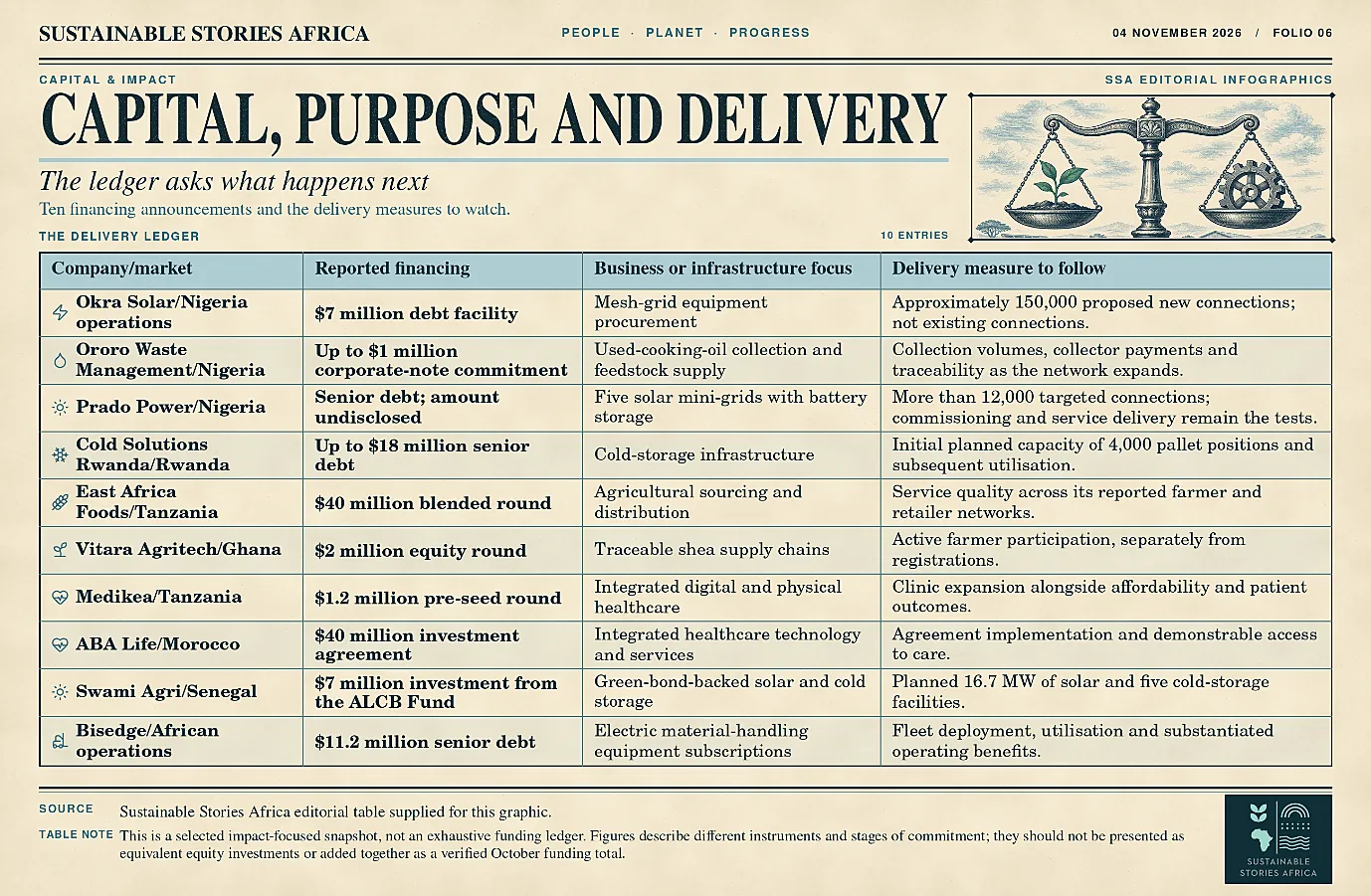
- His company’s newly reported $7 million debt facility from British International Investment is intended to shorten that distance by funding equipment purchases before individual projects close.
Okra develops mesh-grid technology that allows neighbouring homes and businesses to share solar electricity.
- With more than 13,000 households already connected, it sits within a wider group of businesses featured in African-Startups’ October 2026 funding roundup: companies addressing problems as varied as unreliable power, fragmented food distribution and access to healthcare.
Their stories converge around a practical question.
- What changes when finance reaches the equipment, networks and services that daily life depends on?
The answer will emerge not from the announcements alone, but from what these companies deliver next.
Different Origins Meet Shared Everyday Needs
No single founding story behind this group.
- Some businesses emerged around digital platforms; others built their propositions around physical infrastructure.
- Their ages, markets and financing needs differ substantially.
Even the roundup’s description of them as startups requires care: it includes established institutions such as Kenya’s Family Bank and Cameroon’s industrial group Prometal alongside younger technology ventures.
In Nigeria, Ororo Waste Management’s story begins with a material many businesses discard: used cooking oil.
- Founded in 2021 by Ayodele Banjo and Lawson Nzekwe, the company collects oil and channels it into waste-based feedstock markets.
- Its reported network includes collection hubs in Lagos, Abuja and Port Harcourt and around 5,000 paid collectors.
Rising Tide Africa’s commitment of up to $1 million takes the form of corporate-note financing, not an ordinary equity round.
- Reporting indicates that the first tranche was disbursed in September, with further releases scheduled through December.
That timing matters: inclusion in an October roundup does not establish that every transaction originated or closed during October.
Tanzania’s East Africa Foods follows another route.
- Its reported $40 million blended round supports a business that sources produce from more than 28,000 registered smallholder farmers and supplies over 10,000 urban retailers.
Here, the company’s proposition connects production to the infrastructure needed to reach a market.
Progress Becomes Meaningful Beyond The Announcement
For these businesses, impact is significant when expressed through a service: electricity supplied, produce stored, healthcare delivered, or a payment completed.
Cold Solutions Rwanda is developing a cold-storage facility in Kigali with an initial 4,000 pallet positions, expandable to 8,000.
- Its reported senior debt facility of up to $18 million supports infrastructure intended to reduce post-harvest losses and strengthen agricultural logistics.
These are intended outcomes, not evidence that the full benefits have already materialised.
Ghana’s Vitara Agritech, previously Sommalife, addresses a different part of the agricultural chain.
- Its TreeSyt platform supports farmer profiling, purchasing, training and traceability in shea supply chains.
The roundup reports 150,000 registered farmers and 40,000 active participants, two measures that should remain distinct when assessing reach.
Healthcare introduces another test: whether expansion improves access and quality together.
Tanzania’s Medikea combines telehealth with clinics, pharmacies and diagnostic services.
- Its reported $1.2 million pre-seed round accompanies plans to expand its clinic network.
Morocco’s ABA Life has announced a $40 million investment agreement for an integrated healthcare platform.
- Neither figure, by itself, demonstrates better patient outcomes.
Building Capacity Requires More Than Equity
The financing structures reveal an important part of the story.
- These companies are not all raising venture equity to develop software.
- Some need working capital to buy equipment; others require longer-term finance for assets that will earn revenue over time.
Prado Power illustrates that distinction.
- Its REPP 2 senior debt facility supports five Nigerian mini-grids with 1.84 MWp of solar capacity and 5.2 MWh of battery storage.
- Reporting places the announcement on September 30, although the transaction appears in the October roundup.
The debt helps bridge upfront construction requirements within a model that also uses performance-based public grants.
Okra’s facility tackles a related constraint earlier in the supply chain.
- Buying components in volume before developers complete transactions can reduce procurement delays and make equipment available sooner.
Hannan’s account links working capital to the pace at which communities can receive electricity.
- “Every month a project is delayed is another month a community goes without power.” Afnan Hannan, chief executive, Okra Solar.
The next reporting chapter should therefore follow deployment as closely as fundraising.
- For energy businesses, that means commissioned systems and dependable service.
- For agricultural platforms, it means functioning supply relationships and measurable farmer benefits.
- For healthcare companies, it means care that remains accessible as operations grow.
These are the questions that turn an investment story into an accountability story.
Path Forward – The Next Chapter Must Demonstrate Delivery
The companies in this roundup have described plans to expand electricity access, strengthen food systems and widen healthcare services.
Their financing provides resources to pursue those ambitions, but commitments and targets differ from completed delivery.
Their lasting significance will depend on what follows: infrastructure that works, services people can afford and evidence that reaches beyond company announcements.
Africa’s development story needs capital. It also needs a clear account of what that capital makes possible.