Nigeria sits on one of Africa's largest institutional capital pools of N29.43 trillion in pension assets as of February 2026, while facing an annual infrastructure financing gap that exceeds $100 billion. The distance between those two realities is not primarily a financial one. It is a structural, governance, and coordination problem.
At Proshare HardFacts Episode 9, Bolaji Balogun of Chapel Hill Denham introduced the concept of a Capital Market National Deal Room as the missing architecture to bridge that gap and outlined exactly what it would take to build it.
Nigeria's Capital and Infrastructure: The Unfinished Connection
No serious conversation about Nigeria's infrastructure future can avoid a central paradox: the country has the capital pools and the financing instruments to fund transformation at scale, and yet the gap between available institutional capital and deployed infrastructure finance remains stubbornly wide.
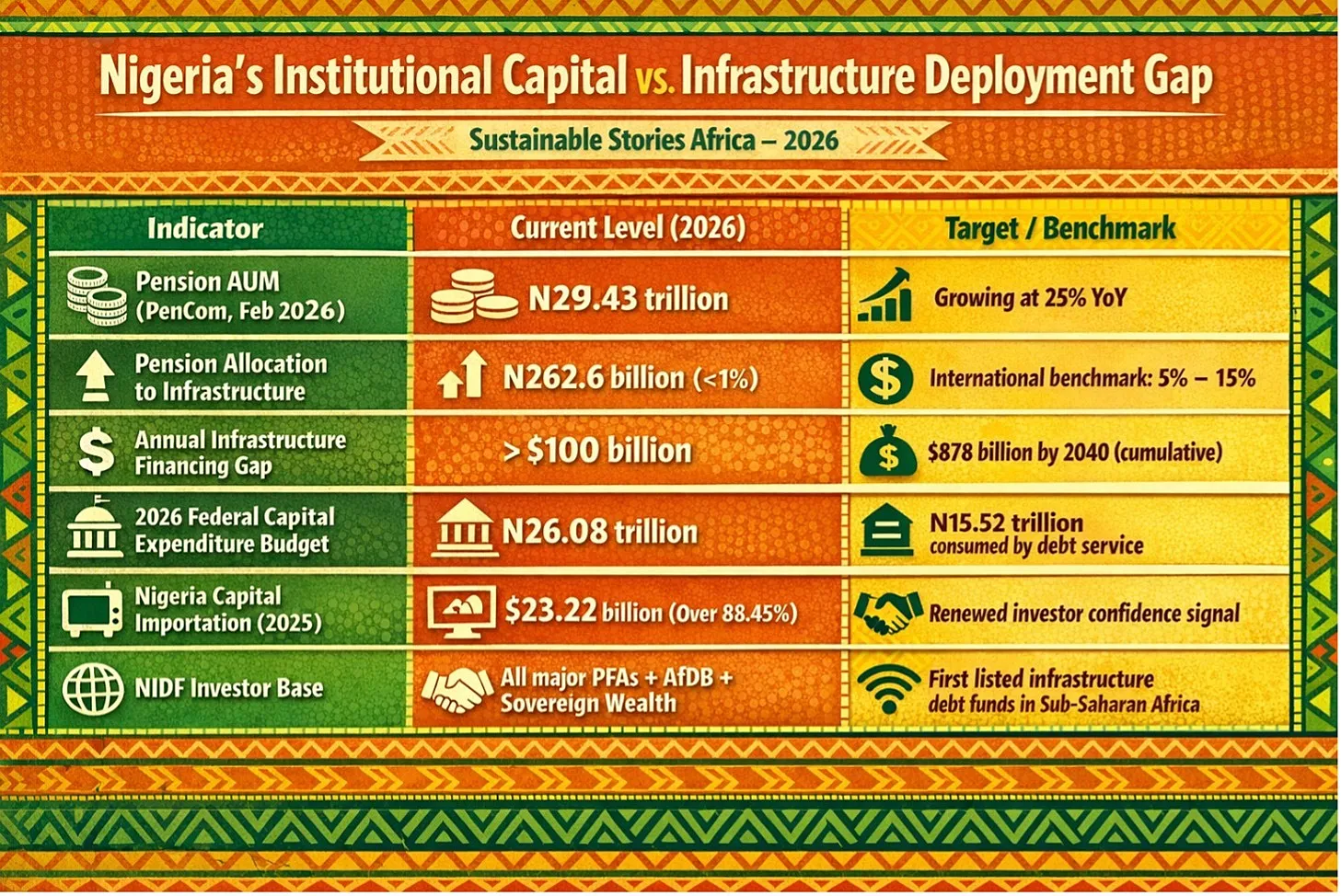
As of February 2026, Nigeria's total pension assets under management stood at N29.43 trillion, a figure driven by strong equity gains and rising contribution volumes, according to PenCom.
Set against an annual infrastructure financing requirement that Agusto & Co. estimates will reach $878 billion by 2040, requiring sustained annual investment of over $100 billion, the gap is not primarily a supply-of-capital problem.
It is a problem of market architecture: of project pipelines, risk allocation, regulatory design, and coordination between public and private actors.
It was precisely this architectural gap that Bolaji Balogun, CEO of Chapel Hill Denham, chose to address head-on during the ninth edition of Proshare HardFacts on March 30, 2026.
In conversation with Olufemi Awoyemi, Balogun advocated for a Capital Market National Deal Room, a structured, institutionalised mechanism to aggregate, prepare, and match Nigeria's infrastructure project pipeline with its institutional capital base.
The concept is not new in global markets. In Nigeria, it may be the most consequential structural reform yet to be fully embraced.
N29 Trillion Looking for a Home, It Cannot Find
Nigeria's pension assets have grown at a remarkable pace. From N18 trillion in 2021 to N29.43 trillion in February 2026, the Contributory Pension Scheme has compounded into one of Africa's most significant pools of long-duration domestic savings.
However, pension fund allocation to infrastructure, the asset class most closely matched to pension funds' long-duration, inflation-sensitive liability profiles, remains strikingly modest relative to the size of the pool.
PenCom data reveal that pension funds in infrastructure grew by 48.1% to N262.6 billion, a positive trend, representing less than 1% of total pension AUM compared with a portfolio that should, by international standards, allocate 5% – 15% to infrastructure debt and equity.
Africa's fast-growing pension industry, led by Nigeria's N28.04 trillion in assets as of January 2026, remains "largely sitting on the sidelines" of the infrastructure investment opportunity, according to a BusinessDay analysis.
The reason is not appetite. It is the absence of a structured, visible, and investment-ready pipeline of infrastructure projects that PFAs can evaluate and deploy at scale.
What a National Deal Room Looks Like and Why It Matters
The proposed Capital Market National Deal Room, spotlighted in Proshare’s Capital Market Outlook 2026 and HardFacts Episode 9, redefines infrastructure finance through transparency and scale.
Designed as a public repository of investment-ready projects, it systematises data on risk profiles, ownership, regulatory status, and financial forecasts, creating an infrastructure marketplace accessible to pension funds, DFIs, impact investors, and private capital.
The model draws its precedent from initiatives, such as the IFC–Ministry of Budget and Economic Planning partnership, which is building a national PPP pipeline in transport, energy, ICT, and sanitation.
Similarly, the Nigeria Infrastructure Debt Fund (NIDF) exemplifies the approach at the fund level. A National Deal Room would expand this logic, moving from portfolio consolidation to a market-wide system that unlocks institutional participation and mobilises private capital at a transformative scale.
What Nigeria Looks Like When the Architecture Works
The potential impact of a National Deal Room is transformative, not incremental. When institutional capital systematically flows into infrastructure, economies gain across multiple fronts, from lower logistics costs and higher agricultural productivity to better health, education, and digital access.
Such stability attracts both private and foreign investment. Nigeria’s capital importation increased by 88.45% to $23.22 billion in 2025, signalling renewed investor confidence.
A Deal Room that turns infrastructure into investable, transparent assets could channel that momentum into real development outcomes, including jobs, services, and growth. For pension fund contributors, access to diversified infrastructure debt enhances long-term returns and mitigates reinvestment risk associated with heavy exposure to FGN security.
As Balogun’s NIDF record shows, infrastructure debt is not speculative but a resilient, yield-generating asset class. The Deal Room would extend that logic nationwide, making productive capital deployment a systemic feature of Nigeria’s financial market.
Building the Deal Room – Who Must Move and How
Realising the National Deal Room concept requires deliberate, coordinated action from five categories of actors:
- Federal government and the presidency – Establish the Deal Room as a formal institution, potentially housed within the Federal Ministry of Budget and Economic Planning or the Infrastructure Concession Regulatory Commission (ICRC), with a mandate to maintain a continuously updated national asset register and investment-ready project pipeline.
- Capital market regulators (SEC, PenCom, NGX) – Deepen and clarify the regulatory corridors that allow PFAs to increase infrastructure allocations, including refined guidelines on greenfield infrastructure, credit enhancement structures, and listed infrastructure vehicles modelled on NIDF.
- Development finance institutions (AfDB, IFC, World Bank, AIIB) – Co-invest in project preparation facilities, providing the grant and concessional financing needed to take infrastructure projects from concept to bankability, de-risking the pipeline before it reaches commercial markets
- Institutional investors (PFAs, insurance companies, sovereign wealth) – Develop internal infrastructure investment capabilities, including specialist teams, risk models, and governance frameworks that allow confident allocation to a growing infrastructure pipeline.
- Private sector deal originators and fund managers – Expand the pipeline of structured infrastructure vehicles, including funds, listed trusts, and project bonds, that translate raw project pipelines into investable instruments accessible to the full range of institutional and retail capital.
The Proshare Capital Market Outlook 2026 was explicit: the government must develop a comprehensive national asset register and establish a deal room to coordinate and accelerate infrastructure financing.
That recommendation, echoed and amplified by Balogun during HardFacts Episode 9, is the clearest market signal yet that the architecture is understood, and the moment for construction has arrived.
Path Forward – Closing the Gap With Market Discipline
Bridging Nigeria’s N29.43 trillion pension pool with its $100 billion annual infrastructure gap demands more than intent; it requires market discipline.
A Capital Market National Deal Room, underpinned by a national asset register, strong PPP pipeline, and retooled regulation, could be the decade’s most transformative financial reform.
For the ESG community, the alignment is natural: infrastructure financed through green and sustainability-linked instruments advances Nigeria’s NDCs, attracts global climate capital, and anchors the transition to a resilient, low‑carbon economy.