
Africa’s 2026 economic report makes a clear argument: frontier technologies can help the continent move from low-productivity growth to smarter, greener and more competitive development. But adoption alone is not transformation.
The real question is whether African countries can build the skills, rules, infrastructure and financing needed to turn scattered tech gains into economy-wide productivity, jobs and industrial depth.
Technology must deliver real economic value
Africa’s latest frontier-technology debate is no longer about novelty. It is about conversion: how to turn digital adoption, data and innovation into productivity, industrial upgrading and shared prosperity.
That is the core message from Chapters 5 and 6 of the Economic Report on Africa 2026. The report says frontier technologies can support economic transformation across health, trade, energy, education and industry, but only when they are matched with institutional capability, human capital, financing, infrastructure and policy discipline.
The stakes are immediate for policymakers, investors, firms and communities. Africa is entering a more technology-driven global economy with strong natural and demographic advantages.
However, it still faces data, financing and capability gaps that could leave it consuming value rather than creating it. The report frames this as a strategic development choice, not a narrow technology question.
The promise is real
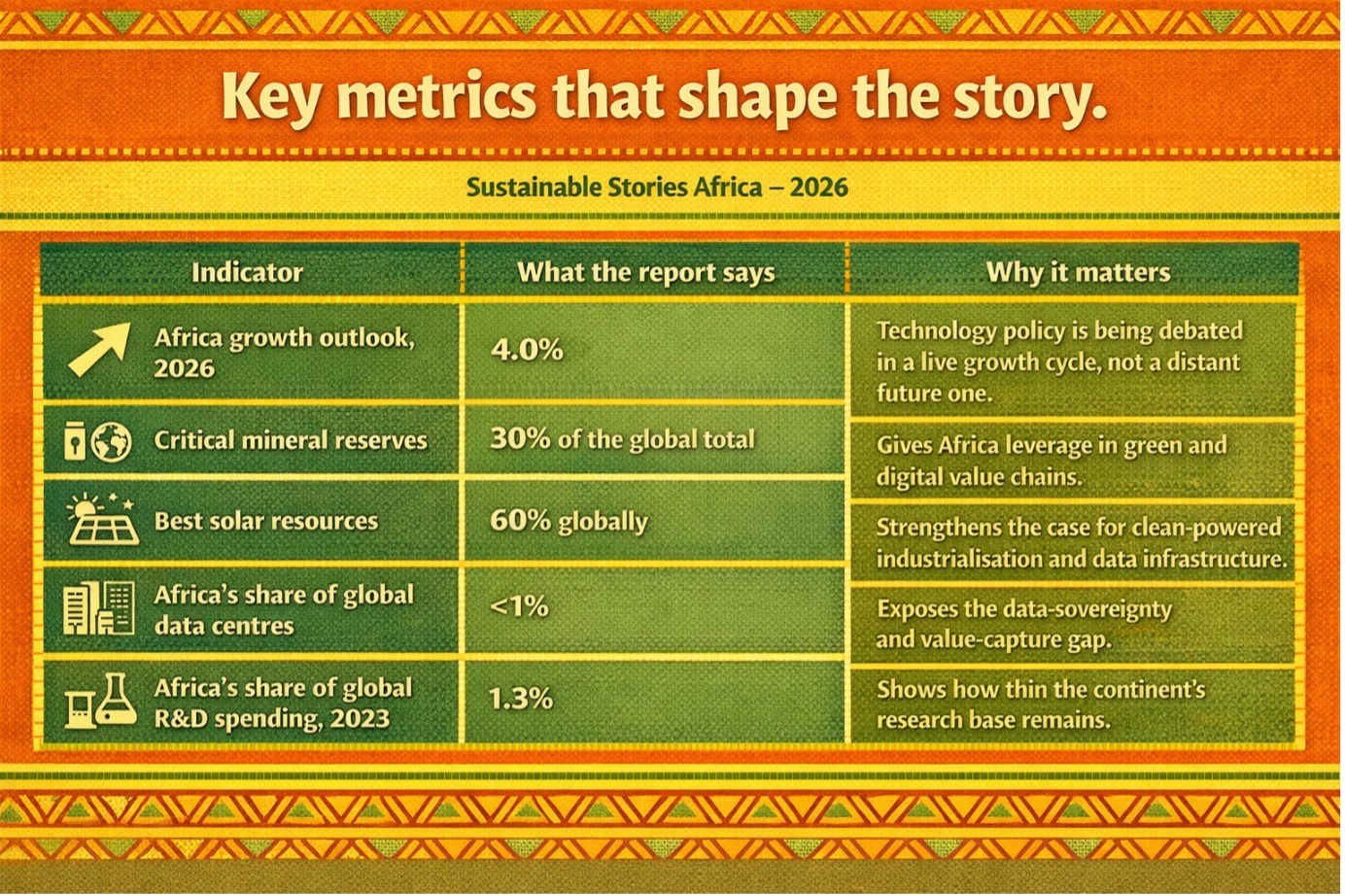
Africa’s opening is significant. The report says the continent holds about 30% of the world’s critical mineral reserves and 60% of its best solar resources, while growth is expected to reach 4.0% in 2026.
However, Africa still hosts less than 1% of global data centres, meaning much of the continent’s data is stored, processed and monetised elsewhere.
That contrast explains why the report’s argument feels urgent. Frontier technologies can help increase efficiency, improve service delivery, support a cleaner industry, deepen trade and create jobs.
However, they do not automatically generate productivity gains. The report stresses that durable gains come when technology adoption is combined with skills development and industrial activity, rather than when countries rely on ICT expansion alone.
Where gains and frictions meet
Chapter 5 is especially useful because it grounds digital theory in African realities. Zanzibar’s Kadi ya Matibabu shows what happens when technology is embedded in public systems: 92% enrolment, 1.6 million residents covered, faster processing and stronger compliance.
Similar lessons emerge from South Africa’s BMW plant, Togo’s land system and Egypt’s e-tax reforms. The message is straightforward: technology succeeds when it is tied to institutions, financing, governance and real user adoption.
However, the chapter avoids techno-optimism. Weaker results in agriculture, transport, e-governance and education show that digital tools can fail when infrastructure, skills, technical support and regulation lag.
The report groups these constraints into six areas.
- Policy
- Finance
- Inclusion
- Market gaps.
Its labour-market warning is equally important. AI may displace 92 million jobs globally and create 170 million, but transition costs will hit hardest in African economies with large informal sectors, weak reskilling systems and limited social protection.
What the upside could unlock
The report is compelling, describing what a better path could produce. Frontier technologies can help operationalise the AfCFTA, improve learning systems, deepen mineral beneficiation, support interest in nuclear and clean energy systems, and build new jobs across logistics, manufacturing, services and digital trade.
It also links these tools to broader SDG and Agenda 2063 outcomes, not merely firm-level efficiency.
This matters for African markets because the upside is not abstract. Better data systems can improve tax collection and service delivery.
- Better logistics and trade platforms can lower friction in regional commerce. Better industrial policy can shift value creation from raw extraction to processing, components and regional supply chains.
- Better energy and digital infrastructure can support both climate resilience and enterprise growth.
The report’s most persuasive insight is that frontier technologies are not a side story to development; they are becoming part of the development model itself.
What African stakeholders must do
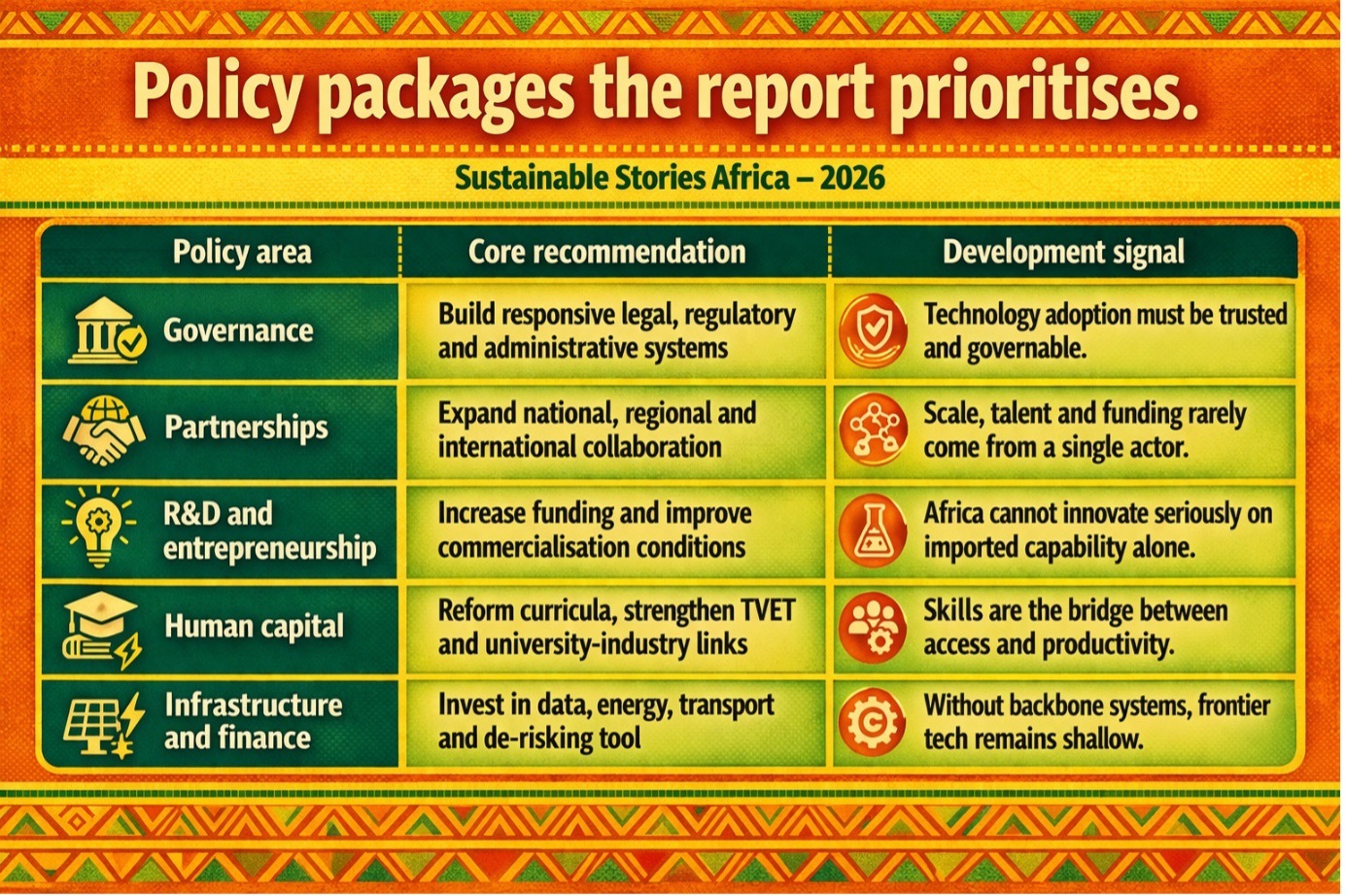
The report’s policy message is firm. Governments should strengthen
- Governance
- Foster partnerships
- Promote R&D and entrepreneurship
- Build inclusive and strategic roadmaps
- Invest in human capital
- Expand hard and soft infrastructure
- Reform the financing environment
- De-risk early-stage investment.
It also argues that policy sequencing matters: countries should not chase digital expansion first and hope ecosystems catch up later.
- For regulators, that means moving faster on rules, coordination and institutional clarity.
- For investors, it means treating power, logistics, cloud capacity, skills and data governance as part of the investment case, not background conditions.
- For businesses, it means embedding technology in operations, supplier development and workforce transition plans.
- For universities and training systems, it means closing the persistent gap between labour-market demand and educational output.
Africa’s frontier-tech moment will not be won by apps alone. It will be won by systems that make adoption productive, inclusive and durable.
Path Forward – Build capability before hype
Africa’s policy priority is becoming clearer: build sovereign data and digital infrastructure, strengthen skills and innovation ecosystems, deepen regional markets through the AfCFTA, and mobilise patient capital for technological transformation.
Those are the foundations the report keeps returning to.
What is being advocated now is not slower ambition, but smarter sequencing. The promise of frontier technologies remains real.
The next step is to ensure that governance, education, infrastructure and finance move with the technology, rather than years behind it.