Carbon pricing is no longer a distant European policy debate. It is becoming a live commercial issue for exporters, suppliers and boards that want to stay in global markets.
The bigger shift is strategic: carbon is moving from sustainability reporting into product costing, pricing, margin planning and supply-chain competitiveness.
A permanent cost enters trade
For African exporters, the European Union’s Carbon Border Adjustment Mechanism is becoming more than a compliance rule. It is emerging as a new commercial discipline, one that links emissions data directly to profitability, customer relationships and long-term access to overseas markets.
That is the central warning in Carbon Cost as a Permanent Business Factor: Navigating CBAM and the New Era of Carbon Pricing in International Trade, a March 2026 briefing that argues businesses should now treat carbon cost as part of the cost of goods sold, not as a side issue for ESG teams.
The message matters sharply for African and emerging-market producers selling into Europe, especially in carbon-intensive sectors where new trade rules can reshape margins, pricing power and supplier rankings.
The issue is no longer whether carbon pricing will influence trade. It is how quickly firms can adapt before compliance becomes a market filter.
Carbon moves into core business
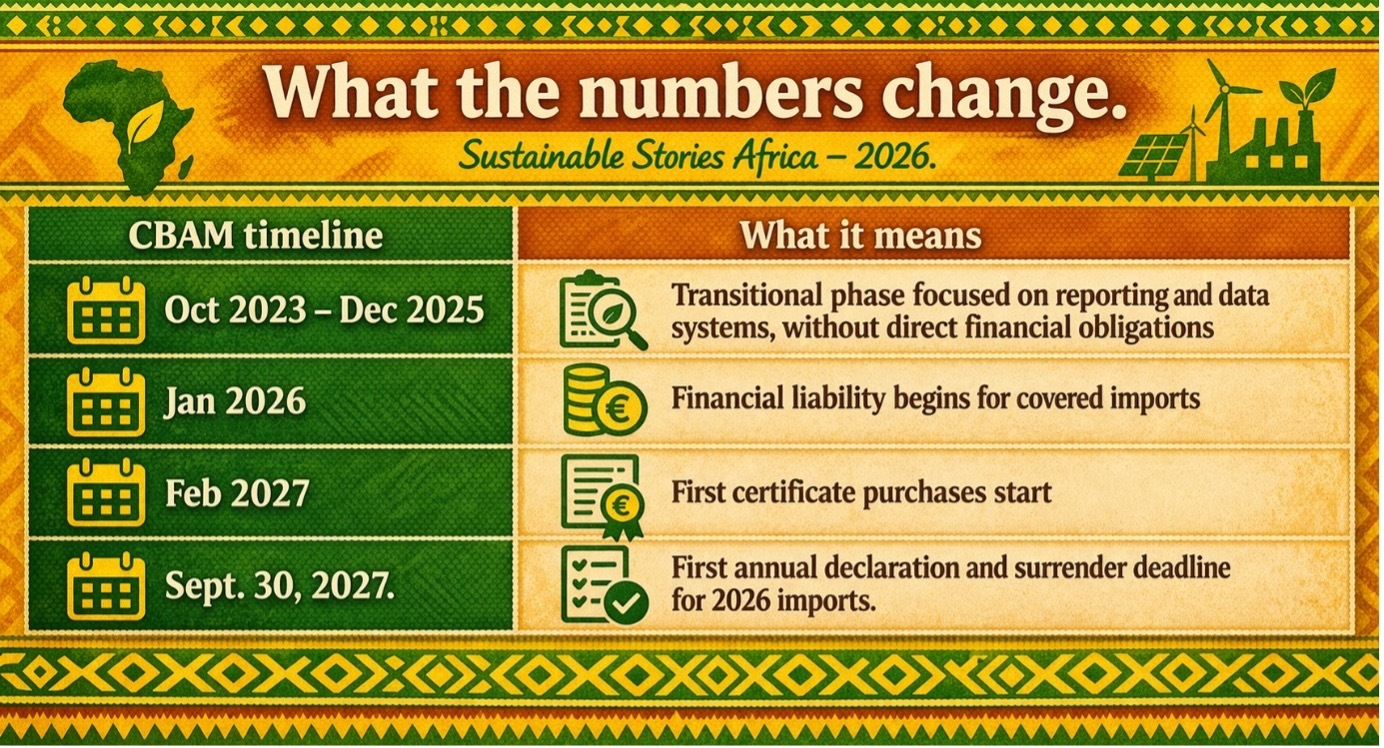
The most important shift is timing. The CBAM transition phase, which ran from October 2023 to December 2025, focused on quarterly emissions reporting and system building, with no direct financial obligation.
That period is over. From January 2026, imports create financial liability, and importers must begin monitoring emissions in preparation for payments.
The first certificate purchases begin in February 2027, while the deadline for the first annual declaration and certificate surrender for 2026 imports is September 30, 2027.
The sectors already in scope are steel, cement, aluminium, fertilizers, electricity and hydrogen. The briefing also flags a critical threshold: importers above 50 tonnes a year must apply for Authorized CBAM Declarant status by March 31, 2026, though electricity and hydrogen are exempt from that threshold and fall under CBAM obligations regardless of import volume.
That makes this a business story, not just a regulatory one. Under the mechanism, EU importers must declare the embedded emissions in their imports and purchase CBAM certificates from national authorities. The certificate price is tied to the EU Emissions
Trading System auction price, using a quarterly average in 2026 and weekly pricing from 2027. Any carbon price already paid in the exporting country can be deducted, but only with proof.
What the numbers change
For many African firms, the real disruption will come from the way carbon cost moves into everyday commercial calculations.
The briefing says businesses should “embed carbon costs into product costing, margin analysis, and profitability models” and treat CBAM as “a permanent cost of goods sold.”
That is a profound change in corporate planning because it pulls sustainability data into finance, procurement and pricing decisions.
It also means companies cannot rely on low-effort compliance. The document warns that using default values rather than verified actual emissions can trigger materially higher carbon costs.
In practice, that puts pressure on exporters to generate assurance-ready evidence packages covering system boundaries, activity data, monitoring methodologies and verification documentation.
Two numbers in the briefing show why boards should pay attention. It says firms should plan for escalating carbon price scenarios of €149 per tonne by 2030 and €400 – €630 per tonne by 2050.
Even where the upper range is uncertain, the strategic direction is clear: carbon exposure is likely to become more financially significant over time, not less.
For exporters in African markets, this creates a familiar but sharper divide: firms with better data, cleaner production and credible verification will look safer and more attractive to international buyers. Firms without that infrastructure could find themselves commercially discounted.
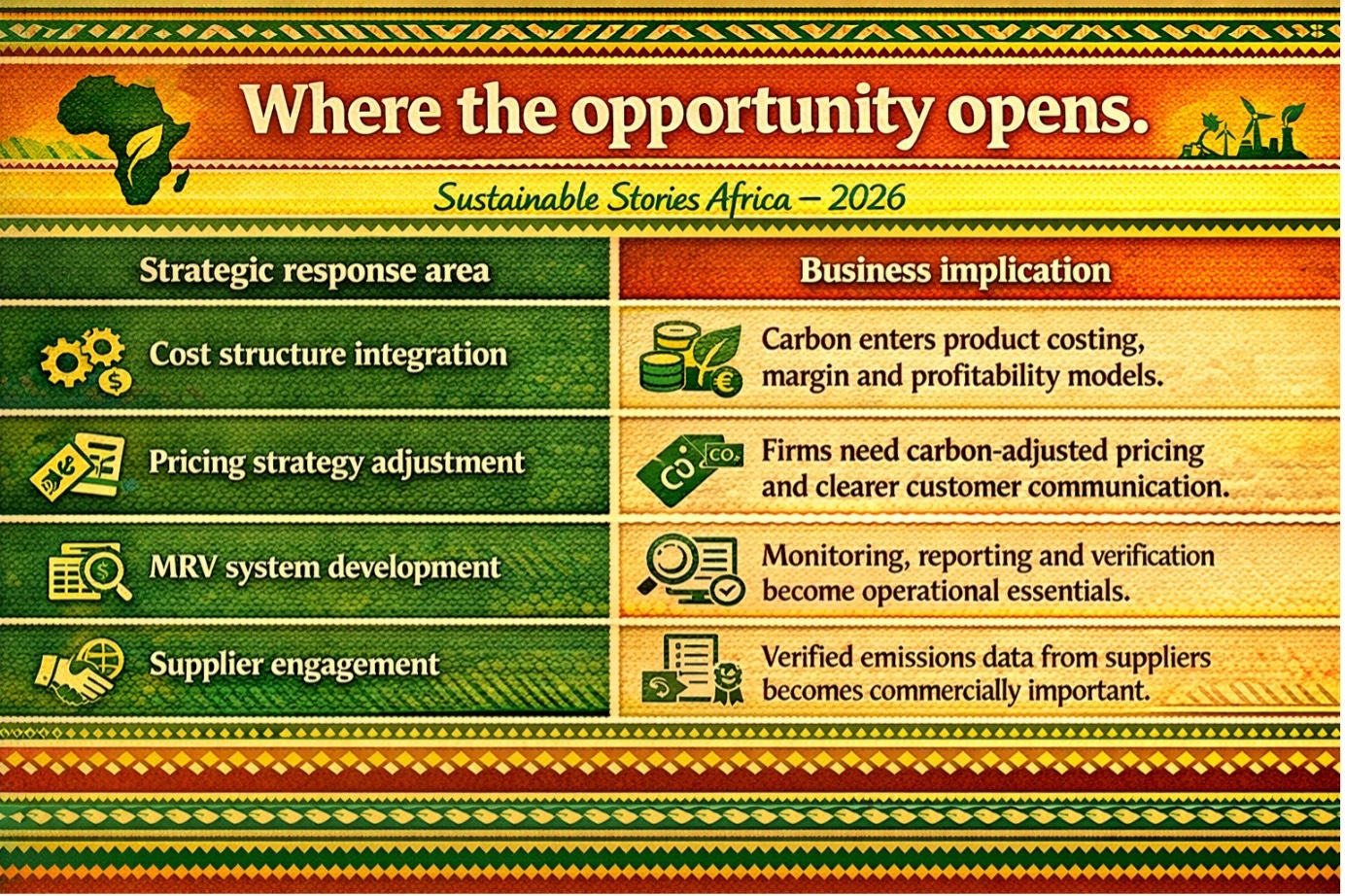
Where the opportunity opens
There is, however, an upside. The briefing argues that suppliers capable of providing verified, low-carbon products will gain preferential status with EU importers because carbon performance is becoming a commercial differentiator.
In other words, better emissions management can support customer retention, pricing conversations and market positioning.
That opportunity is especially relevant for African manufacturers seeking to move up value chains rather than remain stuck in low-information, low-margin export relationships.
A supplier that can provide transparent emissions data, verified methodologies and lower embedded carbon can compete on something more durable than price alone.
For policymakers, financiers and trade advisers, the lesson is equally important: competitiveness in the next phase of trade will depend not only on production volume, but also on emissions visibility.
Build systems before penalties bite
The practical to-do list in the briefing is blunt. Companies should map supply-chain emissions, starting with high-impact suppliers and materials.
They should establish monitoring, reporting and verification systems aligned with CBAM Annex IV and VI requirements, engage suppliers for verified emissions data, and bring in accredited third-party verifiers early to avoid bottlenecks.
For African businesses, that means ESG teams cannot carry this agenda alone. Finance teams need carbon-adjusted models. Procurement teams need supplier data strategies.
Executives need to test how rising carbon prices could reshape margins and capital allocation. Regulators, meanwhile, have a role in helping local firms build MRV capacity and credible carbon-pricing evidence so exporters can prove any carbon cost already paid at home.
This is where the local reality becomes decisive. If African markets want to preserve export competitiveness, they will need stronger emissions accounting systems, better verification ecosystems and more strategic industrial support.
Path Forward – Competitiveness now depends on carbon
Carbon cost is becoming part of trade math, not just ESG language. Exporters that treat it as a permanent business factor will be better positioned to protect margins, satisfy buyers and stay relevant in tightening global markets.
The next phase requires system-building at speed: better MRV, earlier verification, stronger supplier data and policy support that helps firms turn compliance pressure into a competitiveness strategy. Structured in line with the uploaded SSAL news template.