The global economy is becoming more electricity-intensive, and business strategy is shifting with it. Electrification is moving from climate ambition to operational necessity.
That shift matters for African markets because it links power access, affordability, industrial competitiveness and public health in one framework.
The business case is no longer theoretical.
Why the growth model is changing
The most important message in Electric Advantage: The Business Case for an Electrified Economy is simple: the future economy is electric.
The paper argues that electrification is no longer a narrow climate discussion but a whole-economy strategy that can make growth more affordable, secure and competitive.
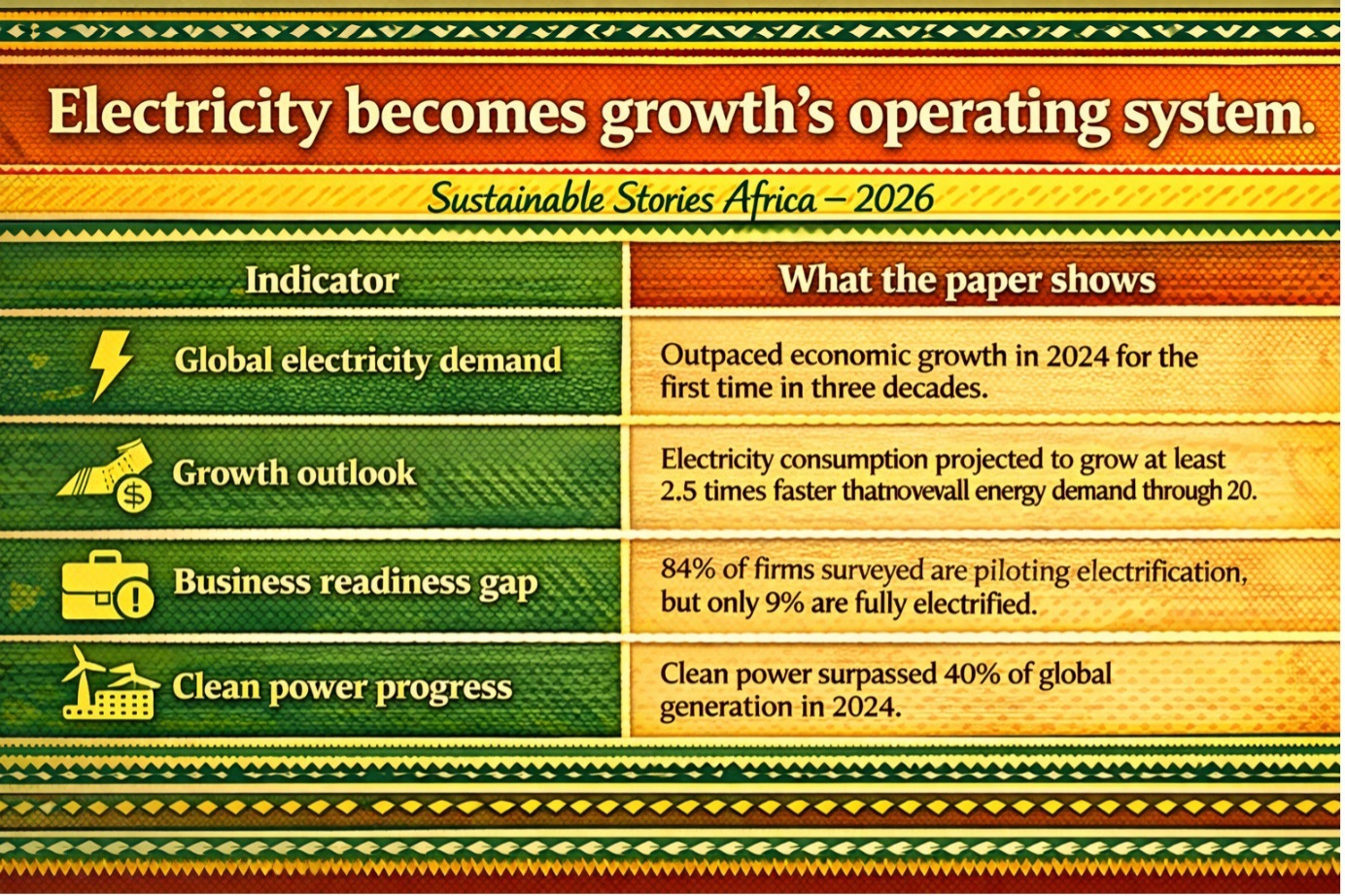
That matters because the macro signals are shifting. In 2024, global electricity demand outpaced economic growth for the first time in three decades, and through 2030 electricity consumption is projected to grow at least 2.5 times faster than overall energy demand.
The implication is structural, not cyclical. More of what now drives value creation, from manufacturing and mobility to buildings and digital services, depends on electricity.
For African and other emerging markets, this is not just a decarbonisation story. It is a development story.
It is about whether economies can expand access, reduce exposure to imported fuel shocks, attract investment and build new industrial capacity without repeating a volatile fossil-fuel-heavy pathway.
That is where the paper’s central argument lands with force: electrification is the mechanism that turns clean power into real economic value.
Electricity becomes growth’s operating system
Electricity is fast emerging as “the operating system on which growth runs,” signalling a deep shift in how economies modernise.
The report argues that electrified technologies, including heat, mobility and industry, can match fossil systems’ output with far less energy, making electrification the most scalable path to both productivity and decarbonisation.
However, ambition is outrunning action. While 84% of surveyed firms are testing electrification solutions, only 9% are fully electrified, a gap now defining industrial competitiveness.
Investors, meanwhile, are prioritising “electrification readiness” when choosing where to commit capital. This readiness depends on affordable clean power, faster grid access, stable tariffs, and clear policy.
Ultimately, advantage will rest not with countries talking net zero, but with those powering growth through reliable, investable electricity.
The economics are becoming harder to ignore
The report argues that electricity is becoming the operating system of growth, built on three pillars: competitiveness, energy security and affordability.
Across all three, electrification is framed as a commercial advantage, not an environmental premium.
The message is clear: countries that align policy, pricing and infrastructure with this shift will be better placed to attract investment and industrial growth.
On affordability, the numbers are striking. In 2024, solar PV was about 41% cheaper and onshore wind 53% cheaper, on average, than the lowest-cost fossil-fuel alternatives.
Utility-scale battery storage costs also fell 93% between 2010 and 2024. The issue is whether tariffs, subsidies and market rules let those savings reach firms and households.
The report is strong on energy security. It notes that 74% of the world’s population lives in net fossil-fuel-importing countries.
Electrification powered by domestic renewables can reduce that exposure, while clean technologies available today could displace 75% of existing fossil-fuel demand. Electric vehicles are two to four times more efficient than internal combustion engines.
It also grounds the case in livelihoods. Electrification could free up 3% to 5% of household income annually, while air pollution causes 6.7 million premature deaths and roughly $6 trillion in economic costs each year.
Crucially, two-thirds of emerging markets, including Vietnam, Brazil and India, already outpace the United States in solar deployment, while a quarter lead in electricity’s share of final energy demand.
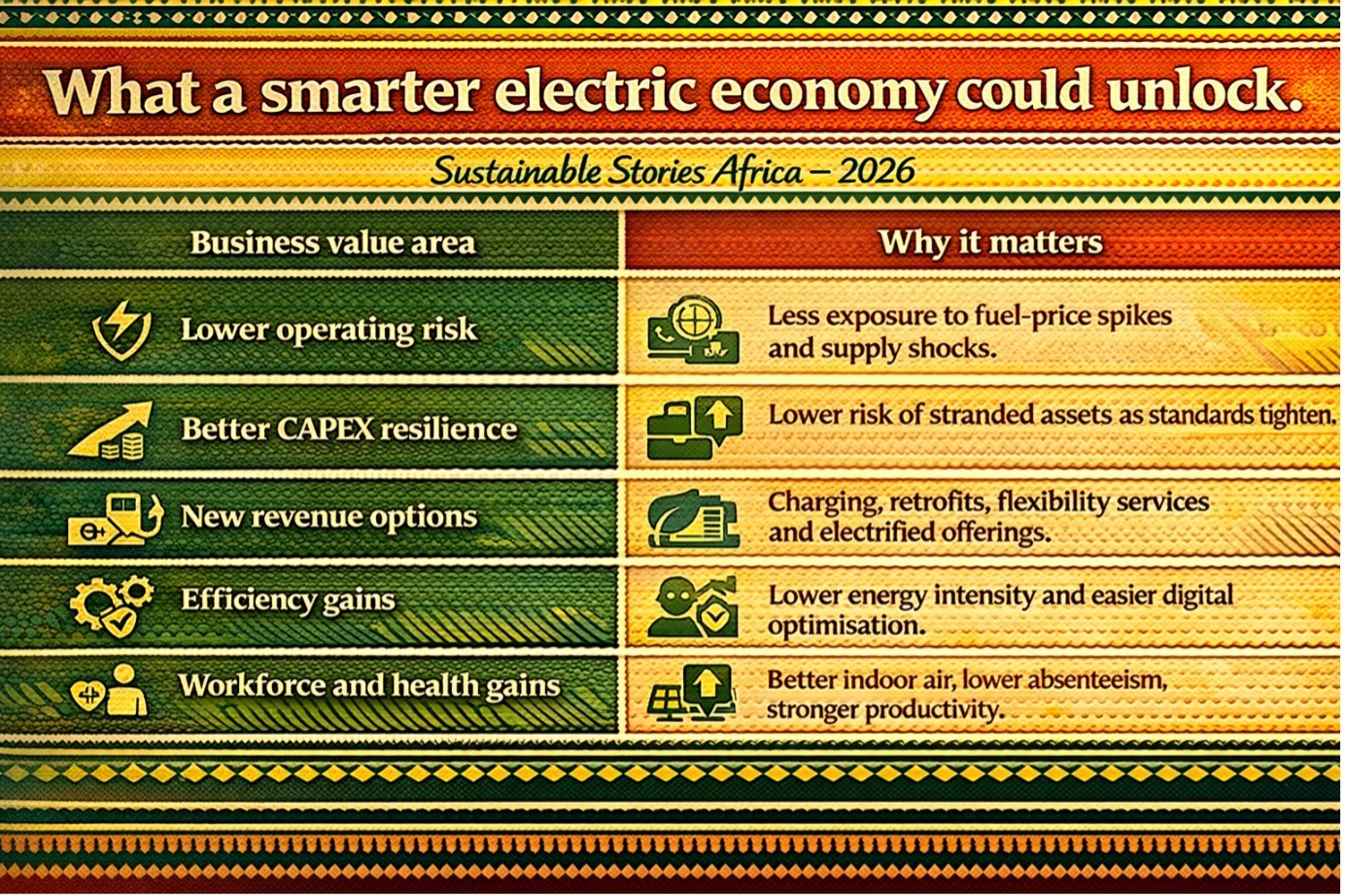
What a smarter electric economy could unlock
The report casts electrification as an upgrade: reliable, affordable power, cleaner transport, more productive industry and digital systems that can scale without disruption.
For business, that means lower fuel-price exposure, more predictable costs, stronger competitiveness and new service markets.
It ties the shift to jobs. The electricity sector is now the largest energy employer, while survey data show three-quarters of firms expect workforce growth.
For African economies, that supports a transition centred on employment, not just technology imports.
SMEs are central to that story. They account for around 90% of businesses, 70% of employment and up to 70% of global GDP, benefiting as adopters and providers through lower running costs and demand for installations, retrofits, maintenance, charging and delivery models.
What governments and firms must fix now
The report is clear: business ambition will not deliver electrification at scale without state action.
- Governments must align rules, incentives and skills, while expanding grids, storage, clean power, permitting and digital infrastructure. As the systems map on page 18 shows, deployment depends on linked enablers, from tariffs and finance to data systems and workforce capacity.
- For business, the message is equally practical. Electrification cannot remain inside sustainability teams; it must shape capital allocation, procurement, site design, fleets, suppliers and product strategy. The report rightly frames it as a portfolio-wide business model shift, not a series of isolated equipment upgrades.
That matters for Africa. Fossil-fuel subsidies hit $ trillion in 2023, and distorted taxes, levies and tariffs can slow adoption even when electric options are cheaper over their lifetime.
The same applies to AI infrastructure: data-centre demand could reach 945TW by 2030, nearly of global electricity use, making planning critical for local grids, prices and clean investment outcomes across markets.
Path Forward – Build readiness, then scale
The case for electrification is becoming economic before it becomes ideological.
Markets that can turn abundant clean electricity into cheaper mobility, cleaner industry and healthier homes will have a stronger claim on future investment and productivity.
The next step is readiness: better grids, fairer tariffs, clearer policy, stronger skills and business strategies that treat electrification as core infrastructure for growth.
The uploaded standard news prompt was used as the structural guide for this article.