
Financial services firms are rethinking how sustainability reporting is organised, governed and delivered.
The question is no longer whether disclosure matters, but whether reporting models are robust enough for a more regulated, data-heavy and politically contested era.
That matters for African markets because banks, insurers and asset managers are under similar pressure to prove credibility, control data, and connect sustainability disclosures to strategy, risk and commercial relevance.
Why Reporting Models Are Being Rebuilt
The future of sustainability reporting in financial services is looking less like a side function and more like core institutional infrastructure.
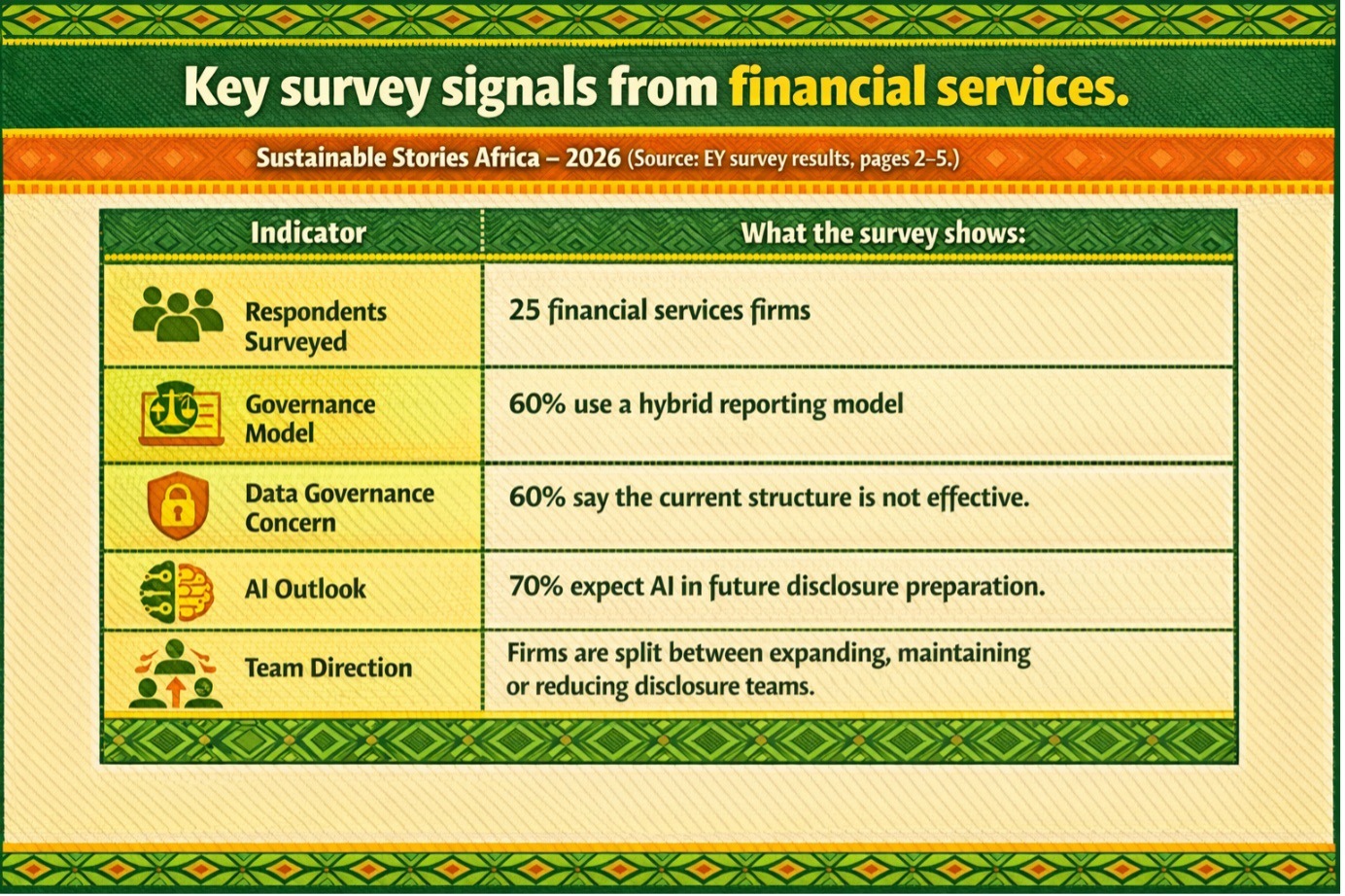
An EY survey of 25 financial services firms finds that banks, insurers and asset managers are redesigning their operating models as regulatory change, data governance pressures, artificial intelligence and commercial strategy begin to converge.
That shift is important because it marks a move away from sustainability reporting as a specialist exercise managed at the margins.
Instead, reporting responsibilities are moving deeper into finance, risk and compliance, while boards and management teams reconsider who owns disclosure, who controls the data, and how reporting should support both credibility and competitiveness.
For African and other emerging markets, the signal is clear. The institutions that treat sustainability reporting as operating architecture rather than corporate narrative are likely to be better prepared for tougher assurance demands, greater anti-greenwashing scrutiny and more demanding investors.
Disclosure Moves Into The Core
A striking finding in the survey is that 60% of respondents operate a hybrid reporting model, in which central governance exists but local units retain autonomy over local reporting execution.
On page 3, the survey shows that no single governance model has become dominant, but the broad direction is clear: firms are balancing group-level oversight with local accountability.
Just as important, reporting preparation is moving away from sustainability specialists and into business-as-usual functions such as finance, risk and compliance.
The chart on page 3 discloses responsibilities, reinforcing that shift. Finance appears especially prominent for environmental disclosures, investment functions stand out in product-related disclosures, and sustainability teams remain involved but no longer appear to be acting alone across all categories.
That change matters now because sustainability reporting is becoming harder to separate from broader corporate control systems.
If disclosures influence capital allocation, reputational risk, product positioning and supervisory scrutiny, then they cannot sit outside the firm’s mainstream governance machinery.
Five Forces Are Reshaping Reporting
EY’s survey shows sustainability reporting in financial services is no longer a fixed compliance task.
Five forces are reshaping this narrative:
- Shifting sustainability priorities
- Regulatory flux
- Budget pressure
- Differing levels of ambition
- Market expectation, and rising commercialisation.
Together, they point to a reporting model increasingly shaped by politics, markets, technology and cost discipline.
The regulatory backdrop is central. The survey says the EU Omnibus Simplification Package, the rise of AI and a tougher political climate have left firms uncertain about what comes next.
However, that uncertainty is not reducing reporting pressure. Instead, it is pushing firms to build systems that can absorb revisions, withstand scrutiny and adapt quickly.
The staffing model is shifting. Some firms expect sustainability disclosure teams to grow as reporting becomes a commercial opportunity, while others are holding headcount flat or cutting it through data and technology efficiencies.
Over time, demand will centre on regulation, stakeholder management, finance, audit, project delivery, analytics and AI capability.
The sharper warning lies in governance. While 60% of respondents say their sustainability data governance is not effective, 70% expect AI to support future disclosure preparation.
That contrast is telling: automation may help, but weak controls, poor-quality data and fragile internal systems still threaten credibility and limit technology’s promise today.
For African institutions, this resonates beyond Europe or the UK. Many banks and insurers across the continent are already navigating overlapping expectations from investors, domestic regulators, development finance institutions and international reporting frameworks.
The challenge is not only producing sustainability reports, but building reporting systems that can be trusted.
Better Models Can Do More
Better sustainability reporting models can do more than improve disclosure. EY’s survey suggests that they can sharpen decision-making, reduce reputational risk, strengthen client trust and support innovation, as firms increasingly view sustainability as a source of commercial value.
That matters in African markets, where financial institutions sit at the centre of climate finance, green lending and transition planning.
Stronger reporting can help banks understand financed-risk exposures, insurers track climate vulnerabilities, and asset managers back stewardship claims with stronger evidence.
In each case, better systems help move institutions from aspiration to defensible practice.
The survey shows specialist expertise matters. As sustainability moves into the core, firms will need specialists to guide strategy and prepare for issues such as nature and human rights.
Build Reporting Like Infrastructure
The operational message is straightforward. Financial institutions need to treat sustainability reporting as infrastructure, not as an annual publication process.
That means clarifying governance, assigning ownership, strengthening controls, upgrading data systems and building teams that combine regulatory literacy with financial, technological and assurance capabilities.
The survey points to several pragmatic shifts.
- First, firms need governance models that balance central standards with local execution.
- Second, they need stronger data governance, especially where multiple data sources feed disclosure.
- Third, AI should be deployed with AI-specific governance and risk processes, not as a shortcut around weak controls.
- Fourth, firms need to decide whether sustainability is only a compliance obligation or also a business opportunity, because that decision will shape staffing, technology and ambition.
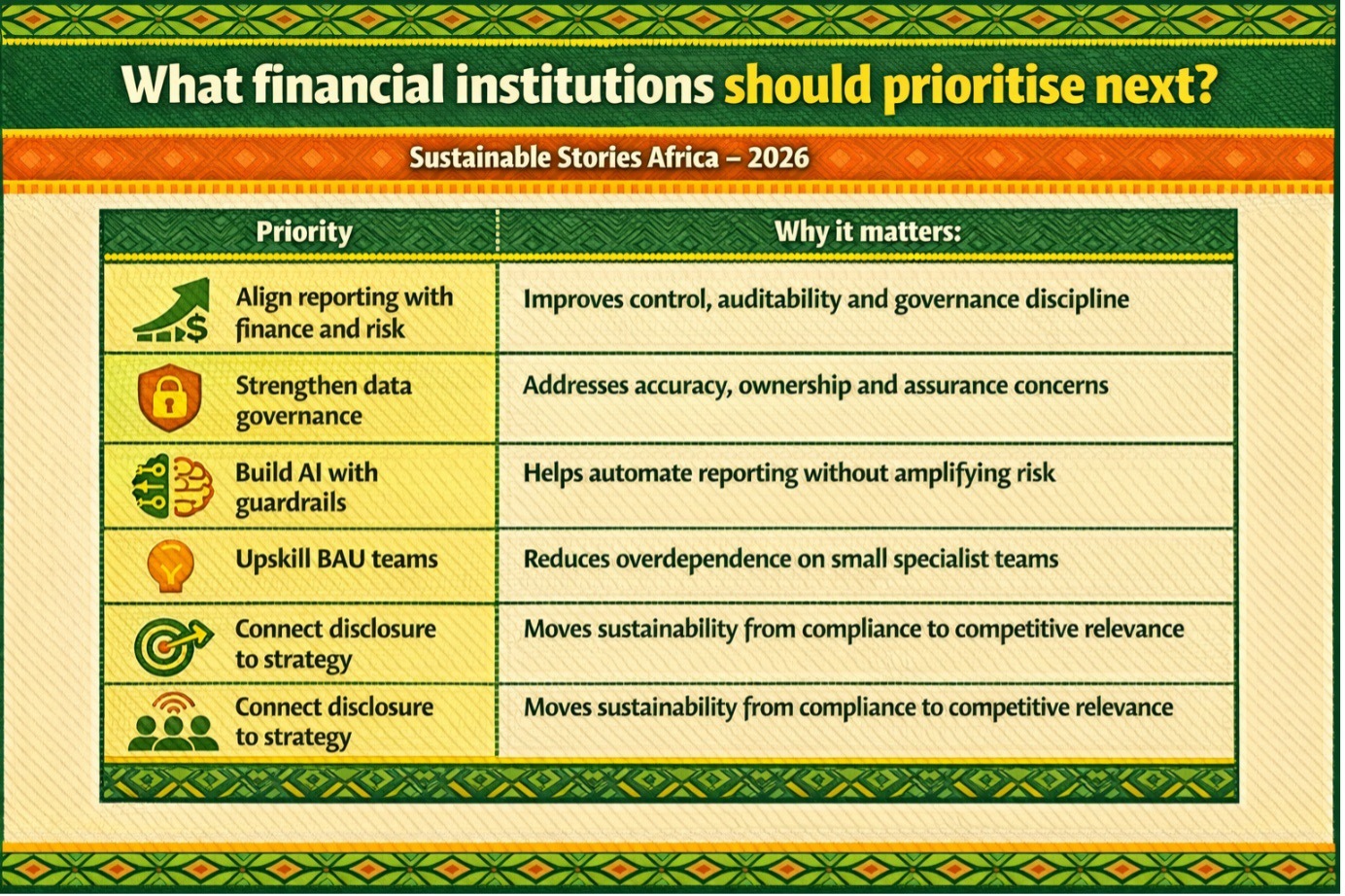
These priorities are strongly implied by the survey’s findings on governance, team design, technology and commercialisation.
For regulators and market institutions in Africa, the lesson is equally practical. They should encourage disclosure systems that are credible, phased and decision-useful, while recognising that institutions need time, skills and infrastructure to meet higher standards well.
Path Forward – Control, Credibility, Commercial Relevance
Financial institutions are entering a phase in which sustainability reporting must work like a control function, not just a communications exercise.
The institutions that build stronger governance, better data and clearer accountability will be better placed to withstand scrutiny and capture opportunity.
For African markets, the priority is to future-proof reporting models now: embed disclosures into finance and risk, strengthen data governance, use AI carefully, and connect sustainability reporting to strategy, trust and long-term value.