
FINPOLNOMICS 9 / LEADERSHIP & GOVERNANCE
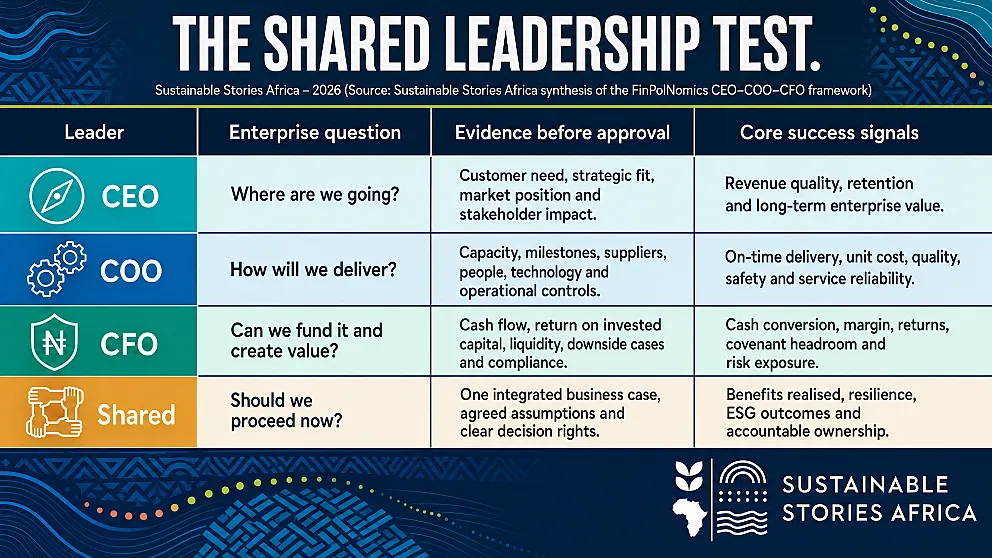
FinPolNomics presents a simple leadership equation: the CEO chooses the destination, the COO builds the route, and the CFO ensures the journey can be funded.
In African markets shaped by expensive capital, infrastructure gaps and rising complexity, that alignment is no boardroom nicety.
It is the operating discipline that separates scalable growth from costly ambition.
Growth Demands More Than A Vision
A strategy can look convincing in a board presentation and still fail at the factory gate, the service counter or the company’s bank account. FinPolNomics’ CEO–COO–CFO framework reduces that risk to three linked questions:
- Where are we going?
- How will we deliver?
- Can we afford it
- Will it create value?
The questions are universal, but their urgency is sharper in African and other emerging markets. Companies must often absorb currency swings, costly credit, infrastructure gaps, policy changes, and fragile supply chains.
The World Bank expects Sub-Saharan Africa to grow by 4.1% in 2026, yet warns that tighter financial conditions, debt pressures and structural constraints continue to weigh on investment and job creation.
That tension makes leadership alignment a development issue as well as a governance issue. When direction, delivery and finance move together, firms can turn scarce capital into reliable products, stronger jobs and credible returns.
When they separate, employees, suppliers, customers and communities inherit the cost of decisions that looked coherent only at the top.
Half Of Projects Still Miss Full Value
The strategy–execution gap is not an abstract management problem.
Project Management Institute research published in 2025 found that only half of projects met its modern definition of success:
- Creating value greater than the effort and expense involved, as judged by key stakeholders.
- 13% failed outright and 37% delivered only part of the expected result.
In PMI’s 2026 work, 97% of professionals reported managing at least one complex project, while nearly one in three complex projects failed.
Those numbers describe what leadership misalignment feels like below the executive floor.
- A CEO announces a new market before licences and distribution are ready.
- Operations accelerates output without understanding the cash tied up in inventory.
- Finance cuts spending that protects quality, customer trust or long-term capacity because the strategic reason was never made explicit.
Each leader may be acting rationally within a narrow mandate; the enterprise still loses.
FinPolNomics therefore treats the CEO, COO and CFO as one decision system, not three adjacent job descriptions.
- The CEO supplies strategic intent
- The COO turns intent into an operating model
- The CFO converts both into a funded, risk-adjusted value case.
Collaboration is the control that keeps ambition from outrunning capability or capital.
Three Leaders, One Enterprise Value Chain
A hypothetical Lagos consumer-goods company eyeing two neighbouring markets illustrates why expansion decisions demand three perspectives.
- The CEO sees demand and brand fit
- The COO sees logistics and staffing
- The CFO sees forex exposure and returns.
Alone, none is sufficient; together, they form the investment case.
The CEO's role is to define the customer problem, defensible advantage and non-negotiable outcomes. "Enter West Africa" is an aspiration, not a strategy; a real mandate specifies timing, fit, risk appetite and measurable value.
The COO's role is conversion: turning strategy into capacity, supplier agreements and customer experience. In constrained environments, redundancy, such as backup power and alternative logistics, can be rational, provided it's costed upfront, not bolted on after disruption.
The CFO's role is disciplined possibility: revealing viable cash, return and downside conditions, testing shocks, protecting liquidity, and linking ESG commitments to budgets and capital allocation.
Alignment Converts Ambition Into Durable Value
The payoff extends beyond smoother meetings. Aligned leadership sharpens the quality and speed of trade-offs, including phasing expansion, leasing equipment, redesigning products, hedging exposure or pausing capital.
When strategic, operational and financial assumptions sit in one view, bad news travels faster, and corrective action starts earlier.
- For citizens, this discipline means fewer abrupt closures and more dependable jobs.
- For suppliers, it means realistic volumes and payment terms.
- For investors, it means evidence that management understands how growth becomes cash.
These benefits matter in a region where IFC estimates Sub-Saharan Africa's formal MSME funding gap at roughly $331 billion, including about $32.2 billion in unmet demand in Nigeria.
Alignment also strengthens sustainability.
A CEO's net-zero or inclusion ambition requires the COO to redesign processes and the CFO to fund and measure results, turning ESG from promise into operating discipline. Delay risks stranded initiatives and eroded trust.
Boards Must Build A Shared Rhythm
- Boards should first require an integrated decision memo for every material initiative, covering the strategic case, operating model, funding, expected return, ESG effects, principal risks, accountable owner and exit conditions, creating a single version of the truth before capital is committed.
- Leadership teams need a shared dashboard. Revenue growth without margin can mask value leakage; profit without cash flow can conceal stress. A balanced set may include revenue quality, gross margin, cash conversion, return on invested capital, delivery reliability, customer retention, safety, emissions intensity and employee turnover, each with an owner, baseline, target and intervention trigger.
- Companies should run weekly operating reviews, monthly performance and cash reviews, and quarterly strategy and capital reviews, since different decisions move at different speeds.
- Decision rights and incentives must reinforce the enterprise, not silos.
- The CEO should not commit before finance tests assumptions;
- The COO should challenge timelines;
- The CFO should challenge evidence without blocking growth.
Variable pay should span growth, cash, customer, people and sustainability outcomes.
- Leaders should jointly stress-test shocks, including currency, rates, energy, suppliers, regulation, demand and climate, identifying warning signals, cash effects and decision owners.
PATH FORWARD – Align Vision, Delivery, and Financial Discipline
African businesses do not need smaller ambitions; they need ambitions translated into operating capacity, cash discipline and measurable stakeholder value.
Boards should institutionalise one business case, one dashboard and one decision rhythm across the CEO, COO and CFO.
The test is practical: can the organisation explain where it is going, how it will deliver and why the investment remains viable under pressure? When all three answers agree, sustainable growth becomes more than a promise; it becomes governable.