Nigeria’s reforms improved growth, inflation and reserves in 2025, but household welfare and public investment remain under pressure.
The African Development Bank estimates annual financing needs of $47.6 billion to accelerate progress toward the Sustainable Development Goals, leaving a $31.5 billion gap that conventional public finance cannot close alone.
Stability Improves, but Welfare Pressures Persist
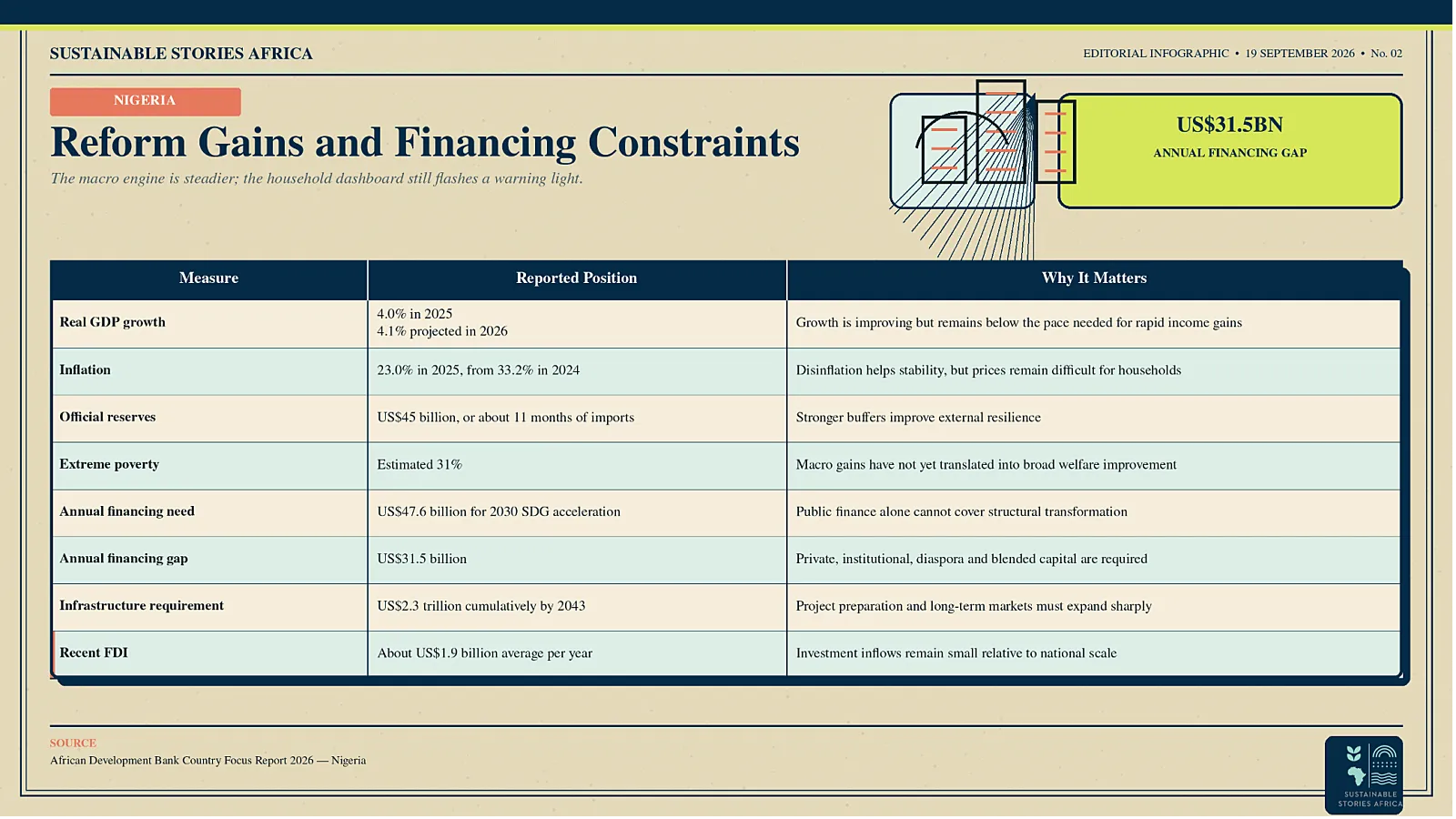
Nigeria recorded 4.0% real GDP growth in 2025 as services, oil and gas, agriculture, trade and real estate responded to a more stable macroeconomic environment.
According to the African Development Bank Country Focus Report 2026, inflation fell to 23.0% from 33.2% in 2024, while gross official reserves reached $45 billion in December 2025, equivalent to about 11 months of imports.
Those improvements matter after a period of exchange-rate disruption, subsidy reform and sharp increases in living costs.
However, real GDP per capita growth slowed to 1.9%, and extreme poverty remained at an estimated 31%.
The reform story is therefore split between better national indicators and households still absorbing expensive food, transport and essential services.
Nigeria’s next phase depends on whether stability can support investment at scale.
- The country needs capital for power, transport, industry, agriculture, housing, skills and climate resilience.
- Public budgets are too constrained to carry the load, while private investment requires credible policy, investable projects and risk-sharing structures.
Reforms Reset Key Macroeconomic Indicators Rapidly
The 2026 outlook is positive but measured.
- The African Development Bank projects growth of 4.1% in 2026 and 3.7% in 2027, led by services, agriculture, oil and gas, and public and private investment.
- Inflation should continue to ease, although it is expected to remain in double digits because fuel and food prices are still elevated.
Fiscal pressure has not disappeared.
- The federal fiscal deficit widened to an estimated 2.4% of GDP in 2025 from 1.5% in 2024, even as revenue increased to 13.5% of GDP from 10.8%.
- Debt-service obligations and other spending needs absorbed much of the gain.
This limits the amount available for capital projects and social protection.
Financing Needs Outrun Available Long-Term Capital
Annual financing needs are estimated at $47.6 billion to accelerate progress toward the 2030 Sustainable Development Goals.
The corresponding annual gap is $31.5 billion.
- For the African Union’s Agenda 2063 objectives, the report estimates annual needs of $8.3 billion and a $5.5 billion gap.
- Separately, raising infrastructure to 70% of GDP by 2043 could require $2.3 trillion cumulatively.
Capital inflows remain small compared with the requirement.
- Foreign direct investment averaged about $1.9 billion a year over the five years reviewed.
- Weak project pipelines, security concerns, policy uncertainty, limited long-term credit and infrastructure bottlenecks reduce the number of opportunities that can absorb institutional capital at acceptable risk.
Reforms have started to improve the base.
- Tax measures, fuel-subsidy removal, foreign-exchange liberalisation, bank recapitalisation, market reforms and stronger inter-agency coordination can support investment.
Their value, however, depends on consistent implementation and safeguards that prevent fiscal adjustment from eroding productive capacity or social stability.
The Right Capital Mix Could Deepen Growth
Nigeria has large pools of domestic and diaspora capital that can be mobilised more productively.
- Pension and insurance assets could support infrastructure through well-governed vehicles with transparent cash flows.
- Green bonds and blended finance can direct capital toward renewable energy, resilient transport and water systems.
- Diaspora instruments can convert remittances into optional long-term investment without compromising household support.
Natural capital also offers financing opportunities, but only where valuation, ownership and benefit-sharing are credible.
- Carbon, forestry and ecosystem-linked finance must not become off-budget borrowing or a transfer of community rights.
- Transparent registries, environmental integrity and local participation are essential to preserve value.
Regional integration can improve the capital pool and scale of projects.
- Common market standards, payment links and cross-border infrastructure can make investments more attractive than isolated national transactions.
- Nigeria’s size provides a strong anchor, but regulatory consistency is needed so investors can distinguish commercial risk from policy risk and price both transparently.
Tax Markets and Institutions Must Move Together
Federal and subnational governments should widen the tax base, reduce leakages and simplify compliance while protecting smaller firms from arbitrary enforcement.
- Revenue gains need a visible link to service delivery.
- Better procurement, e-payment coverage and public investment management would improve the credibility of that link.
Capital-market regulators and government should expand reliable long-term instruments, strengthen disclosure and create standard structures for infrastructure and municipal finance.
- Public-private partnerships need stronger project preparation, realistic demand assumptions and full reporting of contingent liabilities.
The welfare side of reform also requires attention.
- Targeted cash support, food-system investment, transport efficiency and skills programmes can protect households and raise productivity while macroeconomic adjustments mature.
- Stability will remain politically and economically fragile if it is not accompanied by visible gains in jobs, incomes and essential services.
Measurement should connect financing to results.
- Public reports can track project completion, power availability, travel time, learning, health access, firm credit and jobs alongside the amount raised.
That approach reduces the risk that innovative instruments become a substitute for execution and helps citizens judge whether higher revenue and new liabilities are improving public value.
Path Forward – A Reform Dividend Built on Delivery
Nigeria’s reform dividend will depend on delivery, not announcements.
Lower inflation, predictable foreign exchange and stronger revenue must translate into investable projects, reliable services and falling poverty.
The practical test is whether government can crowd in long-term capital without hiding fiscal risks.
Transparent instruments, credible institutions and household protection bridge the gap between stability and inclusive growth.