Botswana's diamond downturn has turned a familiar diversification debate into an immediate financing problem.
The economy contracted in 2025 while fiscal and external buffers weakened.
The AfDB estimates a $6.2 billion development financing gap.
Closing it will require stronger revenue systems, better project preparation and a clearer route from domestic savings to productive investment.
Financing Choices Now Shape Botswana's Recovery
Botswana entered 2026 with a financing challenge that reaches beyond a normal commodity cycle.
- The global diamond slowdown reduced export earnings, weakened public revenue and exposed the limits of an economic model that still relies heavily on one mineral.
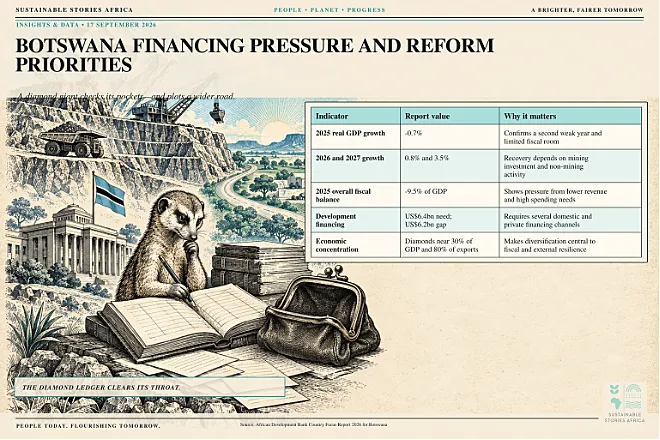
The African Development Bank's 2026 Country Focus Report says real gross domestic product contracted by 0.7% in 2025 after a 2.8% decline in 2024.
The immediate outlook is subdued.
- Growth is projected at 0.8% in 2026 and 3.5% in 2027, supported by renewed mining investment and activity in services.
- Inflation is expected to rise to 6.7% in 2026 before easing to 5.1% in 2027.
These numbers describe a possible recovery, but they also show how little room Botswana has for delayed reform.
The central question is how the country can fund diversification as mineral revenue falls and global capital is more selective.
The report's answer combines domestic revenue reform, more efficient public spending, deeper capital markets and investment structures that can convert Botswana's institutional savings into productive assets.
Diamond Weakness Exposes Botswana's Development Financing Vulnerability
Diamonds account for about 30% of Botswana's GDP and nearly 80% of export earnings.
- That concentration magnified the effect of weaker demand for natural stones, competition from lower-priced laboratory-grown diamonds and reduced production
- In the year to September 2025, mining contracted by 10.7% and diamond output fell by 11.4%, while non-mining sectors grew by 2.6%.
The shock quickly spread through the public accounts.
- The overall fiscal deficit, including grants, was estimated at 9.5% of GDP in 2025 and is projected to remain high at 9.1% in 2026.
- Lower mineral receipts, strong expenditure pressure and rising debt have narrowed the government's capacity to fund infrastructure, services and social protection at the same time.
This matters as much to households as to the treasury.
- Slow job creation, youth unemployment, inequality and pressure on public services make diversification a social priority.
A financing strategy that merely replaces lost diamond revenue with additional debt would postpone the adjustment and increase exposure to external borrowing costs.
A Large Gap Meets Narrow Revenues
The report estimates Botswana's development financing needs at $6.4 billion, compared with average financing flows of about $217.2 million during 2021 - 2025.
- The resulting gap is put at roughly US$6.2 billion. The scale makes clear that no single tax measure, bond or public-private partnership can close it.
Its narrow tax base and the cyclical nature of mineral receipts constrain domestic revenue.
- Value-added tax carries much of the burden, while exemptions, informality, transfer-pricing risks and administrative gaps reduce collection.
The report therefore gives priority to digital tax administration, e-filing, e-invoicing, stronger audit capacity and better management of large taxpayers rather than broad rate increases that could suppress demand.
Spending quality is the other side of the financing equation.
- Stronger project appraisal, procurement and monitoring can direct scarce public resources towards investments with clearer economic and social returns.
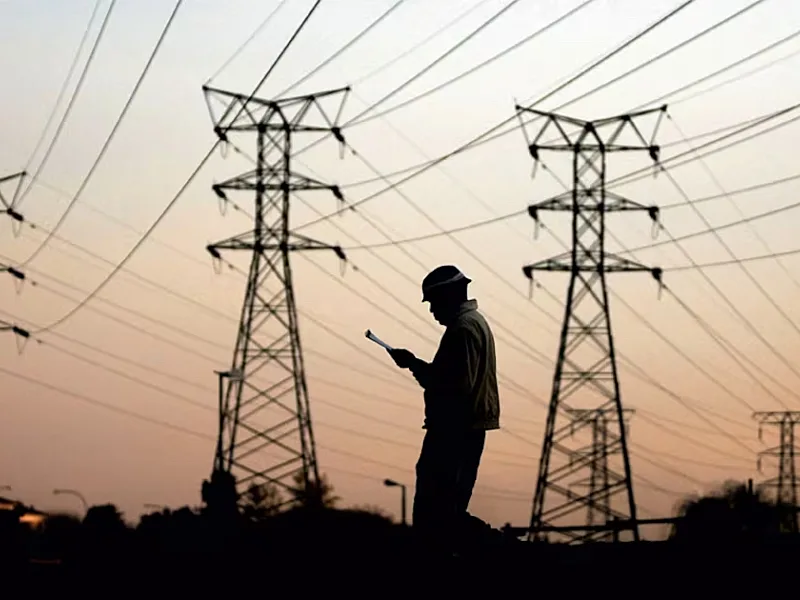
- This is especially important in energy, logistics, water, digital infrastructure and skills, where weak delivery can hold back both private investment and export competitiveness.
Revenue reform also has a governance dimension.
- Wider compliance will be difficult to sustain if households and firms see exemptions for connected interests or cannot connect taxes with reliable services.
- Publishing tax expenditures, procurement results and project performance would strengthen the fiscal social contract and make difficult choices easier to scrutinise.
Domestic Capital Can Finance Diversification Better
Botswana is not short of financial assets.
- Pension funds, insurance institutions, bank deposits and the Pula Fund provide a substantial pool of domestic savings.
- The problem is that conservative mandates, a limited supply of bankable projects and shallow capital markets send a large share of institutional assets offshore instead of into domestic infrastructure, enterprises and climate-resilient investment.
A stronger project pipeline would change that calculation.
- Standardised public-private partnership rules, credible feasibility studies, transparent tariffs and selective guarantees can reduce uncertainty without transferring excessive risk to the state.
- Infrastructure and green bonds could then give institutional investors longer-term assets that match their liabilities while financing renewable energy, transport and water systems.
Public-private partnerships require ambition and restraint.
- Guarantees, availability payments and foreign-currency commitments can create liabilities that emerge years after a project is approved.
Botswana should disclose those exposures, test them against adverse scenarios and select partnerships only when they offer better value than conventional public procurement.
Diversification can also build on assets Botswana already has.
- Mineral beneficiation, tourism, agribusiness, renewable energy and digital services offer routes into regional value chains.
- Natural capital accounting and credible environmental governance could support access to carbon markets, biodiversity-linked funding and other forms of climate finance, provided the projects meet traceability and disclosure standards.
Reforms Must Connect Savings With Projects
In the short term, authorities can protect stability by improving debt management, reducing inefficient tax exemptions and expanding compliance systems.
- Better expenditure controls should accompany revenue measures so citizens and investors can see how additional resources translate into services and productive assets.
The medium-term task is to connect institutional savings with investable projects.
- That requires a project-preparation facility, clearer investment guidance for pension and insurance funds, deeper local-currency bond markets and stronger credit information.
- Partial guarantees and blended finance should be used only where they correct an identifiable market failure and remain transparent in the public accounts.
Regional integration can improve the economics of those projects.
- Links to Southern African transport, power and payments networks can expand market size and reduce transaction costs.
- Common standards and stronger traceability would also help Botswana meet investor requirements in minerals, energy and data-intensive services without creating a separate compliance system for every market.
Over the longer term, Botswana needs a financial system that supports firms outside mining. Interoperable payments, stronger disclosure, regional market integration and better access to finance for small and medium-sized enterprises can broaden participation.
The test of reform is not the number of new instruments launched, but whether capital reaches sectors that create jobs, exports and resilience.
The Path Forward Requires Sequenced Reform
Botswana should first protect fiscal credibility through digital revenue collection, better spending controls and disciplined debt management. It should then build bankable projects and local-currency instruments that allow pension and insurance assets to finance infrastructure and enterprise growth.
Longer-term resilience depends on value addition, export diversification and credible environmental governance.
Success will be measured by capital reaching productive sectors, creating jobs and reducing the economy's exposure to a single commodity cycle.