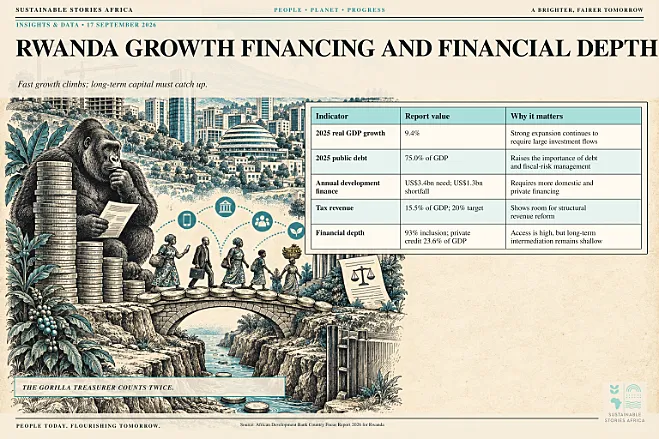
Rwanda grew by an estimated 9.4% in 2025, but debt, debt service and external deficits are placing more pressure on its investment-led development model.
Annual development needs are estimated at $3.4 billion, with a $1.3 billion shortfall.
A deeper domestic financial system must now support declining grants and costlier borrowing.
Fast Growth Carries A Rising Financing Cost
Rwanda's economy grew by an estimated 9.4% in 2025, supported by services, industry and agriculture. Inflation rose to 7.2%, prompting the National Bank of Rwanda to raise its policy rate to 6.75%.
The fiscal deficit narrowed to 5.5% of GDP, but public debt climbed to 75.0%, and the current account deficit widened to 13.1% as investment-related imports increased.
The African Development Bank's 2026 Country Focus Report projects growth of 7.0% in 2026 and 7.4% in 2027.
- That pace remains strong by regional standards, although political conflict in the Middle East, regional insecurity and tighter financial conditions could weaken trade, tourism, prices and access to capital.
Rwanda's challenge therefore is not whether to keep investing.
- Infrastructure, social services, climate resilience and digital transformation remain essential.
The challenge is to finance them without letting debt service, external deficits or expensive borrowing narrow future policy choices.
Rwanda's Growth Model Faces A Funding Test
The country needs about $3.4 billion a year during the 2024 - 2029 Second National Strategy for Transformation period.
- The report identifies roughly $1.5 billion for infrastructure, $0.8 billion for social services, $0.6 billion for climate adaptation and resilience, and $0.5 billion for governance and digital transformation.
Available public and private inflows are about $2.1 billion, leaving an annual shortfall of approximately $1.3 billion.
- Grants have declined to 3.1% of GDP, while borrowing is shifting towards less concessional terms.
- Debt service now absorbs 18% of revenue, increasing the cost of any delay in revenue or expenditure reform.
Rwanda's investment-led model has delivered long periods of growth above 7%, but the economy remains import-dependent, and agriculture employs more than 60% of the workforce.
- The financing strategy must therefore support export diversification, productivity and formal jobs rather than only expand the stock of public assets.
A young population makes the quality of growth more urgent.
- More than 60% of Rwandans are under 25, while micro, small and medium-sized enterprises account for over 97% of businesses.
- Finance that improves digital skills, enterprise growth, and access to regional markets can turn that demographic pressure into productive employment.
Strong Inclusion Coexists With Shallow Financial Depth
Financial inclusion reached 93% in 2024, largely because of mobile money.
However, private-sector credit was only 23.6% of GDP, capital markets are shallow, and borrowing costs remain high.
- Access to an account is valuable, but it does not automatically provide businesses with long-term, affordable finance.
The fiscal base also remains narrow.
- Tax revenue was 15.5% of GDP in 2024/25, below the government's 20% target.
- Taxes on goods and services and trade provide roughly 55% of tax revenue, while property tax contributes only 0.2% of GDP.
- Informality, exemptions and gaps among medium-sized taxpayers constrain the base.
More efficient public spending can reduce the required new borrowing.
- The report estimates that stronger public financial management, especially better capital-budget execution and project efficiency, could generate savings equal to 1% - 2% of GDP each year.
- Integrated financial systems and unified oversight of state-owned enterprises, public-private partnerships and climate liabilities would also make fiscal risk more visible.
Property taxation can widen revenue while improving local accountability, but valuation, billing and appeals must be credible.
- A Kigali pilot would allow authorities to test administrative capacity and public acceptance before national expansion.
- Transparent use of the proceeds for visible local services would help strengthen compliance.
Domestic Markets Can Reduce External Dependence
Rwanda can draw more effectively on domestic savings.
- Pension and insurance assets, collective investment schemes, municipal bonds and housing finance products can provide longer-term capital.
- A regular government bond yield curve at standard maturities would give investors benchmarks and support corporate and state-owned enterprise issuance.
Climate finance is another opportunity.
- The Rwanda Green Fund has mobilised more than $250 million, providing a record that could support green bonds and other sustainable instruments.
- Successful issuance will still require recognised standards, independent verification, credible projects and clear reporting on environmental results.
Regional integration can improve scale and liquidity.
- East African Community capital-market integration, the Pan-African Payment and Settlement System and the African Continental Free Trade Area can reduce cross-border frictions.
The Kigali International Financial Centre can support that ambition only if beneficial ownership, anti-money-laundering and tax-information standards maintain international confidence.
External resilience also requires active risk management.
- A framework linking foreign-exchange reserves, macroprudential tools, debt maturity and stress tests would help authorities prepare for sudden reversals in capital or higher refinancing costs.
That discipline becomes more important as commercial and non-concessional financing takes a larger share of the funding mix.
Sequence Revenue Efficiency Before Market Expansion
Sequencing is critical.
- Rwanda can begin with e-invoicing for all value-added-tax taxpayers, faster VAT refunds, stronger compliance, integrated public financial management and a pilot property tax in Kigali.
- Simplified regimes and digital lending can help micro-enterprises enter the formal economy without imposing costs they cannot manage.
The next phase should reform pension investment rules, deepen benchmark bond issuance and scale well-governed public-private partnerships in energy and transport.
- A National Financial Stability Committee could coordinate oversight across fiscal, monetary and market authorities as new instruments and investors enter the system.
Longer-term priorities include a 20% tax-to-GDP ratio, a current account deficit below 10% of GDP, deeper export capacity and full regional capital-market integration.
- Sovereign risk analytics, investor communication and domestic regulatory skills will determine whether Rwanda can access capital on competitive terms while retaining policy agency.
Evaluate the sequence against outcomes, such as lower project delays, a deeper yield curve, more private credit to productive firms and a declining share of revenue absorbed by debt service.
Those indicators would show whether financial development is increasing Rwanda's room to choose rather than simply adding new liabilities.
The Path Forward Builds Financial Agency
Rwanda should first improve revenue compliance, project execution and fiscal-risk oversight.
These measures can protect essential investment while reducing the need for additional borrowing.
It should then deepen bonds, institutional investment, digital credit and regional market links under strict prudential rules.
Financial agency comes from credible institutions that mobilise savings, price risk well and direct capital towards exports, jobs and climate resilience.