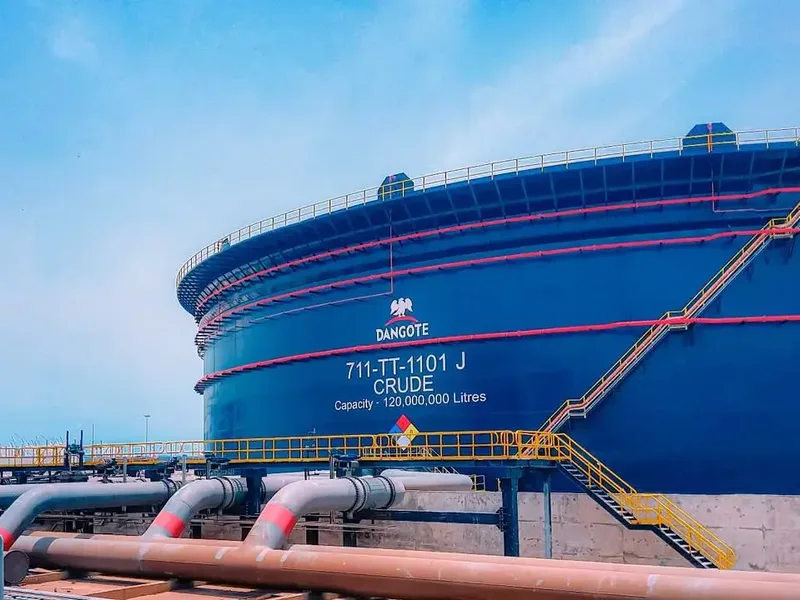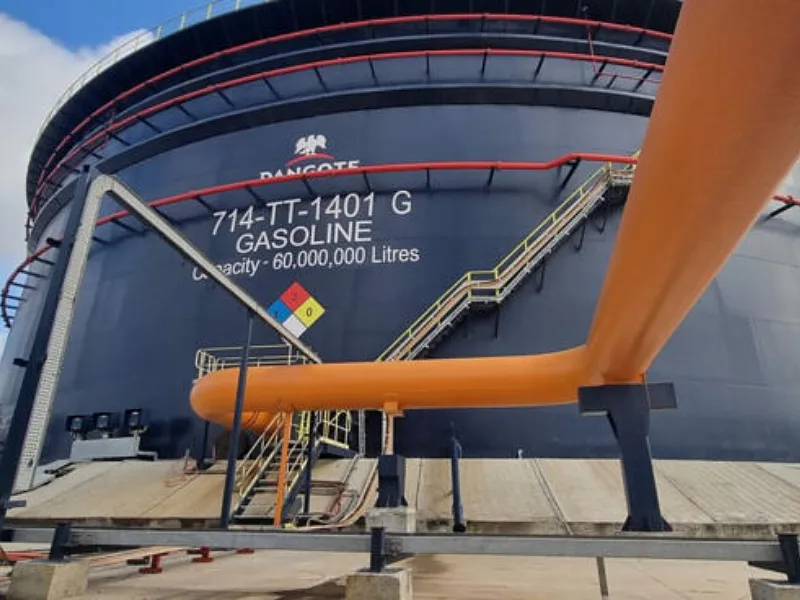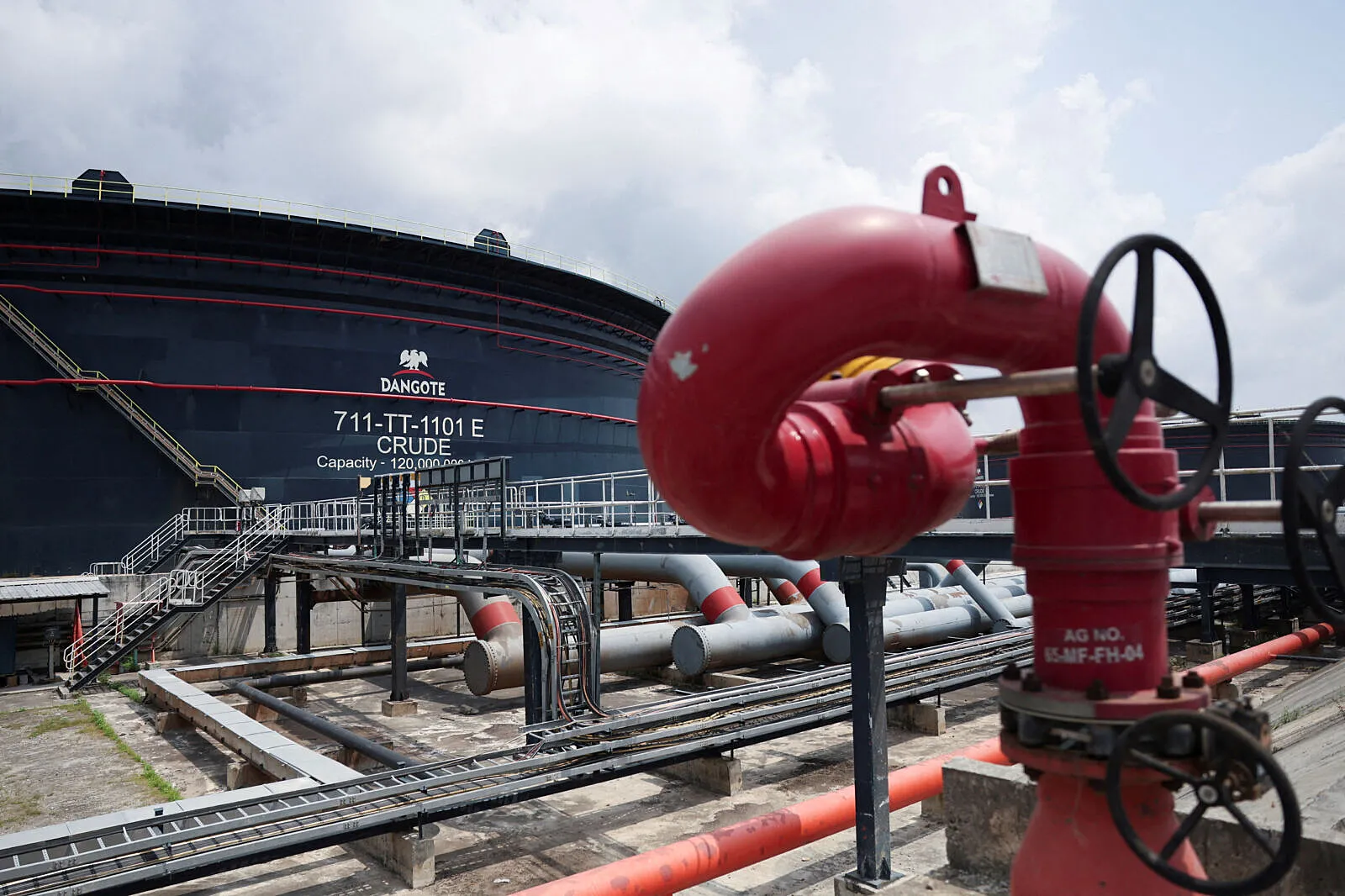
At N525 a share, Dangote Petroleum Refinery’s public offer could raise N2.15 trillion and value the company at about N65.22 trillion after the issue.
The refinery brings rare scale, stronger 2026 earnings and a credible regional energy-security story.
However, the offer will fund only about 11% of a $14.3 billion expansion, while valuation, execution, refining-margin and environmental risks remain central to the investment case.
Dangote Refinery's N2.15 Trillion Share Offer Test
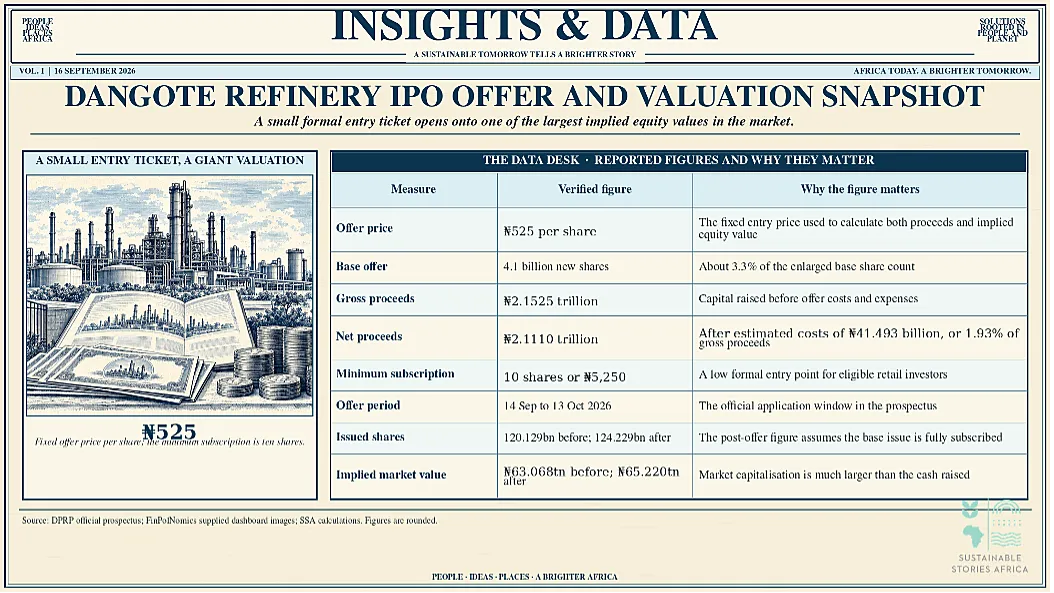
Dangote Petroleum Refinery and Petrochemicals FZE has opened an offer to subscribe to up to 4.1 billion new ordinary shares at N525 each, targeting N2.1525 trillion in gross proceeds.
The application list opened on 14 September and closes on 13 October 2026. A minimum application of 10 shares places the entry ticket at N5,250.
At the base offer, issued shares would rise from 120.129 billion to 124.229 billion, implying a post-offer market capitalisation of N65.22 trillion.
This makes the transaction a major capital-market event and a demanding valuation test.
- Investors are being asked to price a strategic 650,000-barrel-per-day industrial asset after a sharp earnings rebound, while also underwriting a $14.3 billion expansion programme.
Africa's largest offer reaches retail investors
The Nigerian Exchange described the transaction as the first petroleum refinery offered to investors in its 66-year history.
- Its low minimum subscription supports wider participation by retail investors, while the offer's size gives local institutions a rare opportunity to price a large industrial asset on the domestic market.
- The public issue could therefore deepen Nigeria's equity market as well as raise capital.
The ownership shift is still measured.
- The 4.1 billion base shares represent about 3.3% of the enlarged share count, so the established shareholders would retain overwhelming control after the issue.
- Broader participation can improve market depth, but it should not be confused with a transfer of strategic control or an automatic increase in minority influence.
A modest issue carries a vast valuation
Offer proceeds and market value answer different questions.
- The company expects about N2.111 trillion in net cash from the base offer, but applying the offer price to all existing and new shares produces the N65.22 trillion post-offer value.
The FinPolNomics dashboard used for this analysis captures the key distinction:
- The quality of the refinery
- The attractiveness of its share price must be assessed separately.
The Fin-Pol-Nomics diagnostic visuals show first-half 2026 profit after tax of US$3.64 billion and divide the approximate US$49.4 billion post-offer equity value by that annualised result.
- The calculation produces an indicative price-to-earnings multiple of about 13.6 times.
- It is useful as a sensitivity, not a forecast, because it assumes the second half exactly repeats an unusually strong first half.
A Reuters Breakingviews analysis reached the same caution from another angle, estimating the offer at about 8.3 times forecast 2026 EBITDA, against roughly six times for selected United States refiners.
- The comparison is not exact because age, product mix, growth and market exposure differ.
It nevertheless shows that the entry price assigns material value to future expansion and sustained strong refining conditions.
Profit momentum arrives with market tailwinds
The audited numbers show a rapid operating turnaround.
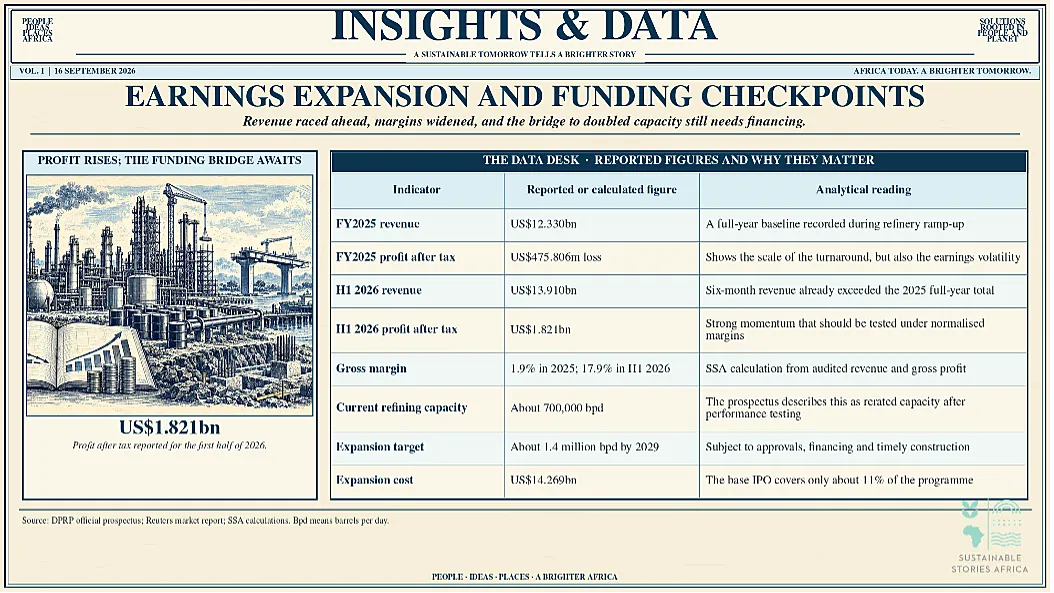
- Revenue reached $12.33 billion in 2025, when the company recorded a $475.8 million loss.
- In the first six months of 2026 alone, revenue rose to $13.91 billion, and profit after tax reached $1.821 billion.
Based on the reported figures, gross margin improved from about 1.9% in 2025 to 17.9% in the first half of 2026.
That change reflects ramp-up and favourable markets. Reuters reported that disruption to Middle Eastern fuel flows tightened European diesel and jet-fuel supply, while Dangote supplied about 80,000 barrels per day of jet fuel to Europe in the second quarter.
- Recent earnings may therefore contain both structural gains and peak-cycle support.
A valuation test should use normalised refining margins, planned maintenance and downside scenarios, not only the latest half-year result.
Fresh capital funds only the first stretch
The prospectus estimates offer costs at N41.493 billion and directs the N2.111 trillion net proceeds entirely to expansion.
- About N686.5 billion, or 32.5%, is allocated to refinery process units and major equipment.
- N841.0 billion, or 39.8%, to utilities, offsites and associated infrastructure
- N583.5 billion, or 27.6%, to construction, installation and other works.
The bigger funding picture is very critical.
- At roughly $1.6 billion, the base offer represents only about 11% of the estimated $14.269 billion expansion programme.
- The prospectus says the balance will be funded in phases through internally generated cash flows and other sources, including debt, trade finance and project finance.
The IPO is therefore the first financing layer, not the full expansion solution.
The plan adds another crude-distillation line and associated units to lift capacity to about 1.4 million barrels per day by 2029.
- Polypropylene capacity is also intended to rise from about 830,000 tonnes a year to 2.4 million tonnes by 2030.
These targets remain subject to regulatory approvals, financing and timely execution.
- Cost overruns, delays, or heavier borrowing would change the cash-flow and valuation case for new shareholders.
Energy security gains carry transition costs
The strategic case is substantial. Large-scale local refining can reduce imported-fuel dependence, retain more value within African supply chains and support regional exports.
- Reuters reported that Nigeria's gasoline imports fell from about 400,000 barrels per day in 2024 to 83,000 in 2026 as Dangote production expanded.
- Petrochemicals, storage, marine logistics and export access also make the investment story broader than fuel sales alone.
Energy security and sustainability are related, but they are not equivalent.
- The refinery says it produces Euro V-equivalent fuels and uses sulphur recovery, tail-gas treatment, vapour recovery, continuous emissions monitoring and wastewater treatment.
Those systems can reduce specific pollutants and operational risks.
- They do not remove greenhouse-gas emissions, water demand, effluent, spill exposure or the longer-term transition risk attached to a major hydrocarbon asset.
For an SSA sustainability lens, future public reporting should quantify absolute and intensity-based greenhouse-gas emissions, energy and water use, effluent quality, spills and remediation, workforce safety, community impacts and transition-related capital expenditure.
- Consistent indicators, targets and external assurance would allow investors to test environmental claims against a planned doubling of throughput.
What investors should test before subscribing
The official prospectus should remain the primary decision document.
It states that SEC clearance and registration do not amount to an endorsement or recommendation.
Five tests are especially important before an investor accepts the offer price.
- Sustainable earnings: Estimate profit across normal refining margins, crude-price movements, maintenance periods and weaker product demand rather than extrapolating one strong half-year.
- Funding resilience: Assess how much of the remaining expansion cost can be met from operating cash, how much debt may be required and whether another equity issue could dilute investors.
- Execution discipline: Track procurement, construction milestones, regulatory approvals, commissioning dates and cost variance for the second crude-distillation line and related infrastructure.
- Operating exposure: Review crude-supply security, foreign-exchange conversion, maritime logistics, product-market concentration and the sensitivity of margins to global disruptions.
- Governance and sustainability: Examine controlling-shareholder influence, related-party transactions, minority protections, environmental liabilities and whether future ESG data are complete and independently assured.
The listing could broaden public ownership and demonstrate that Nigerian capital markets can fund industrial infrastructure at scale.
- Still, the base issue's 3.3% share of enlarged equity and roughly 11% contribution to expansion funding show that the public offer is smaller than the headline valuation may suggest.
- Future returns will depend on durable margins, financing choices, project delivery and credible management of environmental and social risks.
Path Forward – Dangote Refinery: Compelling Asset, Uncertain Price
The disciplined conclusion is that Dangote Refinery may be strategically compelling and not automatically attractively priced.
Investors must judge N525 against normalised cash flows, the capital still required and the risks they are being asked to carry.
“This analysis is informational and does not constitute investment advice.”
Sources and relevant links
- Dangote Petroleum Refinery and Petrochemicals FZE official prospectus
- Nigerian Exchange report on the opening of the IPO
- Dangote Refinery official website
- Dangote Refinery sustainability and environment page
- Reuters factsheet on the public offer
- Reuters report on 2026 earnings and fuel-market conditions
- Reuters Breakingviews valuation analysis
- FinPolNomics interactive investor dashboard supplied by the requester
Suggested tags Dangote Refinery IPO, Nigerian Exchange, refinery valuation, energy security, African capital markets, sustainable finance