Solar project economics are shaped long before construction crews reach a site.
A RatedPower playbook argues that digital modelling can test terrain, equipment, layout and storage choices in minutes rather than weeks.
The claimed LCOE improvement of more than 5% is a vendor estimate; however, the planning logic matters for African developers: better inputs and transparent scenario testing can reduce design risk before committing scarce capital.
Better Design Starts Before Project Finance
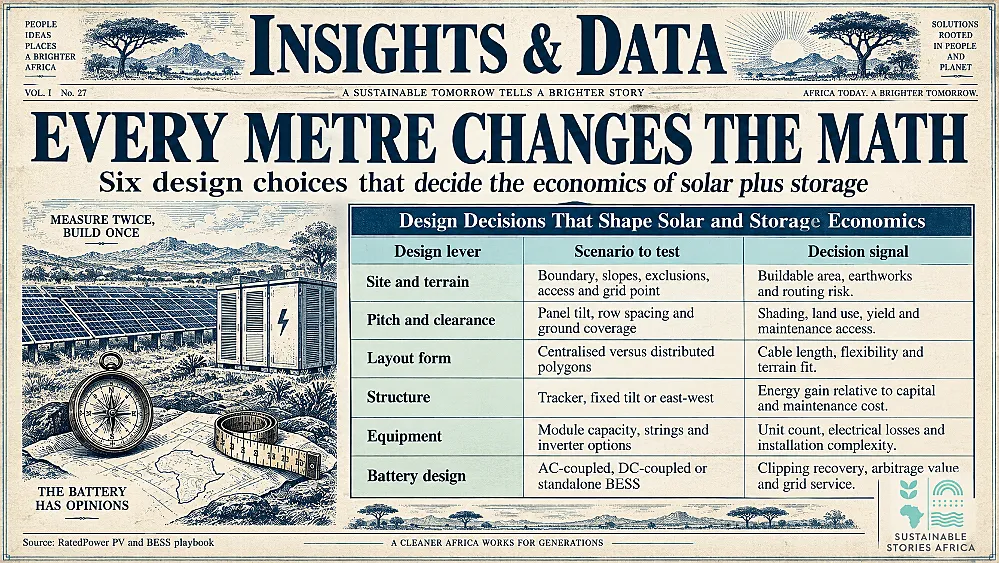
A solar plant can lose value through decisions that appear small on a drawing: row spacing, panel tilt, cable length, inverter selection, road placement or an incorrectly sized battery. Once procurement or construction begins, correcting those choices becomes expensive.
The RatedPower playbook presents simulation as an early-stage discipline for utility-scale solar photovoltaic and battery energy storage system projects.
- Its platform tests many configurations, estimates lifetime energy output and produces technical and commercial documentation from the selected design.
RatedPower says its software can improve levelised cost of energy by more than 5% and shorten some planning work from weeks to minutes.
- Those are vendor claims, not an independent performance guarantee.
The useful insight is that design decisions should be compared systematically before a developer treats one concept as the project.
Digital Design Moves Before Construction Begins
The first requirement is reliable site data.
- A model needs the geographical boundary, topography, overhead lines, substations, medium-voltage routes, restricted areas and access points.
- It also needs module, structure, string and inverter options, together with credible cost assumptions.
That sequence applies for African projects, where incomplete surveys, fragmented land records and uncertain grid-connection information can weaken feasibility studies.
- Software cannot repair a wrong coordinate, an omitted easement or an unrealistic tariff.
- It can, however, expose how sensitive the design is to each assumption.
RatedPower's CAD import workflow lets developers bring DWG files into the platform, preserve georeferencing and select the relevant layers.
- This can reduce conversion errors between engineering tools.
- The advantage is strongest when teams maintain a controlled source of site data and record who approved each revision.
Data quality needs its own budget.
- A developer should define coordinate systems, survey tolerances, resource-data periods and grid-study assumptions before simulations begin.
- Each imported layer should carry a date and owner.
- That control prevents a fast modelling process from multiplying an old boundary, stale equipment price or unapproved connection point across every scenario.
Small Layout Choices Reshape Project Economics
Batch simulations let a team compare pitch, clearance, ground coverage, shading, installed capacity and energy yield.
- A developer can run several scenarios together, inspect the resulting table and open a specific layout for more detail.
- The playbook says the layout editor can create up to ten configurations in a batch.
Centralised and distributed layouts illustrate the trade-off.
- A single large polygon can simplify land use and reduce some costs on regular terrain. Multiple smaller polygons can respond better to uneven ground or separate parcels, although longer cable routes may add losses and cost.
- The lowest-cost answer depends on the site.
The same applies to structures.
- Trackers follow the sun and usually increase generation, but fixed structures may produce better economics where terrain, maintenance capability or capital cost limits the benefit.
- Higher-capacity modules can reduce unit count and installation complexity, while string length influences electrical losses.
- The layout-editor session shows how such choices can be refined after automated generation.
Grid connection design can overturn an apparently attractive layout.
- The nearest connection point may lack capacity, require a dedicated substation or impose long cable runs and electrical losses.
- Developers should compare substation and dedicated-station scenarios with the same energy-yield and cost assumptions, then test how curtailment or connection delays affect returns.
Storage Design Extends Solar Project Value
Battery storage adds another layer of choice.
- An AC-coupled system connects the battery through its own conversion equipment, while a DC-coupled design can capture energy that would otherwise be clipped before conversion.
- Standalone storage can also be modelled independently from a solar plant.
The playbook reports that DC-coupled BESS represented about 22% of RatedPower's hybrid simulations by December 2024.
- That figure describes activity on the vendor's platform, not the wider market, but it indicates growing developer interest in alternative coupling arrangements.
Storage value depends on more than physical size.
- Charge and discharge timing, battery degradation, solar production and electricity prices determine the commercial outcome.
- RatedPower's arbitrage function models these variables, while its standalone BESS product tour demonstrates siting, grid-point and electrical-configuration inputs.
For African markets with evening peaks, constrained grids or weak reliability, storage can improve dispatch and reduce curtailment.
- It can also make a project more expensive without generating adequate revenue.
- Developers therefore need a bankable offtake case, not merely a technically elegant battery design.
Battery sizing should be tested against the service being sold.
- A system designed for short evening shifting differs from one providing reserve capacity, firm supply or merchant arbitrage.
- Degradation, round-trip efficiency, replacement schedules and warranty limits should appear in the same financial model as the energy-price assumptions that create revenue.
Developers Need Better Inputs and Governance
Simulation should sit inside a documented decision process.
- Engineering, finance, procurement and environmental teams need common assumptions for equipment costs, resource data, land restrictions, system losses and grid availability.
- Each design iteration should retain its inputs and explain why it was accepted or rejected.
The platform can generate bills of quantities, capital-expenditure analysis, net present value, return on investment, payback estimates, LCOE calculations and single-line diagrams.
- These outputs can support a proposal, but they remain only as reliable as their underlying data. Independent engineering review and lender due diligence still matter.
Developers should use high-resolution topography where complex ground conditions justify it, while avoiding unnecessary survey costs on simple early-stage sites.
- Meteorological and geographical datasets from IRENA, SolarAnywhere, PVGIS and NASA can supplement local evidence, but site measurements and grid studies should govern final design.
Teams considering the tool can consult the RatedPower knowledge base, review its product solutions or request a software demonstration.
- The procurement question should be concrete: does the platform improve design traceability, shorten iteration and reduce material or energy losses enough to justify its cost and training burden?
Before investment approval, freeze the preferred model as a controlled baseline.
- Changes to modules, batteries, roads or grid equipment should trigger a documented comparison against that baseline.
- This creates a usable audit trail for lenders and protects the project from design drift between feasibility, tendering and detailed engineering.
Path Forward – Build Bankable Project Discipline Early
African solar developers should compare layouts, equipment and storage configurations before procurement, while preserving a clear record of data sources and approvals.
Scenario speed is valuable only when assumptions are credible.
A strong process combines digital modelling with field surveys, grid studies, independent review and commercial stress tests.
That discipline can lower avoidable design risk and give investors a clearer project case.