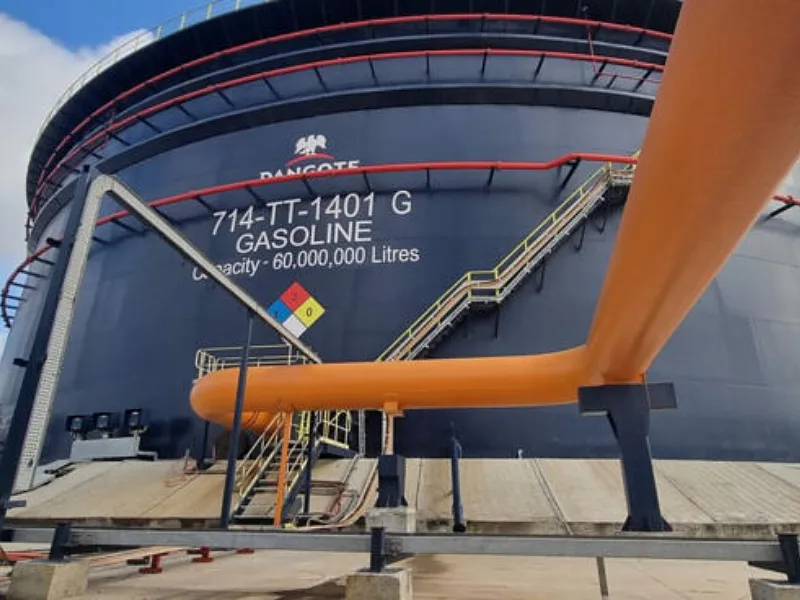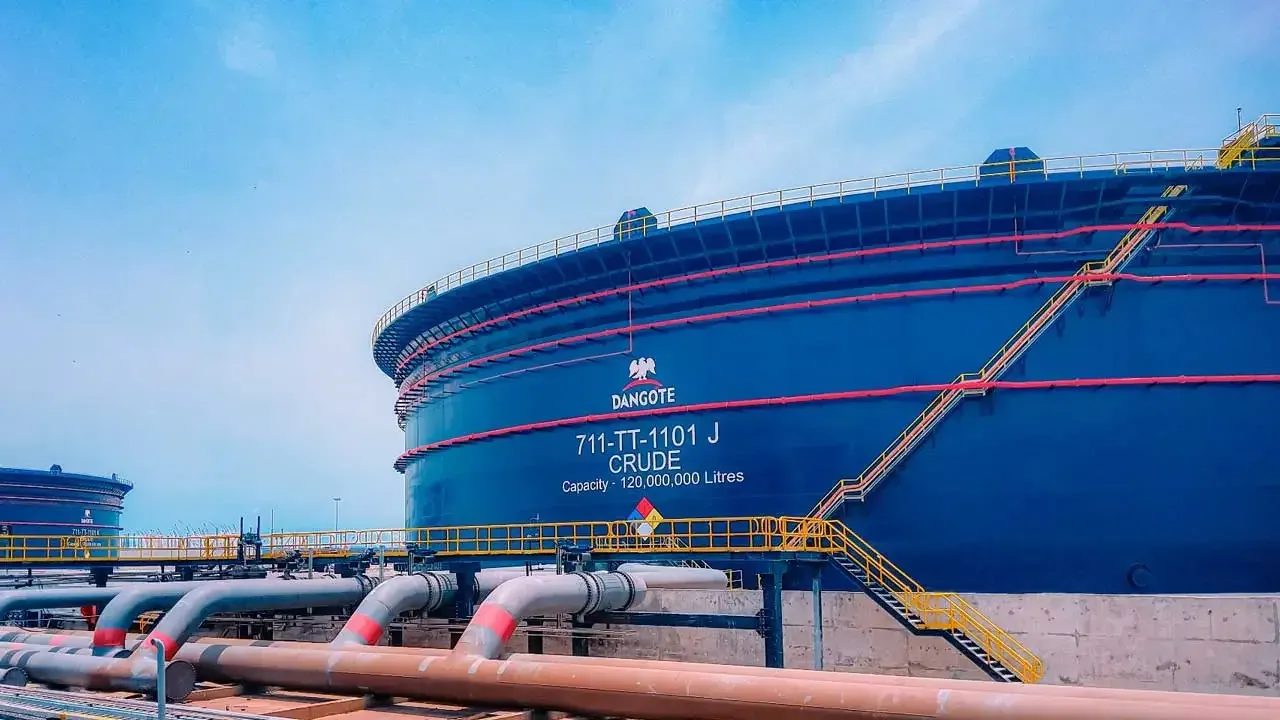
The Dangote Refinery can distil crude while its residue fluid catalytic cracking unit is unavailable, but it loses a major route for turning heavy residue into higher-value fuels.
That changes output, feedstock choices and margins.
RFCC incidents are common in global refining. The concern is concentration: a single-train design gives the Lekki complex fewer alternative paths when its critical conversion unit is unreliable.
One Unit Shapes Refinery Economics Deeply
A crude-oil distillation unit separates a barrel into fractions with different boiling points.
- Gases and naphtha emerge first, followed by kerosene, jet fuel and diesel. Heavy residue remains at the bottom and carries less value unless the refinery can convert it into lighter products.
Residue fluid catalytic cracking, or RFCC, performs that conversion.
- Hot, reusable catalyst particles break large hydrocarbon molecules into smaller molecules that can become petrol, liquefied petroleum gas, diesel components and petrochemical feedstocks.
The US Energy Information Administration explainer describes the greater catalytic-cracking role in gasoline production.
Feyi Fawehinmi's RFCC and Refining explainer uses the unit to examine why operational problems at the Dangote Refinery matter beyond engineering.
The issue is the value recovered from each barrel and the resilience of Nigeria's most important refining asset.
RFCC Reliability Constrains Fuel Output Today
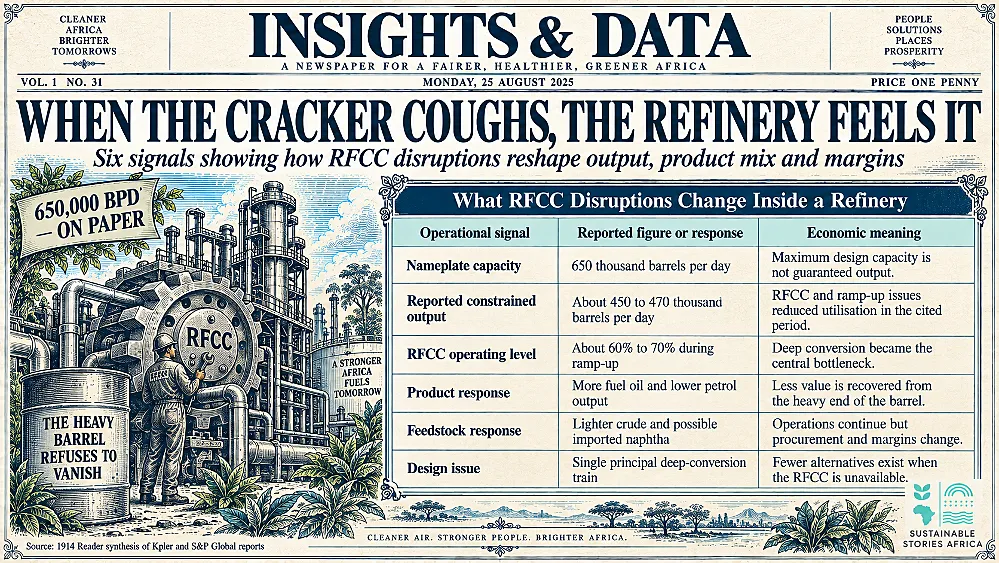
The Kpler September refinery update cited in the original article placed Dangote's output near 450,000 to 470,000 barrels per day against 650,000 barrels per day of nameplate capacity in 2025.
- It described repeated RFCC problems, near-biweekly outages from April 2025 and operation at about 60% to 70% of unit capacity during ramp-up.
Kpler expected overall runs to ease to about 420,000 to 450,000 barrels per day from 490,000 to 500,000 earlier.
- It also estimated fuel-oil production at 85,000 to 95,000 barrels per day and petrol production at 100,000 to 120,000 barrels per day while the unit was constrained.
These figures came from a September 2025 operating update and should not be read as current production data for September 2026.
- Their continuing value is explanatory: when deep conversion is limited, a refinery can still run, but its product mix and economics change.
The distinction between operation and optimisation matters to public debate.
- Crude may enter the plant and finished fuels may leave it while a bottleneck still reduces the proportion of higher-value products.
- Reliable reporting should therefore show throughput, unit availability and yield together rather than using a single production headline.
Complex Units Fail but Design Matters
RFCC units operate under severe heat and complex catalyst circulation.
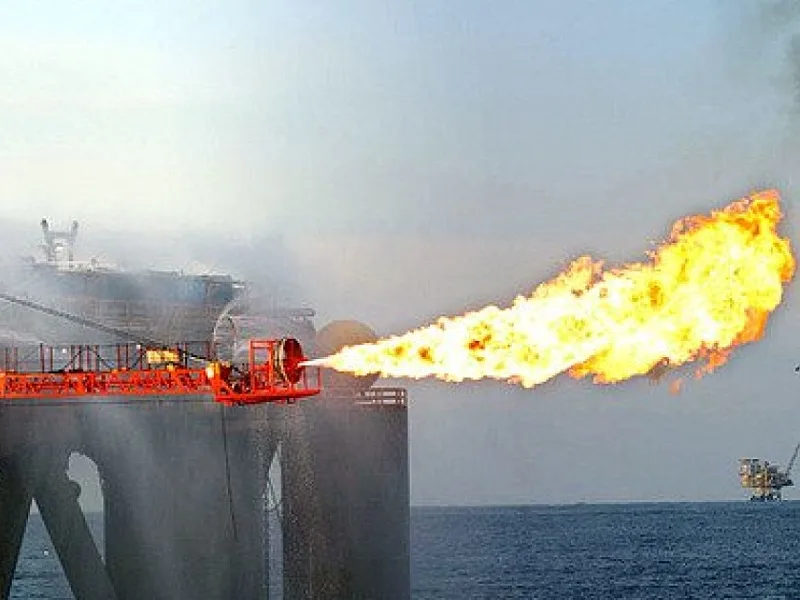
- Leaks, fires, regeneration problems and unplanned shutdowns occur across the industry.
- The technology traces its commercial development to work documented by the Oil and Gas Journal, and decades of experience have not removed operational risk.
The original explainer compares several incidents.
- S-Oil's Onsan refinery restarted its No. 2 RFCC within days after a fatal 2022 fire.
- A leak at Vietnam's Nghi Son refinery reduced output by 20% to 25% for about ten days.
- A 2017 Dalian fire was contained within two hours.
- The 2018 Husky Superior incident was far more severe, causing 36 injuries and more than $500 million in damage, according to the US Chemical Safety Board report.
- A 2025 Galveston Bay fire was followed by a reported restart
- An ExxonMobil Beaumont FCC unit reportedly returned within 48 hours.
The lesson is not that failure is harmless.
- It is that large refineries often isolate problems through multiple units or alternative conversion routes.
- S&P Global examples cited by Fawehinmi suggested that new plants may need 10 to 33 months to overcome RFCC start-up problems.
- Dangote was within that range, but the reported frequency of outages made resilience important.
Multiple trains also change maintenance planning.
- Operators can schedule work on one unit while another remains available, although duplicated capacity costs more to build and maintain.
- A single train concentrates expertise and equipment, but it requires a stronger spare-parts strategy, inspection, repair capability and contingency planning because a failure carries system-wide consequences.
Alternative Routes Protect Output and Value
A multi-train refinery can keep one conversion train operating while another is repaired.
- Other plants combine FCC or RFCC units with delayed cokers, hydrocrackers and hydrotreaters.
- A Ruwais refinery presentation, for example, showed several paths for processing heavy material.
- The Jamnagar configuration listed a delayed coker, RFCC, hydrocracker and hydrotreater.
Dangote is widely described as a single-train refinery.
- Its mild hydrocracker provides some processing capability, but the RFCC appears to be the central deep-conversion route.
- Concentration can reduce duplicated capital and deliver economies of scale when the system works.
- It also creates a larger operational consequence when the unit does not.
Resilience should therefore be measured in foregone output and margin, rather than only hours offline.
- A second train or alternative conversion unit costs capital and may be inefficient when unused.
- The decision depends on failure probability, repair time, lost product value, safety exposure and Nigeria's wider dependence on the complex.
That wider dependence raises the value of redundancy beyond the refinery's private cash flow.
- Disruption can alter imports, foreign-exchange demand, domestic inventories and fuel logistics.
- Regulators evaluating resilience should count these system costs without turning operational oversight into day-to-day management of a private plant.
Operators Need Transparent Reliability Evidence Now
When the RFCC is unavailable, one response is to export more low-value residue. Another is to run a lighter, sweeter crude slate that leaves less heavy material to convert.
- The Kpler analysis said the refinery used about 60% Nigerian light grades and 35% imported West Texas Intermediate in 2025, with average crude quality near 38 API.
A third response is to import naphtha.
- Naphtha is already a light fraction, so hydrotreating, isomerisation and reforming can turn it into petrol without passing through the RFCC.
- This can support fuel supply, but the refinery gives up part of the margin it would earn by cracking its own residue into valuable components.
Operational disclosure should show RFCC availability, throughput, planned and unplanned downtime, product yield, crude slate and imported intermediate feedstocks.
- Safety and root-cause findings should also be published at an appropriate level.
- These indicators allow policymakers, lenders and the public to distinguish a temporary ramp-up problem from a persistent design or maintenance constraint.
Government decisions on import policy, crude supply and market intervention should use that evidence.
- A systemically important refinery can be operating while still below its optimal economic configuration.
- Policy should not assume that nameplate capacity equals reliable production.
A consistent monthly disclosure schedule would improve accountability.
- It could report crude receipts, total runs, RFCC availability, major maintenance, key product yields and imported blend components, with clear definitions and historical comparisons.
- Independent verification would reduce speculation while protecting genuinely sensitive commercial information.
Source Links Preserved From The Original
Market and technical background: Kpler's September refinery-status update; the Oil and Gas Journal history; and the US EIA catalytic-cracking explainer.
Incident evidence: Reuters reports on S-Oil Onsan, Nghi Son and ExxonMobil Beaumont; the Dalian refinery fire; the US Chemical Safety Board Husky report; and reports on the Galveston Bay fire and subsequent restart.
Alternative configurations: the Ruwais expansion presentation; 1914 Reader's Jamnagar discussion; and the Reuters Jamnagar fact box. The original article also links a Nation report on fuel-quality claims, which illustrates the disputed public-information environment around the refinery.
Path Forward – Publish Reliability Data Before Intervention
Dangote Refinery should publish consistent RFCC availability, throughput, downtime, crude-slate and product-yield data, alongside credible root-cause and safety information.
Regulators need the same evidence before changing fuel or import policy.
The wider lesson for African infrastructure is that scale must be paired with resilience.
Design savings should be tested against the economic cost of a single critical unit becoming unavailable.