
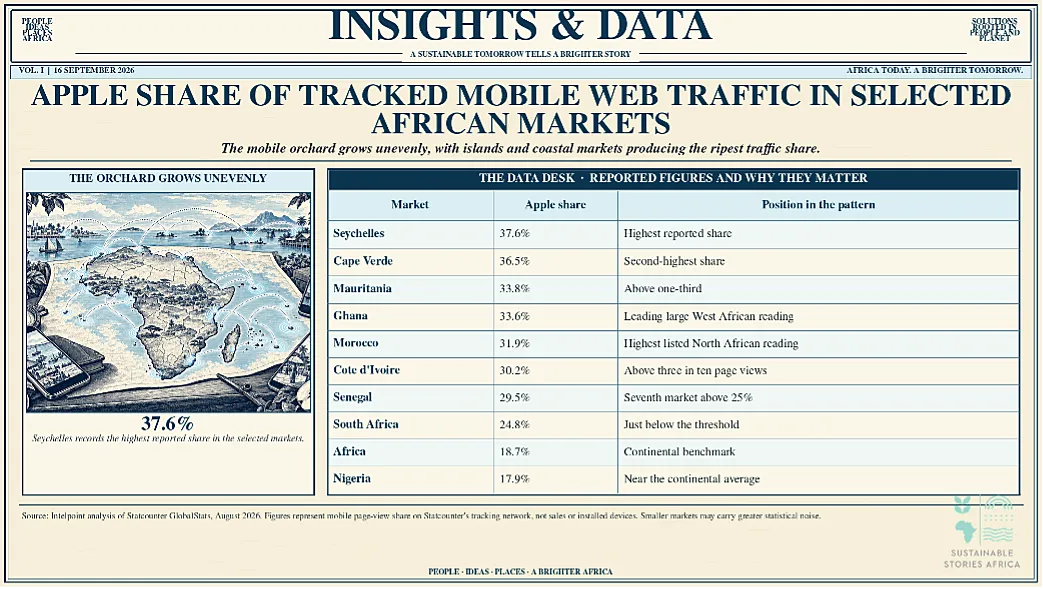
Apple generated more than one-quarter of tracked mobile web traffic in seven African countries in August 2026, led by Seychelles at 37.6%.
The pattern creates opportunities for targeted digital services, but it is not a sales ranking.
Market size, affordability and the limits of web-traffic data remain essential to interpretation.
Apple Finds Pockets of African Strength
Apple's continental footprint looks modest when Africa is treated as one market.
- Its share of tracked mobile page views stood at 18.7% in August 2026.
- Country-level data tells a more varied story: Apple exceeded 25% in seven markets and approached that threshold in South Africa.
Seychelles led with 37.6%, followed by Cape Verde at 36.5%, Mauritania at 33.8%, Ghana at 33.6%, Morocco at 31.9%, Cote d'Ivoire at 30.2% and Senegal at 29.5%, according to an Intelpoint analysis of Statcounter GlobalStats. South Africa followed at 24.8%.
These figures matter to developers, media companies, advertisers, banks and online retailers because a device's operating system shapes product testing, payments, privacy controls and advertising tools.
However, the data measures page-view share on Statcounter's network. It does not measure shipments, active devices, revenue or the installed smartphone base.
Seven Markets Cross the Quarter Threshold
The leaders do not form a single geographic bloc.
- They include small island economies, West African markets and a North African manufacturing and tourism hub.
This spread suggests that Apple's traffic share depends on a combination of purchasing power, travel and diaspora links, device resale channels, mobile-network quality and user behaviour.
The Statcounter data alone cannot prove which factor dominates.
The comparison with Nigeria is revealing.
- Nigeria is the continent's largest smartphone market, but Apple's mobile vendor share was 17.9%, close to the African average of 18.7%.
- Large users can create substantial commercial volume even when a brand's percentage share is lower.
- Conversely, a high percentage in a small country may represent a limited absolute audience.
That distinction prevents a common analytical error.
- Percentage share answers how tracked traffic is divided within a market.
- It does not answer how many people own an iPhone, how many devices were sold or how much consumers spent.
Strategy requires both the proportion and the size of the underlying market.
Small Markets Lead a Fragmented Pattern
Below South Africa, the next group remained above 20%: Namibia at 24.1%, Mauritius at 22.4%, Gambia at 22.0%, Rwanda at 21.7%, Benin at 21.0% and Equatorial Guinea at 20.5%.
- The distribution shows meaningful iOS traffic outside the continent's biggest economies.
It also shows why an Africa-wide average can obscure commercial detail.
- A product team using only the 18.7% continental figure could underinvest in iOS quality in Accra, Dakar or Abidjan.
- A team using only the 37.6% Seychelles figure could overestimate the total addressable market.
Country design, testing and marketing decisions need both traffic share and audience volume.
Statcounter builds its series from page views recorded on participating websites.
- That approach captures active browsing rather than devices sitting unused, but it can be influenced by the types of sites in the network, browsing habits and changes in the sample.
- Intelpoint also cautioned that Seychelles and Cape Verde each have fewer than one million residents, making their estimates more sensitive to statistical noise than readings from larger populations.
The country pattern should therefore be treated as a market signal that requires confirmation.
- A sustained share over several months, supported by app-store activity, retailer data and network analytics, would give a stronger basis for investment than a single monthly snapshot.
The discipline is especially important when budgets depend on a small number of high-value customers.
Premium Audiences Create Targeted Digital Opportunities
For digital businesses, the data supports selective investment rather than a uniform premium-device strategy.
- Banks and fintech companies can prioritise secure iOS journeys in markets where Apple's traffic share is high.
- Media and entertainment platforms can test subscription offers, while retailers can assess demand for accessories, trade-ins and refurbished devices.
Advertisers can also use device mix as one input when segmenting audiences, but they should avoid treating an Apple user as a simple proxy for wealth.
Household income, shared devices, second-hand purchases and business travel can all affect traffic.
Responsible targeting requires privacy protection and should not turn an inferred device profile into unfair exclusion from credit, insurance or essential services.
The opportunity extends to local developers.
- Strong iOS traffic in several Francophone and small-market contexts rewards localisation, low-bandwidth design and payment options that work across borders.
Developers still need Android coverage because it remains dominant across much of Africa.
The practical goal is consistent service quality across devices, with testing effort weighted by reliable local evidence.
Device longevity adds another dimension.
- Software support, battery replacement, repair networks and secure resale can extend the useful life of premium phones and widen access without relying entirely on new imports.
- Businesses that support repair and verified refurbishment can reduce electronic waste, but they also need strong controls for data erasure, parts quality and consumer protection.
Businesses Must Read Traffic Data Carefully
Decision-makers should combine the Statcounter series with handset shipments, active-device estimates, app analytics, retail pricing, income data and network performance.
- Tracking changes over several months can also reduce the risk of responding to short-term sample noise, particularly in countries with populations below one million.
Product teams should maintain a country-by-country device matrix covering operating-system versions, screen sizes, browser behaviour, payment failures and accessibility
Marketing teams should report both percentage reach and estimated audience size.
Investors should ask whether a high traffic share translates into retention, transaction value or subscription revenue.
Public policy has a different task.
- Regulators and service providers should ensure that government portals, health platforms and financial services work on affordable devices as well as premium ones.
- A growing iOS audience can attract investment, but digital inclusion depends on services that remain usable across the full device market.
Telecommunications operators and retailers can improve the evidence base by publishing consistent, privacy-preserving indicators on device types, network generation and repair or trade-in activity.
- Shared standards would help policymakers and businesses separate changes in ownership from changes in browsing.
They would also make it easier to monitor whether digital growth is broadening access or concentrating benefits among already connected users.
Path Forward – Build Strategies Around Evidence and Access
Apple's traffic share reveals commercially important pockets of demand, especially in seven markets above 25%.
Businesses should use that signal to improve local product testing and audience measurement.
They should also preserve the limits of the evidence.
Combining traffic, sales, affordability and user-behaviour data will produce better investment decisions while keeping African digital services accessible across income groups and device types.