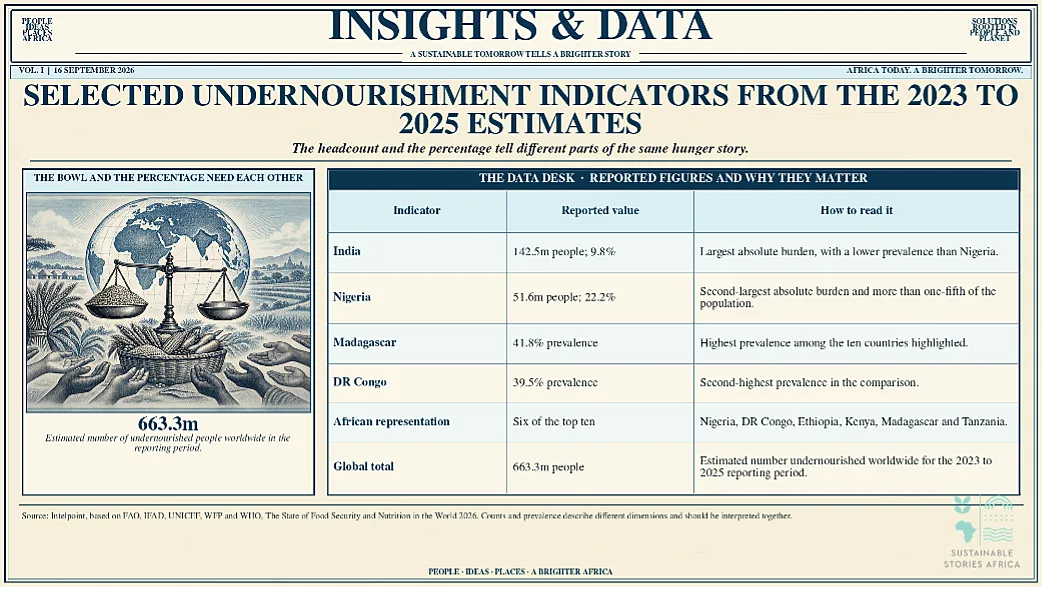
Nigeria had an estimated 51.6 million undernourished people in the 2023 to 2025 period, second only to India's 142.5 million, Intelpoint's review of UN data shows.
Six of the ten countries with the largest absolute burdens are African. The figures sharpen the case for affordable diets, resilient food systems and accountable delivery.
Nigeria's Hunger Burden Demands Immediate Attention
Nigeria recorded the world's second-largest undernourished population in absolute terms, with an estimated 51.6 million people affected during 2023 to 2025.
- Only India ranked higher, at 142.5 million, according to an Intelpoint visualisation based on The State of Food Security and Nutrition in the World 2026.
Population size explains part of the ranking, but prevalence reveals the depth of the problem.
- About 22.2% of Nigerians were undernourished, more than twice India's 9.8%.
- Madagascar had the highest prevalence among the ten countries highlighted, at 41.8%, followed by the Democratic Republic of the Congo at 39.5%.
Six of the ten countries with the largest absolute totals were African:
- Nigeria, the Democratic Republic of the Congo, Ethiopia, Kenya, Madagascar and Tanzania.
The concentration turns food security into a central test of public policy, economic resilience and the social dimension of sustainability across the continent.
Two Countries Carry Disproportionate Human Burdens
India's 142.5 million undernourished people were almost three times Nigeria's total.
- The comparison demonstrates why absolute counts and prevalence must be read together.
- A populous country can contain a very large number of affected people even when its national rate is lower.
- A smaller country can face a more pervasive crisis when a higher share of its people lack sufficient food.
The country estimates use the 2023 to 2025 period and sit within a global total of 663.3 million undernourished people for that reporting window.
- The 2026 UN report separately estimated that around 645 million people faced hunger in 2025.
- The two figures use different time frames, so they should inform the same debate without being treated as interchangeable.
The UN's wider evidence shows the regional imbalance.
- Africa had about 309 million hungry people in 2025, compared with 292 million in Asia.
- Approximately 20% of Africa's population faced hunger, while 56.6% experienced moderate or severe food insecurity.
Globally, about 2.1 billion people experienced moderate or severe food insecurity.
Africa Dominates the Highest Burden List
Undernourishment measures habitual food intake that is insufficient to maintain a normal, active and healthy life.
- It is distinct from acute food insecurity, which can describe a shorter and more severe emergency.
- The indicator is useful for long-term comparison, but national averages can conceal sharp differences between regions, income groups, women and men, and urban and rural households.
The data also moves the debate beyond food production alone.
- The 2026 UN report focused on the high cost of a healthy diet and found that one-third of the world's population could not afford one.
In Africa, roughly two-thirds could not.
- Food may exist in a market while nutritious diets remain beyond the reach of households facing low incomes, high transport costs, inflation or interrupted livelihoods.
Nigeria's place in the ranking highlights the continental pattern at national scale.
- A rate of 22.2% means the burden extends far beyond a limited emergency caseload.
- It affects labour productivity, school participation, maternal health and children's development, while increasing pressure on public services.
- The human consequences are distributed unevenly, which is why national totals must lead to more detailed state and community analysis.
The six African countries in the top ten also differ in population, conflict exposure, climate risk, infrastructure and policy capacity.
- A common continental response can support finance, research and trade, but delivery must reflect local food systems and household constraints.
- The shared outcome is insufficient nutrition; the route into that outcome is not identical everywhere.
Better Systems Can Convert Food Into Nutrition
Progress is possible.
- The UN reported a third consecutive annual decline in global hunger in 2025 and the first signs of improvement in Africa since the adoption of the 2030 Agenda.
- The improvement remains too slow, but it shows that policy, investment and delivery can change the direction of the data.
For Nigeria, success would mean more than increasing harvest volumes.
- It would mean reducing post-harvest losses, improving storage and transport, supporting climate-resilient production, protecting livelihoods in conflict-affected areas and making nutritious foods affordable.
- Social protection can help households through price shocks, while maternal and child nutrition programmes can direct resources toward those facing the greatest long-term harm.
Better nutrition would strengthen health, learning and productivity.
- It would also reduce pressure on humanitarian systems and make communities more resilient to climate and economic shocks.
- These benefits connect directly to Sustainable Development Goal 2, but they also affect poverty reduction, education, gender equality and decent work.
The design of support matters.
- Cash transfers lose value when food inflation rises faster than benefit levels, and food distribution can fail when procurement or logistics break down.
- Programmes need regular price adjustments, transparent beneficiary systems, grievance channels and independent monitoring.
- Local procurement can support farmers where supply is reliable, while emergency imports may be necessary when domestic markets cannot meet immediate needs.
Nigeria Needs Coordinated Action Across Systems
Government should treat affordability, availability and diet quality as linked outcomes.
- Agricultural policy can support diverse foods, including legumes, fruit, vegetables and animal-source foods where appropriate, alongside staple crops.
- Infrastructure budgets should prioritise rural roads, storage, electricity and market systems that reduce the cost of moving food from producers to consumers.
Federal and state programmes need transparent targeting and public reporting.
- Decision-makers should publish subnational indicators on food prices, dietary affordability, child nutrition and programme coverage, disaggregated where possible by sex, age, location and income.
- That evidence can show whether interventions reach the communities hidden by national averages.
Businesses and financiers also have responsibilities.
- Food companies can improve supplier resilience, reduce loss, protect food safety and offer healthier products at accessible prices.
- Banks and investors can finance storage, irrigation, logistics and local processing while assessing land, water, labour and community risks.
- Development partners should align emergency support with longer-term systems that communities can sustain.
Accountability should follow the money from budget approval to household outcome.
- Public dashboards can track funds released, projects completed, market prices, programme coverage and nutrition results.
- Independent audits and community feedback can identify leakage or exclusion early. Success should be judged by whether fewer people are undernourished and more households can afford a healthy diet, not only by tonnes produced or programmes announced.
Path Forward – Make Nutrition Progress Measurable and Local
Nigeria needs a coordinated plan that links agricultural production, household income, social protection, nutrition services and secure local markets.
Targets should be measured below the national level and tied to budgets and responsible institutions.
The immediate priority is to protect vulnerable households while lowering the structural cost of healthy diets.
Consistent data, transparent delivery and investment in resilient food systems can turn national commitments into fewer people living with hunger.