
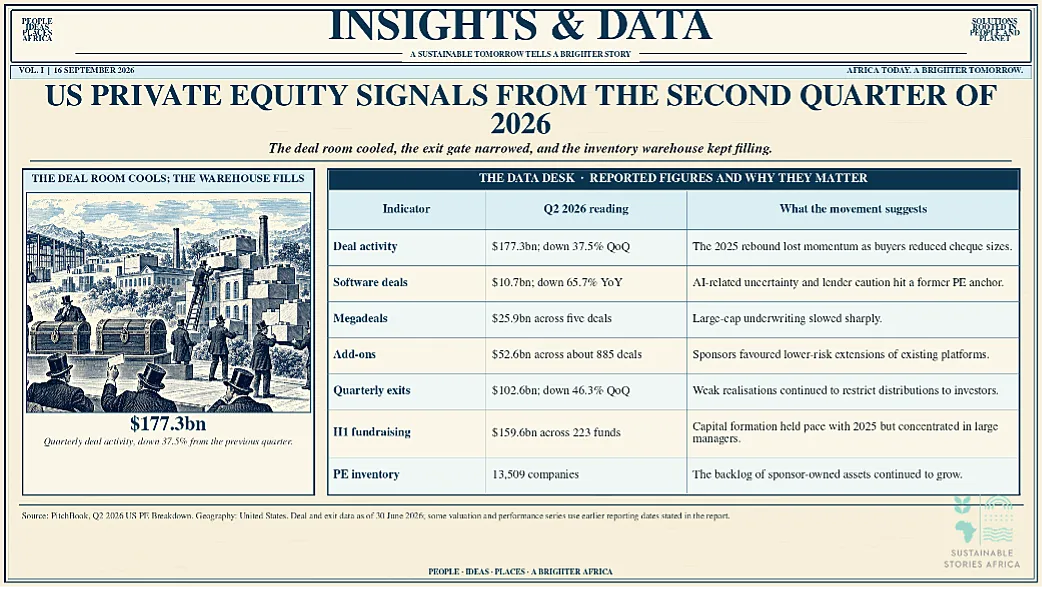
US private equity deal value fell 37.5% quarter-on-quarter to $177.3 billion in the second quarter of 2026, reversing the momentum of a record 2025.
PitchBook's data shows a market moving toward smaller add-ons and growth investments as software reprices, exits weaken and fundraising concentrates among the largest managers.
A Record Year Loses Its Momentum
The recovery of US private equity expected after a record 2025 did not survive the second quarter of 2026.
- Deal value fell to $177.3 billion, down 37.5% from the previous quarter and the lowest level since the fourth quarter of 2023, according to PitchBook's Q2 2026 US PE Breakdown.
The decline was broad, touching sectors, deal sizes and transaction types.
- Higher-for-longer interest-rate expectations, wider lending spreads, an energy-driven inflation shock and uncertainty over artificial intelligence combined to make buyers more selective.
- Deal count was more resilient, rising 11.5% from a year earlier to an estimated 2,384 transactions, but the mix shifted toward smaller commitments.
For African investors, founders and fund managers, this is more than a US market story.
- Global limited partners compare opportunities across regions.
When distributions slow and established US managers absorb more commitments, emerging-market funds can face a harder fundraising contest even when their underlying businesses remain sound.
Deal Value Falls as Uncertainty Returns
Software recorded the sharpest retreat.
- Quarterly deal value fell to $10.7 billion, 65.7% below the same period of 2025 and 90.3% below its peak in the third quarter of that year
- PitchBook linked the pullback to an AI-driven reassessment of software business models, financing availability and the durability of competitive advantages that previously supported premium valuations.
Energy moved in the opposite direction.
- First-half deal value rose 80.5% from the same period in 2025 as investors followed demand for power, grid assets and data-centre infrastructure.
- The contrast shows that private equity capital has not disappeared.
It is being repriced and redirected toward businesses whose cash flows and strategic relevance appear easier to defend.
Large transactions became scarce.
- Deals worth at least $2.5 billion produced $25.9 billion of value across five transactions, down 59.7% year on year and 81.9% from the third-quarter 2025 peak.
- Take-private value fell 90.1% from the first quarter to $6.2 billion across 11 deals as public markets reached new highs and financing became harder to justify.
Software Retreats While Energy Attracts Capital
The change in deal structure is equally important.
- PitchBook estimated 885 add-on acquisitions in the quarter, roughly three-quarters of all buyouts.
- Add-on count still fell 31.2% year on year and value dropped 44.5% to $52.6 billion; however, the category remained dominant because extending an existing platform usually requires less fresh leverage and less underwriting than buying a new one.
Growth and expansion investments were the only segment to increase, rising 19.1% year on year to an estimated 493 deals.
- That preference for minority stakes and smaller transactions suggests risk control rather than wholesale retreat.
- Investors are still deploying capital, but they are choosing structures that preserve optionality while rate and valuation expectations remain unsettled.
PitchBook's investor survey captured the competing pressures.
- Interest rates and geopolitical risk were each selected by 59% of respondents as leading influences on investment decisions, while AI disruption or opportunity followed at 58%.
- Underlying economic growth registered 53%, financing availability 38% and tariffs 33%.
Respondents could choose more than one factor, so the results describe overlapping concerns rather than a simple ranking with a fixed total.
AI enthusiasm also met practical limits inside portfolio companies.
- Data readiness was the most frequently cited obstacle to faster adoption, at 26%, followed by unclear returns or difficulty justifying cost at 22%, management bandwidth at 20% and talent at 15%.
- Only 11% reported no significant impediment.
The findings suggest that investors need operating plans, data foundations and accountable budgets before treating AI as a source of value creation.
Smaller Deals Offer Lower Risk Routes
Valuation data explains why buyers need caution.
- Median US buyout entry value reached 12.5 times EBITDA in 2025, compared with 9 times in 2015.
- Median debt stood at 4.7 times EBITDA while the equity contribution reached 7.8 times, meaning sponsors were paying more and funding a larger share with their own capital.
Bigger deals carried the richest prices and the greatest leverage.
The opportunity lies in disciplined selection.
- Smaller add-ons can strengthen an existing company's distribution, technology or market reach without exposing a fund to the binary risk of a new platform.
- Growth capital can support businesses that need expansion funding but do not require a full buyout.
Energy and infrastructure may also offer more visible demand, although concentration in any fashionable theme brings its own valuation risk.
This matters for African businesses seeking international capital.
- Investors facing weak distributions may ask for clearer cash-generation plans, shorter routes to profitability and more conservative valuations.
- Companies that can document resilient revenue, governance, customer concentration and foreign-exchange exposure will be better placed to compete for scarce investment attention.
The same discipline applies to fund strategy.
- Managers should distinguish genuine operating improvement from multiple expansion, test debt service under higher rates and price foreign-exchange risk before signing.
- Smaller transactions can still destroy value if integration costs, working-capital needs or governance weaknesses are understated.
Selectivity works only when diligence remains rigorous after the cheque becomes smaller.
Managers Must Restore Liquidity and Discipline
Exits are the central constraint.
- Quarterly exit value fell to $102.6 billion, down 46.3% from the first quarter and 7.4% from a year earlier.
- Public listings provided a narrow bright spot: IPO value rose 42.2% quarter-on-quarter to $27.6 billion, and the number of listings doubled to 12.
The wider market remained dependent on a small number of large realisations.
- Business-to-business companies generated $40.6 billion, or about 45%, of quarterly exit value. Energy was the only sector to record quarterly growth in both exit count and value, producing 14 exits worth $13.5 billion.
- Meanwhile, the inventory of PE-backed companies reached 13,509. Managers cannot wait indefinitely for perfect pricing because limited partners need distributions to make new commitments.
Fundraising reflects that squeeze.
- US managers raised $159.6 billion across 223 funds in the first half. Funds below $1 billion captured only 16.7% of commitments, while evergreen PE assets nearly doubled from $50 billion at the start of 2025 to $99 billion by March 2026.
General partners need realistic marks, planned exit routes and evidence of operating improvement. Limited partners need to test whether reported values can convert into cash.
Path Forward – Liquidity Will Decide the Next Recovery
A durable recovery requires more exits, clearer rate expectations and disciplined pricing.
Managers should prioritise sale readiness, challenge valuation assumptions and use add-ons only where integration can produce measurable operating value.
African funds and companies should prepare for tougher competition for global capital.
Transparent reporting, credible governance and realistic return pathways will matter more while international investors wait for distributions from mature portfolios.