Zambia's macroeconomic outlook is improving, but the country still faces a US$5.4 billion structural financing gap and limited fiscal space after years of debt distress.
New bond guidelines, digital tax systems and copper-linked investment can increase capital.
The real challenge is whether finance supports value addition, resilient infrastructure and jobs rather than another extractive cycle.
Recovery Opens A Window For Capital Reform
Zambia's 2026 Country Focus Report presents an economy moving out of a difficult period of drought, electricity shortages, exchange-rate volatility and debt distress.
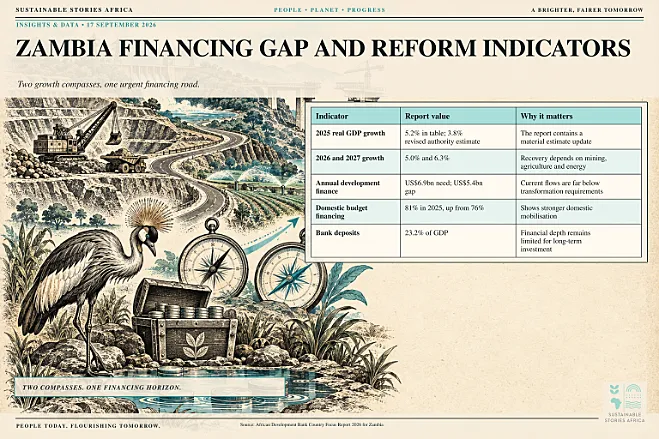
Its main table estimates 2025 real GDP growth at 5.2%, up from 3.8% in 2024, driven by agriculture, information and communication technology, transport, mining and manufacturing.
A footnote records that the authorities revised the 2025 estimate to 3.8% in March 2026 after weaker activity in information and communication technology, trade, finance and insurance.
That revision is important:
- It does not erase the recovery narrative, but it shows why current estimates and project assumptions must be tested carefully.
The report projects growth of 5.0% in 2026 and 6.3% in 2027.
- Inflation is expected to fall from 14.0% in 2025 to 9.3% and 7.2%, while the fiscal deficit is forecast to narrow from 4.6% of GDP to 2.7% and 1.9%.
Sustaining that path will require investment that expands productive capacity without rebuilding unsustainable debt.
The risks remain concrete.
- Recurrent drought can weaken agriculture and electricity supply, lower official development assistance can reduce concessional funding, and copper prices can shift fiscal and external balances quickly.
A credible financing plan must therefore test projects and debt against adverse climate, commodity and exchange-rate scenarios.
Zambia's Financing Gap Tests Its Economic Recovery
The AfDB estimates Zambia's annual financing needs for structural transformation at $6.9 billion through 2030, with a financing gap of about $5.4 billion.
- The report also cites average recent financing flows of $379 million, illustrating how far existing channels fall short of the scale required.
Domestic resource mobilisation has improved.
- The domestically financed share of the budget rose to about 81% in 2025 from 76% in 2024, and tax revenue reached roughly 18.5% of GDP.
- Digital systems, stronger tax administration and institutional reform have supported the increase, but informality, exemptions and commodity cycles still make revenue vulnerable.
Fiscal pressure remains substantial.
- Debt service and fuel-arrears clearance widened the 2025 deficit.
- A temporary tax response to higher fuel prices was estimated to cost the government $200 million in revenue, showing how external shocks can quickly compete with development spending.
The financing gap should also be interpreted as an allocation challenge.
- If new capital remains concentrated in government paper or raw mineral extraction, the economy may gain liquidity without gaining enough productive capacity.
Projects need a clear route to exports, domestic suppliers, reliable energy or lower logistics costs.
Revenue Gains Still Trail Transformation Needs
Zambia cannot close the gap through taxation alone.
- The Capital Markets Master Plan provides a route to mobilise institutional and private capital through municipal, green, social, sustainability-linked and gender bonds.
- These instruments can broaden the investor base, but guidelines must define eligible uses, disclosure, verification and treatment of fiscal risk.
The financial system is broadly stable, and banks remain well capitalised.
- However, deposits equal about 23.2% of GDP, capital markets are shallow and long-term finance remains limited.
- Pension funds and insurers can play a larger role if the market offers transparent assets with suitable maturities and if regulation protects savers while allowing prudent diversification.
Project readiness is the binding bridge between savings and investment.
- Development-finance institutions, guarantees and blended finance can reduce risk, but they cannot rescue weak projects.
- Feasibility studies, procurement, environmental and social safeguards, revenue models and local-content plans must be credible before public or private capital is committed.
The ten-year Capital Markets Master Plan provides a broader institutional framework.
- Its pillars cover government bonds, other securities, new products, market capacity and regulation.
- Progress across all five matters because innovative bonds will not scale in isolation from trading infrastructure, investor confidence and supervisory capability.
Critical Minerals Can Support Broader Productive Growth
Copper, cobalt, manganese and other energy-transition minerals give Zambia a strategic position as supply chains reorganise.
- The opportunity is larger than exporting more ore.
- Copper cathodes, wiring, battery components, mining services and reliable renewable power can retain more value, build technical capability and create stronger links with domestic firms.
Agriculture and agro-processing provide a complementary path.
- Climate-resilient irrigation, storage, energy and transport can reduce losses and support labour-absorbing growth.
- The Lobito Corridor and the African Continental Free Trade Area can lower trade costs and expand markets for agrifood and light manufacturing as well as minerals.
The risk is a new extractive trap under a green label.
- Incentives should be tied to measurable investment, skills transfer, supplier development and environmental performance.
- Clear ESG disclosure across banks, pension funds, insurers and capital markets can improve risk management and help investors distinguish credible transition projects from weak claims.
Copper currently contributes about 12% of GDP and 40% of government revenue, according to the report.
- That importance gives public policy leverage but also creates concentration risk.
- Stabilisation mechanisms, predictable mining rules and transparent treatment of incentives can protect revenue while encouraging the longer-term investments needed for value addition.
New Instruments Need Strong Pipelines And Rules
Zambia's short-term priority is to complete and operationalise rules for innovative bonds while maintaining macroeconomic stability.
- The Bank of Zambia's recent risk-based supervision, prudential, governance, fintech and digital-oversight reforms provide a stronger platform for market development.
In the medium term, tax and business systems should exchange data across the finance ministry, revenue authority, land registry and companies registry.
- Smart Invoice, TaxOnline and customs digitalisation can reduce leakages and simplify compliance.
- Market infrastructure and institutional-investor participation should develop alongside a transparent pipeline of investable projects.
Regulators should publish practical disclosure and verification standards before the market grows.
- Municipal and thematic bonds need rules for use of proceeds, reporting, external review and treatment of defaults.
- Consistent standards will protect investors and prevent the financing label from becoming more prominent than the underlying asset.
Long-term capital should support structural transformation.
- Public policy can encourage mineral value addition, renewable-powered agro-processing and resilient infrastructure without hiding liabilities or weakening competition.
- Support for smaller firms through guarantees, advisory services and better credit information will determine how much of the investment reaches the wider economy.
The Path Forward Links Capital To Jobs
Zambia should finalise credible rules for new bond instruments, deepen digital revenue systems and preserve debt sustainability.
Project preparation and transparent fiscal-risk reporting must come before rapid issuance.
The next test is allocation. Capital should finance mineral value addition, renewable energy, agro-processing, infrastructure and competitive smaller firms.
Zambia will gain financial agency when its natural assets support diversified production, resilient jobs and stronger domestic markets.