Ghana's economy strengthened in 2025 as growth accelerated, inflation fell and debt indicators improved. Yet the recovery has not produced enough jobs or investment to complete structural transformation.
The country needs about US$3.3 billion annually and faces a US$1.5 billion yearly gap. Better taxation, investment efficiency and private capital mobilisation will determine whether stability becomes inclusive growth.
Recovery Creates Space For Financing Reform
Ghana's 2025 performance gives policymakers a stronger platform for reform.
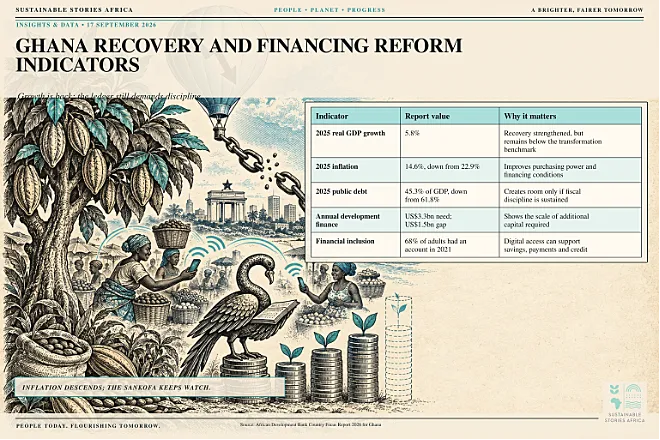
- Real GDP grew by 5.8%, up from 5.6% in 2024, while inflation fell to 14.6% from 22.9%.
The fiscal deficit narrowed to 2.4% of GDP from 6.3%, and public debt declined to 45.3% of GDP from 61.8%, according to the African Development Bank's 2026 Country Focus Report.
The current account moved further into surplus and foreign-exchange reserves improved to 5.8 months of import cover.
- Growth is forecast at 5.0% in 2026 and 5.4% in 2027, with inflation projected to fall to 9.0% and 7.2%, respectively.
The direction is positive, but the report warns that recovery remains exposed to commodity prices, domestic debt rollover pressure and delays in implementation.
The larger challenge is structural.
- Growth remains below the roughly 7% rate the report associates with faster, inclusive transformation.
- Services and private consumption are doing much of the work, while investment, productivity, job creation and local value addition are not yet strong enough to spread the gains widely.
Improved Stability Has Not Closed Ghana's Gap
Ghana requires about $3.3 billion in development finance each year through 2030.
- Average annual flows during 2020 - 2024 were about $1.8 billion, leaving an estimated gap of $1.5 billion.
- That shortfall covers more than public infrastructure.
- It also reflects the capital needed for productive firms, skills, climate resilience and the systems that connect people to better jobs.
The composition of growth explains why financing quality matters.
- Services contributed about half of GDP growth in 2025 and industry 39%, supported by mining and favourable gold prices.
- Agriculture contributed 11%.
- On the demand side, consumption accounted for 91% of growth, while investment contributed only 1.1%.
A recovery led mainly by consumption can stabilise incomes, but it is less likely to build the productive capacity needed for sustained job creation.
Ghana's dependence on gold, cocoa and oil also leaves public revenue and foreign exchange vulnerable to external prices.
- Stronger buffers help, but they do not replace diversification.
- Refining, agro-processing, reliable power, logistics and technical skills are essential if commodity earnings are to create broader domestic value.
The labour-market test is especially important.
- If output expands without formal employment, the state gains less income-tax revenue and households remain exposed to insecure work.
Financing policy should therefore favour investments that raise productivity and create supplier links, rather than treating headline GDP growth as sufficient evidence of transformation.
Growth Gains Mask Structural Financing Constraints
The report places domestic resource mobilisation at the centre of the response.
- Ghana's tax system is constrained by exemptions, informality and compliance gaps.
- Rationalising exemptions, improving value-added tax administration, expanding property and digital taxation and linking tax, customs, land and business databases can widen the base without relying only on higher rates.
Public investment must also generate more output.
- Ghana's incremental capital-output ratio is estimated at about four, which indicates room to improve project selection and execution.
- Better appraisal, procurement and monitoring would lower the amount of new capital required for each unit of growth and reduce pressure on the budget.
The financial system has expanded access, particularly through mobile money.
- In 2021, 68% of adults held an account with a bank or mobile money provider.
However, banks and institutional investors remain heavily exposed to government instruments.
- Sovereign dominance, weak collateral enforcement and limited credit information constrain longer-term lending to small and medium-sized enterprises.
Reducing sovereign dominance requires more than asking banks to lend differently.
- Stable macroeconomic policy must lower the risk-adjusted attraction of government paper, while stronger financial statements, collateral enforcement and credit guarantees make private assets investable.
- Otherwise, institutions will continue to choose liquid public securities over firms whose risks are harder to assess.
Digital Systems Can Unlock Domestic Capital
Ghana can build on its digital infrastructure to improve both revenue and finance.
- E-invoicing, taxpayer identification, integrated government data and risk-based compliance can reduce leakages.
- Alternative data, interoperable payments and well-regulated fintech can also improve credit assessment for firms that lack conventional collateral.
Institutional capital offers another route.
- Pension funds, insurance companies, the Ghana Infrastructure Investment Fund and other long-term investors could finance infrastructure and productive enterprises if markets provide suitable instruments and credible projects.
- Corporate bonds, green bonds, securitisation and blended finance can widen options, but only with clear disclosure and prudent risk sharing.
Diaspora investment can supplement remittances if products are transparent, competitively priced and linked to identifiable projects.
- Natural resources and natural capital can also support green finance, but stronger governance is needed to prevent new instruments from becoming another source of opaque liabilities.
Public-private partnerships should sit within the same discipline.
- Ghana needs a consolidated view of guarantees, termination payments and other contingent obligations before approving projects.
That oversight protects the budget and gives investors greater confidence that contracts will survive changes in fiscal conditions or political priorities.
Ghana Must Improve Revenue And Allocation
Immediate priorities are preserving macroeconomic credibility, strengthening tax administration and protecting high-value public investment.
- Fiscal consolidation should not rely on cuts that weaken health, education or infrastructure
- It should combine better compliance, fewer inefficient exemptions and spending choices supported by evidence.
Ghana should then deepen its long-term capital market.
- Better project preparation, credit guarantees and transparent public-private partnership rules can reduce risk.
- Development Bank Ghana can help finance high-potential sectors, while stronger collateral systems and credit information can improve pricing and access for private firms.
Regional integration can add scale.
- Harmonised regulation, interoperable payment systems and regional bond markets under ECOWAS and the African Continental Free Trade Area can widen the investor base.
- The objective is to move the financial system away from recycling short-term liquidity into sovereign debt and towards allocating capital to productive investment.
Monitor implementation through a small set of public indicators:
- Revenue gained from exemption reform, time and cost to prepare projects, private capital mobilised without hidden guarantees, and credit reaching productive sectors.
These measures would show whether the financing strategy is changing economic capacity rather than simply increasing the volume of transactions.
The Path Forward Links Reform And Trust
Ghana should preserve stability while widening the tax base, improving investment efficiency and protecting productive spending.
Clear project selection and transparent fiscal risk management will help turn each cedi of public finance into more durable growth.
Deeper credit markets, institutional investment and regional integration can close part of the annual gap.
Their success depends on credible rules, bankable projects and capital reaching firms and sectors that create jobs beyond commodity cycles.