South Africa has published a Revised Electricity Pricing Policy that would end decades of opaque, Eskom-centred tariff-setting and replace it with cost-reflective pricing across a competitive, unbundled power market.
The core question: can Africa's most industrialised economy make electricity prices fair, transparent and investable, without pricing poor households out of the grid?
A New Pricing Era for Power
South Africa's Department of Electricity and Energy has published the Revised Electricity Pricing Policy (EPP) 2026 for public comment, marking the most significant rewrite of the country's electricity pricing rules since 2008.
Minister Kgosientsho Ramokgopa gazetted the policy on August 28, 2026, opening a 30-day public comment window that closes in late September.
The revision responds to a fundamentally different electricity sector than the one the 2008 EPP was designed for.
- Eskom is being unbundled into separate generation, transmission and distribution entities, independent power producers are multiplying, and rooftop solar and embedded generation are decentralising supply faster than the old tariff rulebook can track.
For African households and businesses already straining under high energy costs, the policy's central promise, that tariffs will reflect the true cost of supply rather than layers of hidden cross-subsidy, could reshape bills, investment flows and industrial competitiveness for years to come.
A Market Built for Monopoly Meets Competition
South Africa's electricity tariffs have long carried a structural flaw: prices set for a single, vertically integrated utility are now expected to govern a market with multiple generators, private wheeling deals and a National Transmission Company acting as neutral referee.
The Revised EPP states plainly that "the existing Electricity Pricing Policy is no longer fully aligned with the structure and functioning of the evolving [Electricity Supply Industry]"
The stakes are immediate.
- Discriminatory pricing practices currently mean similar customers pay significantly different tariffs with no real difference in the cost of supply, a distortion the policy instructs the National Energy Regulator of South Africa (NERSA) to eliminate within 12 months of the policy taking effect.
- For a country where Eskom's finances, load-shedding history and industrial electricity costs are already front-page news, a mispriced grid is not an abstract regulatory concern; it is a live economic risk.
Cost-Reflectivity Becomes Law, Not Aspiration
The policy's defining instruction is that all licensed generation, transmission, distribution and retail tariffs "should become cost-reflective over the next five years,"except where cross-subsidies or externally funded subsidies are explicitly approved.
- That single sentence carries enormous consequences for household bills, municipal budgets and investor confidence in a sector NERSA has struggled to regulate consistently.
To get there, the policy creates a Central Purchasing Agency (CPA) to manage legacy power purchase agreements, including renewable IPP contracts, while a competitive wholesale market develops around it.
- Transmission costs will be split 50/50 between generators and customers, reversing the assumption that only consumers should bear network costs, a change designed to stop South African users from unknowingly subsidising electricity exported to neighbouring countries.
- Distribution tariffs must be unbundled into separate energy, network, service and administration charges, so customers can finally see what they are paying for, line by line, on their bills.
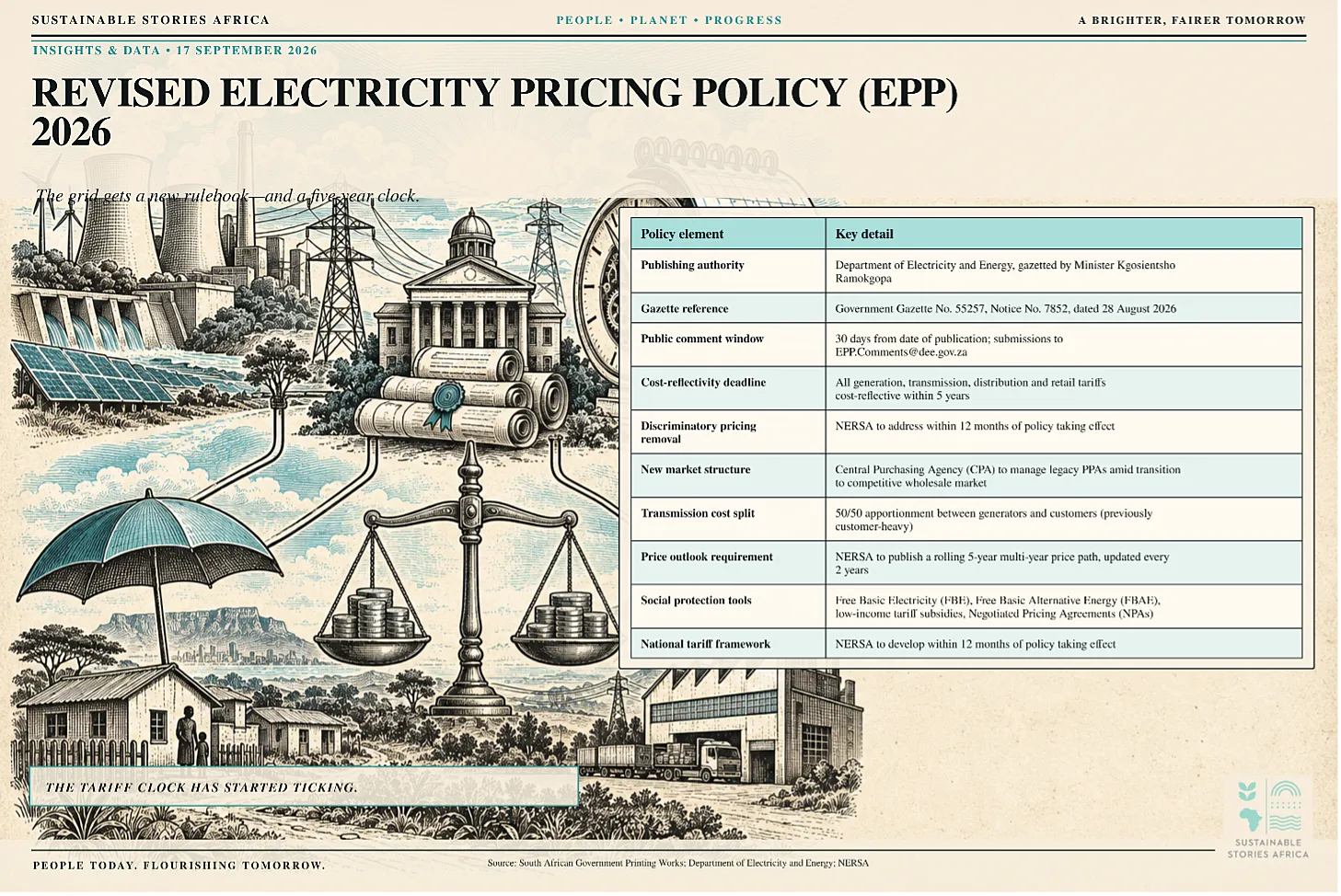
The table below distils the policy's key data points for readers tracking implementation timelines and structural shifts.
What Fair Pricing Could Unlock
If implemented as designed, cost-reflective pricing does more than rationalise bills.
- It removes the guesswork that has deterred long-term investment in generation and grid infrastructure, giving independent power producers, municipalities and private capital a transparent basis for pricing risk.
The policy's push for a published five-year price outlook, updated every two years, would let commercial and industrial customers plan capital expenditure with far greater certainty than South Africa's volatile tariff history has allowed.
For low-income households, the policy does not leave affordability for efficiency alone.
- It retains and formalises subsidy tools, Free Basic Electricity, Free Basic Alternative Energy and targeted low-income tariff subsidisation, explicitly separating these social interventions from the cost-reflective tariff structure itself.
If executed well, this dual-track approach could protect the poorest consumers while still sending honest price signals to everyone else, a balance many emerging markets have struggled to strike.
The risk of inaction is equally clear.
- Continued opaque cross-subsidies erode Eskom's and municipalities' revenue certainty, discourage private investment in generation capacity, and leave South Africa's industrial base exposed to unpredictable price shocks precisely when energy-intensive sectors need stability to compete globally.
Who Must Move, and How Fast
The policy sets hard clocks running.
- NERSA must adopt an asset valuation and investment prudency framework within 12 months, develop a national tariff framework within 12 months, and eliminate discriminatory pricing practices within the same window.
- Electricity distributors must submit cost-of-supply and cost-to-serve studies to justify their tariff applications, with full studies required at least every five years.
- Municipalities, meanwhile, must prepare for tighter scrutiny of the Municipal Surcharge on Electricity as the policy pushes toward transparent, itemised billing under NRS 047 standards.
Businesses, investors and civil society organisations have a narrow window: the 30-day public comment period from August 28, 2026, to submit input before the policy is finalised.
Given the scale of the shift, from generator pricing to residential lifeline tariffs, stakeholders across the energy value chain have a direct stake in shaping the final text before it becomes binding regulation.
Path Forward – Locking In a Fairer Grid
The Revised EPP commits South Africa to cost-reflective tariffs within five years, a rules-based Central Purchasing Agency for legacy contracts, and a published multi-year price outlook to guide investment decisions.
The advocacy is straightforward: transparent bills, non-discriminatory access to networks, and preserved, targeted subsidies for the poor.
Success now depends on NERSA meeting its 12-month deadlines and stakeholders using the comment period to sharpen a policy that, if finalised well, could stabilise Africa's largest power market for a decade.