Liberia's economy grew faster in 2025 and inflation eased, but development needs remain far larger than the country's fiscal and financial systems can currently support.
The AfDB estimates annual financing needs of $2.83 billion through 2030.
Roads dominate the requirement, while informality, shallow markets and dependence on commodities continue to limit domestic capital.
Growth Is Recovering, But Finance Remains Thin
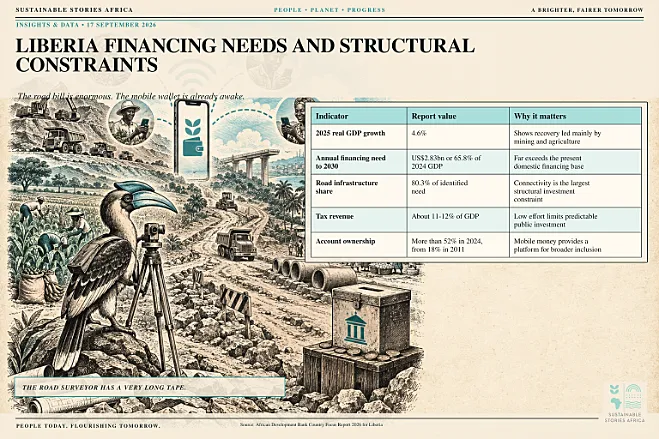
Liberia's economy expanded by an estimated 4.6% in 2025, up from 4.0% in 2024, as mining, agriculture, private consumption and infrastructure spending supported activity.
Inflation eased to 6.0% from 8.2%, and the fiscal deficit narrowed to 1.8% of GDP after reaching about 7.0% in 2023.
The African Development Bank's 2026 Country Focus Report projects growth of 5.0% in 2026 and 5.3% in 2027.
Inflation is expected to rise temporarily to 8.2% in 2026 before easing to 6.7% in 2027.
- The outlook is positive, but reserves remain low, the current account deficit is large and concessional finance is declining.
Liberia therefore faces two linked tasks.
- It must protect the stability gained through stronger revenue collection and expenditure discipline, while financing the roads, energy, education and productive capacity needed to reduce dependence on imports and extractive exports.
Liberia's Financing Gap Dominates Its Development Arithmetic
The report estimates that Liberia needs $2.83 billion each year through 2030 to accelerate structural transformation, equal to about 65.8% of 2024 GDP.
Extending the horizon to Agenda 2063 reduces the annual requirement to $495.3 million, or about 11.5% of GDP, but does not remove the need for sustained reform.
Road infrastructure accounts for 80.3% of the estimated requirement, followed by education at 11.4%, research and development at 4.5% and energy at 3.8%.
The distribution reflects how weak connectivity raises costs across the economy.
- Poor roads do not only delay travel; they make agricultural inputs, market access, public services and industrial investment more expensive.
The current growth model cannot easily fund that requirement.
- Mining and agriculture remain the main engines, while commodity price volatility, governance weaknesses and import dependence expose revenue and foreign exchange.
- The current account deficit narrowed to 14.4% of GDP in 2025 but is projected at 14.8% in 2026 before improving to 13.2% in 2027.
Low reserves compound that exposure.
- Import cover is projected at 2.9 months in 2026 and 3.1 months in 2027, leaving limited protection against fuel, food or financing shocks.
Building reserves therefore depends on stronger exports and more stable capital, not simply short-term compression of essential imports.
Informality And Import Dependence Limit Fiscal Space
Liberia collects tax revenue of roughly 11% - 12% of GDP, below the African average cited in the report.
- Revenue reached a record $818 million in 2025, but the tax effort remains constrained by widespread informality, incentives in mining and compliance gaps.
- About 80% - 85% of employment is informal, which weakens productivity, worker protection and the state's ability to raise predictable revenue.
Recent digital tax, public financial management and transparency reforms have improved credibility.
- The next step is to connect tax administration, customs, business registration and payment data so formalisation becomes simpler and enforcement becomes more targeted.
- Tax reform should also review exemptions and natural-resource agreements that erode the base without delivering sufficient investment or jobs.
Financial depth is equally limited.
- Commercial banks are concentrated in Monrovia, rural access remains thin and high dollarisation constrains monetary policy.
- Account ownership nevertheless rose from about 18% in 2011 to more than 52% in 2024, largely through mobile money.
That expansion produces an infrastructure for savings, payments, tax collection and smaller-ticket credit.
Social conditions raise the stakes.
- Poverty was estimated at 33.6% in 2025, and the low official unemployment rate masks widespread underemployment.
Financing decisions must therefore be assessed against household income, rural access and the quality of work created, not only aggregate investment totals.
Digital Finance Can Extend Growth Beyond Monrovia
Interoperable payments can lower transaction costs for households, farmers and small businesses.
- The Inclusive Instant Payment System and the National Electronic Payments Switch are important foundations, but they require reliable digital identification, connectivity, consumer protection and cybersecurity.
- Inclusion is sustainable only when users can trust the system and obtain useful products beyond transfers.
Liberia can also improve access to longer-term capital.
- Credit bureaus, collateral registries and transparent government securities can help lenders price risk.
- Infrastructure bonds, green finance and blended-finance vehicles could attract domestic, diaspora and development-finance capital if projects are well prepared and liabilities are reported clearly.
Natural capital creates another opportunity.
- Liberia's forests, biodiversity and coastline can support climate and conservation finance, but only with credible measurement, transparent benefit sharing and safeguards for communities.
- Value addition in rubber, cocoa, palm oil, timber and minerals would retain more income domestically and reduce the repeated pattern of exporting raw materials while importing finished goods.
Diaspora products must offer more than patriotic appeal.
- Investors need clear use-of-proceeds rules, reliable payment channels, competitive returns and independent reporting.
- Small, well-governed pilot instruments linked to visible infrastructure or enterprise funds would build a stronger record than a large issuance unsupported by project preparation.
Institutions Must Convert Natural Wealth Into Capital
The immediate agenda is credibility.
The government should complete digital revenue reforms, enforce audit recommendations, strengthen anti-money-laundering compliance and improve coordination between fiscal and monetary authorities.
- Clearer public accounts and better banking supervision will help rebuild confidence among citizens, investors and development partners.
The medium-term agenda is market building.
- A project-preparation facility can raise the quality of public-private partnership pipelines. Government and infrastructure bonds can create benchmarks, while regional payment and capital-market links through ECOWAS can widen scale.
- Credit infrastructure and mobile money should reach rural firms and women- and youth-led enterprises, not only established urban borrowers.
Human capital is part of that market infrastructure.
- Supervisors, lenders and project sponsors need stronger skills in fintech, cybersecurity, climate risk, contract design and investment appraisal.
- Without those capabilities, new instruments may increase complexity faster than institutions can identify and manage the risks.
The long-term agenda is financial agency.
- Liberia should reduce excessive dependence on the US dollar, deepen domestic savings and build regulatory skills in fintech, climate finance and risk management.
- Sovereign or stabilisation funds may help manage resource revenue, but only if protected by transparent rules and independent oversight.
The Path Forward Starts With Credibility
Liberia should first strengthen revenue administration, public financial management and banking supervision.
Digital systems must reduce compliance costs, expand the formal tax base and improve transparency.
Next, the country can build credit infrastructure, regional payment links and bankable projects that attract domestic, diaspora and climate capital.
Natural wealth will support transformation only when value addition, community safeguards and accountable institutions keep more benefits inside Liberia.