Malawi’s economy carries high inflation, debt above 90% of GDP and persistent foreign-exchange shortages after years of weak growth and climate shocks.
An estimated $3.59 billion annual financing gap now separates development ambition from available resources.
Fiscal repair must therefore protect the productive investments that make recovery possible.
Recovery Prospects Meet Severe Financing Constraints
Since 2022, Malawi has grown by less than 2% a year. As an agriculture-dependent economy absorbed floods, cyclones, droughts, foreign-exchange shortages and persistent macro-fiscal stress.
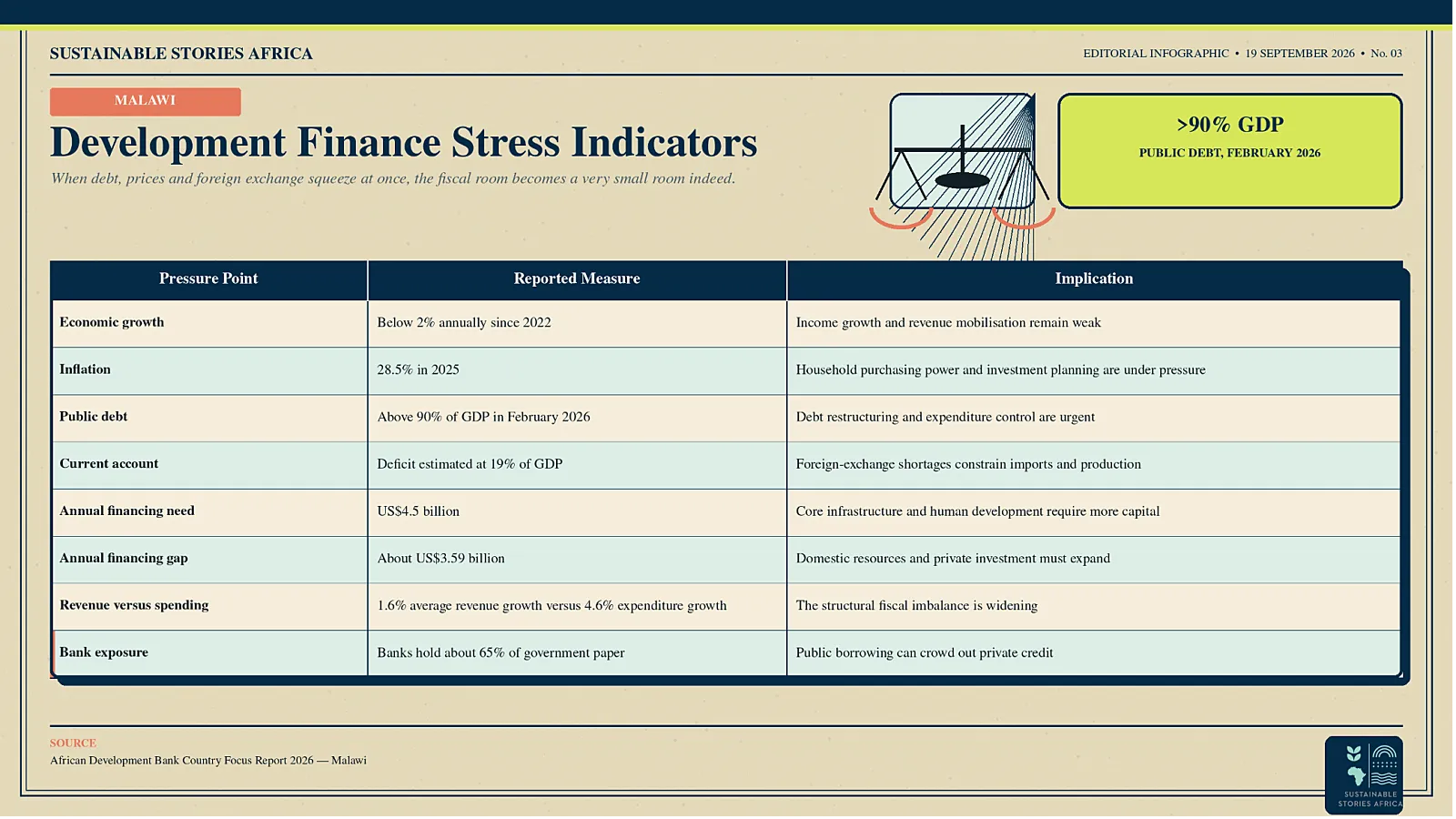
According to the African Development Bank Country Focus Report 2026, inflation remained at 28.5% in 2025, public debt exceeded 90% of GDP by February 2026, and fiscal deficits remained above 10%.
The external position is equally constrained.
- The current-account deficit was estimated at 19% of GDP, and the country continues to rely heavily on donor support and debt.
- Shortage of foreign currency limits access to fuel, medicines, farm inputs and industrial materials, adding a direct operational cost to weak macroeconomic management.
There are still grounds for a recovery.
- A favourable 2025/26 agricultural season, investment in mining and infrastructure, stronger regional integration and human-capital development could support growth.
The challenge is to finance those opportunities without worsening debt distress or crowding out the private sector.
Macrofiscal Stress Shapes Every Development Choice
Malawi’s budget cannot treat revenue, debt and development spending as separate problems.
- Revenue grew by an average of 1.6% over the past decade, while expenditure grew by 4.6%.
- The resulting imbalance increased borrowing and contributed to an estimated $334.8 million budget-financing gap for 2026/27.
Domestic banks hold about 65% of government paper.
- That helps the state meet immediate financing needs, but it can reduce credit available to businesses, particularly firms producing tradable goods.
- High interest rates, inflation and exchange-rate pressure then make private investment more difficult, reinforcing the same weak growth that limits tax revenue.
Financing Gaps Reach Households and Businesses
The report estimates annual development financing needs of $4.5 billion and an annual gap of about $3.59 billion. Sector requirements show why the aggregate is so large.
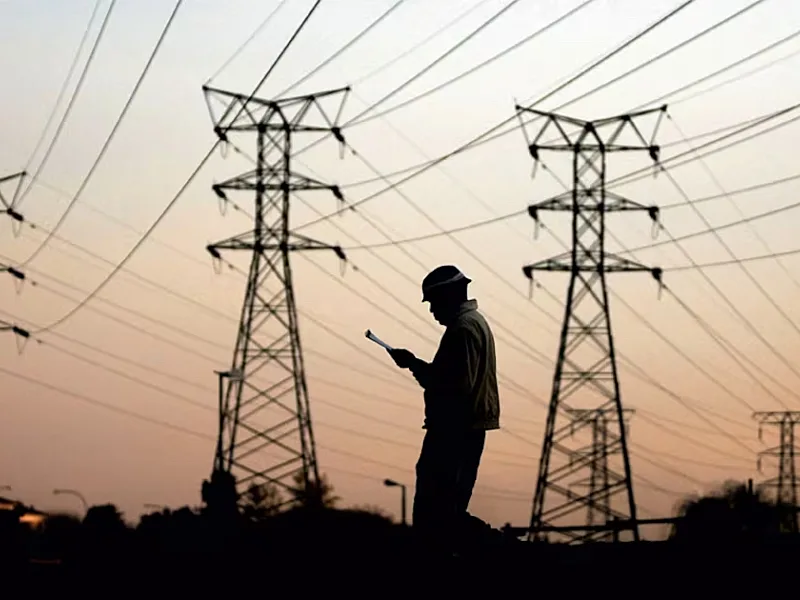
- The World Bank estimate cited in the report puts the energy investment needed to reach 70% access by 2030 at $5.5 billion, while transport needs are about $9.15 billion.
Human development also carries measurable shortages.
- Per-capita health spending is about $40, below the World Health Organisation benchmark of $86 for basic services cited by the report.
- Education, health and skills investment are essential in a young and rapidly growing population, yet they compete with wages, debt service and emergency spending.
Climate exposure turns each financing weakness into a resilience problem.
- A cyclone can damage roads, farms and public facilities while reducing revenue and increasing food imports.
- Without disaster-risk financing, insurance and climate-resilient infrastructure, each shock pushes scarce capital back into reconstruction.
The pressure is also intergenerational.
- Rapid population growth and limited urbanisation add new labour-market entrants faster than the formal economy creates jobs.
- If finance continues to favour government paper over productive firms, younger workers will remain concentrated in informal and low-productivity activity.
Restoring private credit is therefore part of employment policy, not only financial-sector reform.
Better Finance Can Unlock Resilient Sectors
A credible fiscal reset could help ease bank credit for farms, processors, exporters and small businesses.
- Digitised tax administration and a broader base can raise revenue more predictably.
- Better project appraisal can move limited capital toward investments with the largest economic and social returns.
Blended finance could support renewable energy, irrigation, logistics, tourism and mining infrastructure where public benefits are high but commercial risks remain difficult.
- Collateral-light or cash-flow-based lending can extend finance to micro, small and medium enterprises, especially women and young entrepreneurs who lack conventional property security.
Natural capital can support eco-tourism, sustainable agriculture and climate finance, provided projects respect community rights and environmental integrity.
These sectors can diversify exports and reduce concentration of economic risk in rain-fed agriculture.
Fiscal Repair Must Protect Productive Investment
Government should combine expenditure control with protection for high-return capital and social spending.
- Wage-bill management, debt restructuring, procurement reform and the resolution of audit findings can reduce fiscal risk.
- The Integrated Financial Management Information System should support real-time control rather than simply digitise weak processes.
Financial regulators should continue expanding digital finance, consumer safeguards and market infrastructure.
- Business registration can be linked to useful benefits, including credit records, procurement access and simplified taxation, so formalisation becomes an economic proposition rather than only an enforcement demand.
Development partners should coordinate around a transparent national project pipeline and use guarantees or concessional finance to crowd in private capital.
- Disaster-risk frameworks, investment-protection rules and reliable dispute resolution can reduce uncertainty without offering open-ended public guarantees.
Path Forward – From Stabilisation Toward Investable Inclusive Growth
Malawi needs stabilisation that protects the basis for future growth.
Revenue reform, debt restructuring and spending discipline should preserve investments in energy, transport, health, agriculture and skills.
The financing strategy should reward projects that earn foreign exchange, build climate resilience and widen productive employment.
That is how fiscal repair can become economic recovery rather than prolonged contraction.