Refinery economics can look like a wall of acronyms, but eight recurring terms connect crude quality, plant capability, fuel performance and daily margins.
This explainer translates the supplied industry card into decision language and adds the caveats needed to avoid treating local thresholds or market-specific spreads as universal rules.
Eight Terms Connect Crude to Consumers
A refinery buys a variable raw material, runs it through a fixed set of processing units and sells products whose prices and specifications move independently.
A profitable day therefore depends on more than the crude price. Quality, conversion capability, product yield, fuel standards, operating rates and timing all shape the outcome.
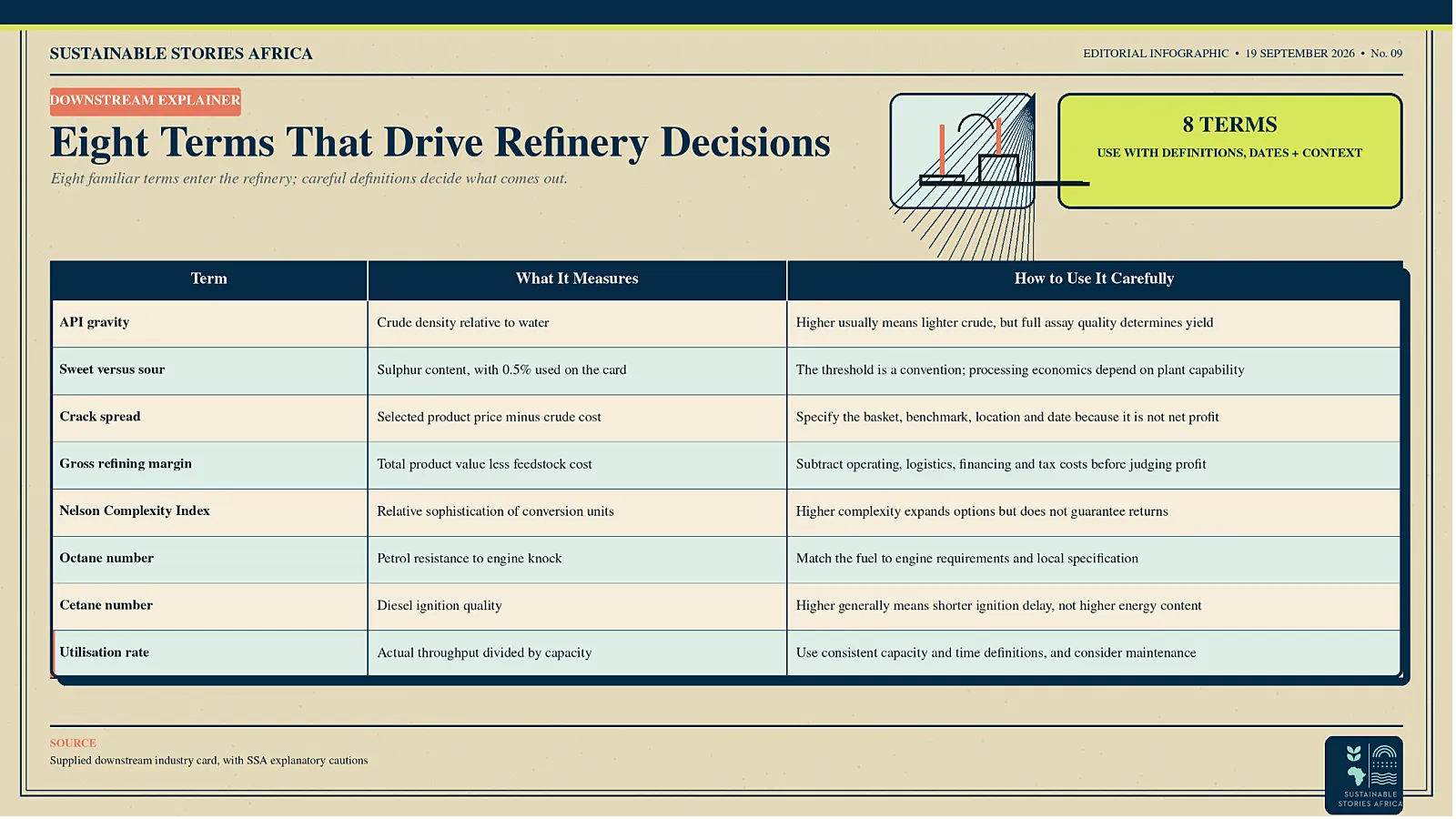
The Vaibhav Shrivastava infographic card highlights them as follows:
- API gravity
- Sweet versus sour crude
- Crack spread
- Gross refining margin
- Nelson Complexity Index
- Octane number
- Cetane number
- Utilisation rate.
Together, they describe the starting feedstock, the refinery’s technical options, the quality of its main transport fuels and how fully capacity is being used.
These measures help compress complex operations into comparable signals.
- They are also easy to misuse.
- Thresholds vary by market, spread formulas use different product baskets, and a high operating rate or complex plant does not guarantee a profit after energy, maintenance, logistics and financing costs.
Crude Quality Determines the Starting Economics
API gravity describes how heavy or light a petroleum liquid is relative to water.
- The standard formula is API gravity equals 141.5 divided by specific gravity at 60 degrees Fahrenheit, minus 131.5.
- Higher API gravity usually means lighter crude with a greater potential share of higher-value light products, although assay quality matters more than one number.
The card classifies crude above 31.1 degrees API as light and below 22.3 degrees as heavy.
- These bands are common reference points, but commercial grades also depend on contaminants, acidity, metals and the detailed yield pattern.
- Two crudes with similar API gravity can behave differently in the same plant.
Sweet and sour describe sulphur content.
- The card uses 0.5% sulphur as the dividing line.
- Lower-sulphur crude generally requires less desulphurisation to meet clean-fuel standards.
- Sour crude can trade at a discount but may be attractive to refineries with the right conversion, hydrogen and sulphur recovery capacity.
The economic question is the available discount compared to the extra cost of processing and product yield.
Margins Depend on Yield and Timing
A crack spread calculates the difference between crude cost and the value of selected refined products.
- A simple one-to-one spread compares one product with crude, while a 3-2-1 spread approximates three barrels of crude producing two barrels of gasoline and one barrel of distillate.
- It is a trading indicator, not a refinery’s audited profit.
The supplied card gives a normal range of $20 to $40 per barrel and an August 2026 record of $102.20.
- These figures are not universal because results vary with location, crude benchmark, product mix, unit conversion and observation period.
Gross refining margin is broader.
- It compares the total value of the refinery’s product slate with feedstock cost, usually on a per-barrel basis.
- It can reflect the actual yield pattern better than a headline crack spread, but it still sits above operating expenses, maintenance, energy, freight, depreciation, interest and tax.
- GRM is a gross operating signal, not net income.
The Nelson Complexity Index compares the cost and sophistication of secondary processing units with basic crude distillation.
- The card describes one as simple, 15 or more as full conversion and the United States average as about 11.
- A higher index signals more capacity to upgrade heavy fractions, but returns still depend on crude discounts, product cracks, reliability and energy cost.
Quality Numbers Protect Engines and Markets
Octane number measures petrol’s resistance to engine knock.
- Higher octane allows engines designed for it to use greater compression or advanced timing without uncontrolled combustion.
- It does not automatically mean more energy per litre, and a vehicle gains little from fuel above the octane level its engine requires.
Cetane number describes the quality of diesel ignition.
- A higher cetane value generally means a shorter ignition delay and can support smoother combustion and cold starting.
Octane and cetane therefore point in different directions: petrol resists premature ignition, while diesel must ignite readily after injection.
These numbers protect consumers because fuel specifications translate refinery operations into engine performance and emissions outcomes.
- Meeting them requires blending, treatment and quality control.
A refinery may sacrifice volume or margin to keep every batch within specification, especially when feedstock changes, or a processing unit is unavailable.
Operators Must Read Metrics as Systems
Utilisation rate compares actual throughput with nameplate or operable capacity over a defined period.
- A higher rate can spread fixed costs across more barrels, but it can also reduce maintenance flexibility and increase the impact of an unplanned outage.
- Comparisons should use the same definition, capacity base and time period.
Investors and policymakers should read all eight measures together.
- API gravity and sulphur indicate feed difficulty; complexity indicates conversion options; crack spreads and GRM indicate market economics; octane and cetane define product quality; utilisation indicates operating intensity.
- The system view explains why the same crude price can produce different results across refineries.
For African downstream policy, the practical questions include feedstock security, plant configuration, maintenance performance, product standards, logistics and working capital.
- Capacity announcements without sustained utilisation say little about actual supply.
- Margin headlines without product specifications or operating costs say little about durable profitability.
The same discipline applies to public reporting.
- A refinery update should state crude runs, operable capacity, utilisation period, principal products, specification compliance and planned outages.
- If margins are cited, the disclosure should identify whether the number is a market crack, a plant-specific GRM or an accounting result.
Clear labels prevent technical signals from being used as political or investment slogans.
Path Forward – Use the Glossary Without False Precision
Use the glossary as a connected dashboard, not eight isolated rankings.
Each metric explains one part of feed quality, conversion, product performance, margin or operating intensity.
Before using any threshold or record, identify the formula, benchmark, geography and period.
That discipline turns a useful explainer into reliable analysis.