
A Federal High Court decision has reinforced concurrent oversight by Nigeria’s competition and telecommunications regulators while acknowledging that the Federal Competition and Consumer Protection Commission (FCCPC) cannot issue telecoms licences.
The pending Wireless Application Service Providers Association of Nigeria (WASPAN) appeal will test where consumer-protection oversight ends, and duplicate authorisation begins, with consequences for operators, lenders and transaction timetables.
One Market Now Faces Two Regulators
Nigeria’s telecommunications and digital-lending sectors increasingly overlap.
- Airtime and data advances use telecoms networks, credit products and consumer data, bringing the Nigerian Communications Commission and the Federal Competition and Consumer Protection Commission into the same commercial space.
In WASPAN Ltd Gte v FCCPC, the Federal High Court in Lagos dismissed a challenge to the FCCPC’s Digital Electronic Online or Non-Traditional Consumer Lending Regulations 2025 on 20 July 2026.
- The court upheld concurrent jurisdiction while recognising that the FCCPC cannot exercise powers reserved to the NCC.
The immediate dispute concerns regulation. The wider issue concerns investment.
- A company may hold its principal sector licence and still need additional approvals or compliance systems under an economy-wide regime.
- That uncertainty can affect due diligence, deal conditions, valuation, financing and post-completion integration.
Court Upholds Concurrency but Draws Limits
The court treated the FCCPC’s competition and consumer-protection mandate as economy-wide.
- It read sections 104 and 105 of the Federal Competition and Consumer Protection Act together with section 90 of the Nigerian Communications Act, concluding that the two regimes coexist rather than displace each other.
The judgment also accepted a boundary.
- The FCCPC cannot issue telecommunications licences or achieve indirectly what it lacks power to do directly.
- Even so, the court upheld paragraph 8 of the DEON Regulations as an FCCPC approval requirement operating alongside NCC licensing.
It also upheld paragraph 24, which requires at least two intermediaries in the lending structure, including one wholly Nigerian-owned service provider, within 60 days of commencement.
Deal Approval Risks Extend Beyond Licences
The commercial market is material.
- The Udo Udoma and Belo-Osagie update cites public reporting that values airtime and data credit at about N400 billion annually, serving an estimated 40 million consumers, many borrowing N100 to N200.
- Rules governing market entry and operating structure therefore reach a large volume of small consumer transactions.
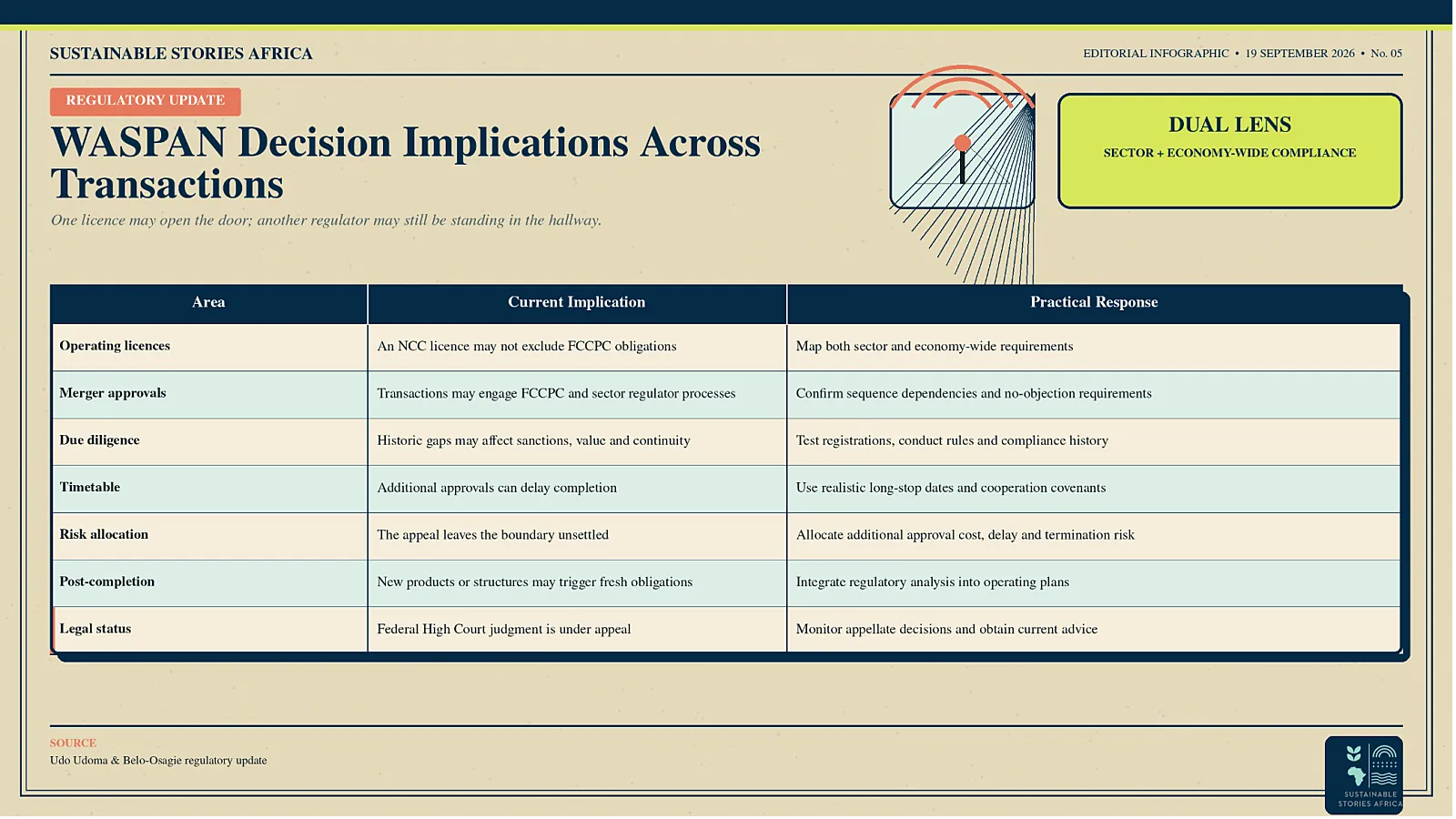
For mergers and investments, the case separates a target’s operating perimeter from a transaction’s approval perimeter.
- The first covers licences, registrations and ongoing conduct rules.
- The second may include merger control, sector consent, notifications and no-objection requirements triggered by a change in ownership or control.
WASPAN appealed on 21 July 2026.
- The appeal challenges the relationship between the general competition law and the sector-specific communications statute, the scope of the FCCPC’s rulemaking powers and the functional line between a consumer-protection approval and a second licence.
The source reports no appellate determination as of its publication date, so the Federal High Court decision should not be treated as settled appellate law.
Clearer Boundaries Could Improve Deal Certainty
A clear appellate framework could reduce duplicate filings, conflicting conditions and unpredictable approval sequences.
- Operators would know which conduct belongs to the NCC, which belongs to the FCCPC and where coordination is required.
- Investors could price regulatory obligations earlier and avoid discovering a second approval path after signing.
Consumers also benefit from coherent oversight.
- Telecoms expertise, competition rules and lending safeguards address different risks.
- The policy goal should be coordinated protection with defined responsibilities, shared information and proportionate requirements, rather than a gap between regulators or repeated authorisation for the same activity.
Transaction Teams Need a Wider Map
Due diligence should map every applicable mandate, not merely confirm the target’s headline licence.
- Teams should review products, customers, data practices, lending structures, marketing, historic compliance and planned expansion.
- A business that is properly licensed today may trigger additional requirements when its services or distribution model changes.
Transaction documents should identify approval sequencing, cooperation duties, long-stop dates and responsibility for additional conditions.
- Where the jurisdictional position is uncertain, the parties should allocate the cost and termination risk expressly.
- Financing documents may also require representations, undertakings and events of default linked to the full approval perimeter.
Regulators can reduce uncertainty by publishing coordination protocols, joint guidance and clear definitions of approval versus licensing.
Until the appeal clarifies the law, operators and dealmakers should rely on substantive regulatory analysis and current legal advice rather than assume that one sector licence exhausts the compliance inquiry.
A regulatory-perimeter memo should be treated as a living deal document.
- It should identify the legal basis, responsible regulator, filing trigger, expected timing, dependencies and consequences of non-compliance for each approval.
- Updating that map between signing, completion and integration can prevent a product or ownership change from creating an unplanned regulatory breach.
Path Forward – The Appeal Will Define Regulatory Limits
The appeal will define whether concurrent oversight remains complementary or becomes duplicate authorisation.
A workable answer should protect consumers while giving regulated businesses a predictable approval path.
Until then, companies and investors should treat regulatory overlap as a diligence, timing and valuation issue from the start of every transaction.