
A recent Nigerian legal analysis argues that interrogatories have no place in garnishee proceedings because the governing statute already provides a complete process for disputed liability.
The position protects speedy judgment enforcement while preventing a creditor from turning a bank or other third party into the subject of open-ended discovery.
Execution Speed Defines the Procedural Question
A monetary judgment is only useful if the law can deliver payment.
- Garnishee proceedings allow a judgment creditor to attach money owed to the judgment debtor by a third party, most commonly a bank.
- Nigerian courts have long treated the process as a special post-judgment mechanism governed principally by the Sheriffs and Civil Process Act.
The procedural question examined by Streamsowers and Köhn is whether a creditor can use interrogatories to compel the alleged garnishee to disclose information about the debtor’s accounts or assets.
- Interrogatories are familiar in ordinary litigation, where parties exchange written questions to narrow issues, obtain admissions and prevent surprise before trial.
The analysis concludes that the answer should be no.
- Garnishee proceedings are summary and statutory, not a fresh lawsuit founded on pleadings.
Their function is to determine whether a specified third party holds an attachable debt, not to create a broad asset-tracing inquiry.
Statutory Design Limits Open-Ended Discovery
Sections 83 to 92 of the Sheriffs and Civil Process Act establish the machinery for garnishee proceedings.
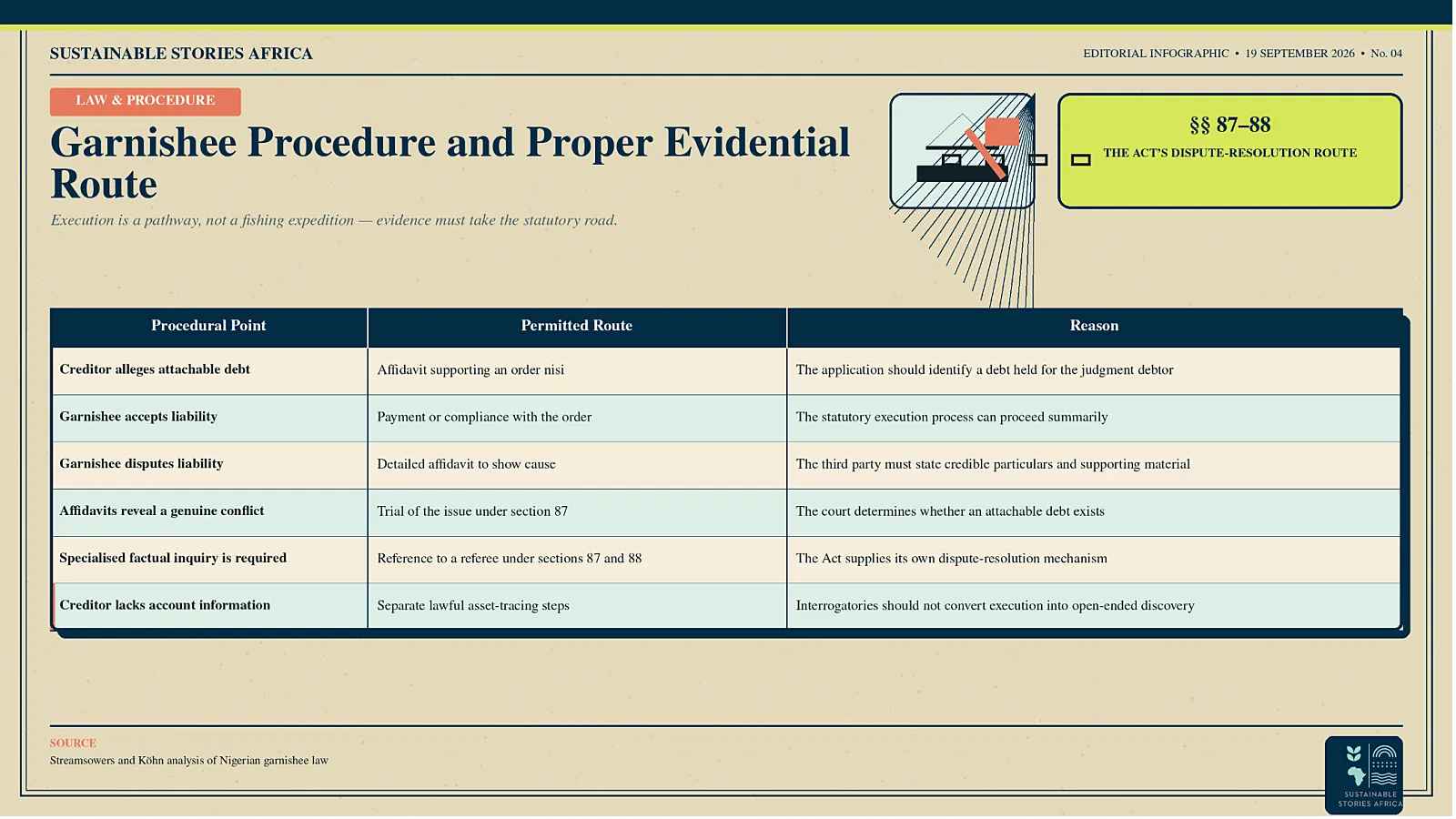
- An order nisi requires the garnishee to show cause why the identified debt should not be attached.
- If liability is genuinely disputed, sections 87 and 88 allow the court to try the issue or refer it to a referee.
That structure is important.
- It balances a creditor’s right to obtain the fruits of a judgment against the rights of a third party that was not the judgment debtor.
- Importing broad discovery could add objections, compliance applications and collateral disputes to a process designed for speed and a narrow question of liability.
Supreme Court Reasoning Narrows the Inquiry
The source relies heavily on Central Bank of Nigeria v Ochiefe, reported in 2025.
- The underlying dispute followed an order nisi based on an allegation that judgment debtors maintained funds under the Treasury Single Account.
- The Central Bank denied holding an account in its name and supported its affidavit with material disputing liability.
The trial court made the order absolute, and the Court of Appeal affirmed.
- The Supreme Court later allowed the appeal and set aside the lower decisions.
- It held that a credible conflict between the creditor’s affidavit and the garnishee’s affidavit could warrant a trial of the issue under section 87 rather than an immediate order absolute.
The judgment did not directly decide whether interrogatories are admissible in garnishee proceedings.
- The legal analysis instead draws an inference from the Court’s reasoning: because the Act already specifies how disputed liability is resolved, general civil-procedure rules should not enlarge the inquiry.
- Abubakar v Yar’Adua provides additional support for treating interrogatories as a case-management device rather than a licence for a fishing expedition.
Clear Procedure Can Protect Every Party
A disciplined statutory process allows judgment creditors to preserve speed and keeps the inquiry focused.
- It also protects banks and other garnishees from being compelled to disclose wide categories of customer or operational information without a proper statutory basis.
The approach does not leave creditors without a remedy.
- A creditor can present specific affidavit evidence identifying money believed to be held by the garnishee.
- The garnishee must answer that case.
If the evidence conflicts, the court can try the issue or refer it to a referee, preserving both enforcement and fairness.
Creditors Must Build Evidence Before Attachment
Judgment creditors should investigate and document the basis for naming a garnishee before seeking an order nisi.
- Applications should identify the alleged debt with as much precision as the available evidence permits.
- Garnishee orders should not be used as a substitute for pre-application asset tracing.
Garnishees should file detailed affidavits to show cause and attach reliable records when denying liability.
- A bare denial may not establish a genuine dispute.
- Courts, in turn, should evaluate the competing material and use sections 87 and 88 where necessary rather than defaulting either to an order absolute or an expanded discovery process.
The article allows insights into professional legal analysis rather than a new judicial ruling on interrogatories; parties should seek advice on the governing court rules, facts and current appellate authorities before acting.
- The core procedural distinction nonetheless remains useful: enforcement determines an identified liability; discovery searches for information to build a case.
The distinction also supports data and banking confidentiality.
- A focused order tied to identified evidence gives the court a basis for deciding what must be disclosed and why.
- A general demand for account information risks exposing unrelated customer material and increasing compliance burdens without establishing that the garnishee owes any debt to the judgment debtor.
Path Forward – The Statutory Route Should Remain Controlling
The statutory route should remain controlling unless an appellate court or legislation establishes otherwise.
Specific affidavit evidence, a proper response and a focused trial of disputed liability preserve both speed and fairness.
That discipline strengthens judgment enforcement without making third parties answer a case the governing statute did not create.