
Africa may need 1.5 – 2.2 GW of data-centre capacity by 2030. However, IBTC warns that the construction pace is outrunning the workforce needed to keep facilities safe, efficient and online.
Its proposed answer is a three-stage pipeline, including identify, certify and deploy, that combines international credentials with live-site experience.
The question is whether operators will invest in people before new control rooms become underused infrastructure.
Buildings Rise Faster Than Operator Pipelines
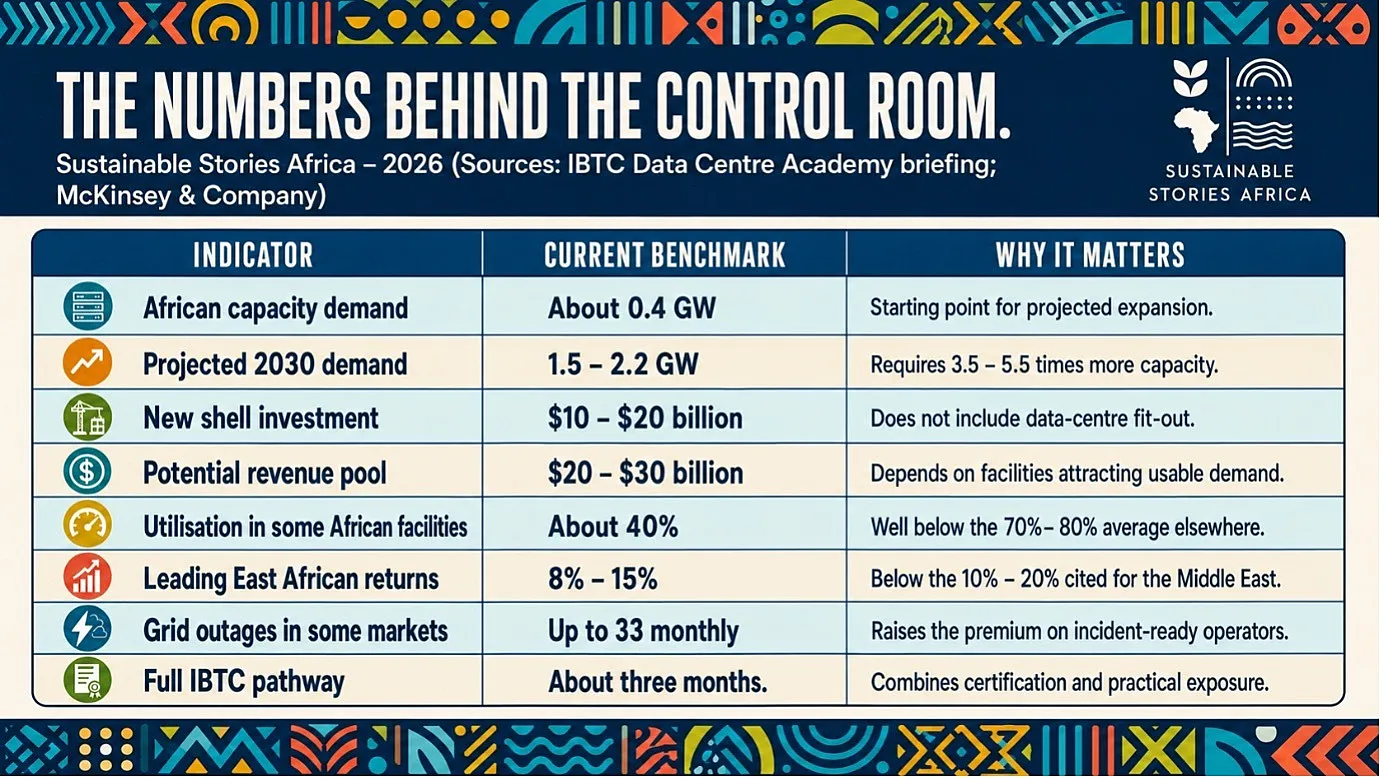
Africa’s data-centre expansion is approaching a decisive stage. Demand could rise from about 0.4 gigawatts today to between 1.5 and 2.2 GW by 2030, requiring $10 – $20 billion in new shell investment and unlocking a potential $20 – $30 billion revenue pool across the value chain.
However, the IBTC Data Centre Academy argues that the constraint receiving insufficient attention is not construction finance, land or demand.
It is the availability of technicians and operators who can manage power, cooling, alarms, maintenance and emergency response inside a live facility.
That distinction matters across Africa. A completed data centre is only an asset when customers trust it, capacity is occupied, and systems remain online.
Without people capable of managing those systems under real operating pressure, expensive buildings can become stranded capacity with impressive specifications but weak utilisation.
Uptime Depends On People Under Pressure
A data centre promising 99.995% uptime allows itself roughly 26 minutes of downtime a year, a demanding target anywhere.
However, especially in African markets, businesses face up to 33 grid outages per month. Each outage demands that generators, batteries, cooling and monitoring systems perform in sequence, with people ready to respond when they don't.
McKinsey's November 2025 analysis estimates demand across Egypt, Kenya, Morocco, Nigeria and South Africa could grow 3.5 – 5.5 times by 2030, requiring $10 – $20 billion in data-centre shells (excluding fit-out) against a $20 – $30 billion revenue opportunity. Local knowledge, skills, reliable power and connectivity are flagged as critical to success.
The IBTC briefing names the resulting workforce gap "the empty control room", not a shortage of intelligent graduates, but a lack of exposure to real operational pressures like heat, alarms and safety protocols.
Employers are forced to compete for scarce experienced staff or absorb lengthy onboarding costs, while most graduates remain sidelined due to a lack of site exposure.
The Talent Gap Has Four Causes
IBTC identifies four structural failures between the classroom and the control room.
- First, technical training remains largely theoretical, so learners may grasp redundancy or cooling diagrams without ever responding to an alarm or conducting a shift handover.
- Second, certification confirms learning but not workplace competence under real operational pressure.
- Third, graduate CVs lack site exposure, causing employers to screen out capable applicants before interviews.
- Finally, there's no visible pathway from education to employment, leaving young people unaware of critical-facility careers and drifting into other industries.
IBTC's response is a vendor-neutral pipeline built around three actions: identify, certify and deploy.
Candidates are screened for aptitude, trained against recognised standards and placed on live facilities through internships.
- The first stage, Data Centre Fundamentals, runs roughly three weeks via blended delivery, covering infrastructure and operations while learners work toward Schneider Electric University's Certified Data Centre Associate credential.
- The intermediate stage, lasting about three months, advances into resilience, redundancy and uptime tiers, with on-site training and EPI/EXIN certification.
Operators can sponsor learners, upskill staff, host interns and shape curricula without competing for talent, since IBTC neither operates data centres nor hires directly. IBTC's project frames this as "recruit, train, place."
A Pipeline Can Convert Youth Into Operators
The opportunity extends beyond filling vacancies. A functioning talent pipeline can cut recruitment time, onboarding costs and reliance on imported expertise, while giving employers evidence of real-world performance and offering young people clearer routes into an expanding sector.
"We're giving operators a mechanism to grow the workforce their facilities will need as Africa's digital infrastructure continues to expand," IBTC Chief Executive Nikki Maritz said.
The development case is significant too. Data centres underpin financial services, digital identities, e-government and AI.
Around 40% of African corporations are already experimenting with generative AI, while the internet economy's share of continental GDP has risen from 1.1% in 2012 to 5.2% in 2025, per McKinsey data cited by IBTC.
Local capacity also strengthens governance, determining whether maintenance is preventive or reactive.
There's an environmental angle too: efficient power and cooling equipment can't deliver savings without skilled monitoring.
However, impact will require measurable outcomes. IBTC hasn't yet disclosed cohort size, completion rates, placement rates or gender participation, metrics that should become central as the programme scales.
Five Decisions Can Staff Africa’s Control Rooms
Operators should begin by converting expansion plans into workforce forecasts.
- Every planned megawatt should be accompanied by estimates for technicians, shift operators, facility managers, safety personnel and maintenance specialists.
- Cohort sponsorship and internship capacity can then be aligned with actual commissioning schedules.
Training providers must design courses with employers, rather than just for them.
- Site hours, simulated incidents, shift handovers, safety procedures and troubleshooting assessments should sit beside classroom instruction and examinations.
Governments, regulators and development finance institutions should treat workforce capacity as part of digital infrastructure.
- Project incentives and financing assessments can examine local skills plans, apprenticeships, inclusion targets and partnerships with technical institutions, rather than power, land and connectivity.
IBTC and participating employers should also publish a transparent performance dashboard.
- Useful indicators include applications, aptitude-screening results, completion, certification, practical hours, placement within six months, retention after one year, employer satisfaction, time-to-competence and participation by women and underserved communities.
Finally, students and career switchers need greater awareness of critical-infrastructure careers.
- Africa’s digital economy requires more than programmers. It needs people who can keep electricity flowing, cooling stable, equipment protected, and incidents contained at three o’clock in the morning.
Path Forward – Africa Must Build Talent Beyond Capacity
Africa’s data-centre strategy should pair every facility pipeline with a workforce pipeline.
Operators must forecast skills, host practical training and report placement outcomes, while governments and financiers recognise human capability as essential infrastructure.
IBTC’s model offers a practical starting point, but its credibility will depend on scale, inclusion and independently visible results.
The control room will not fill itself; Africa must train its operators before new capacity arrives.