Childhood poverty is not a temporary hardship that ends when a young person leaves school. New evidence from the United Kingdom shows that prolonged financial insecurity can shape whether young people complete education, secure work or remain excluded from both.
The lesson reaches beyond Britain: governments, employers and development institutions must treat income security as economic infrastructure, not simply welfare expenditure.
Hardship narrows futures before adulthood begins
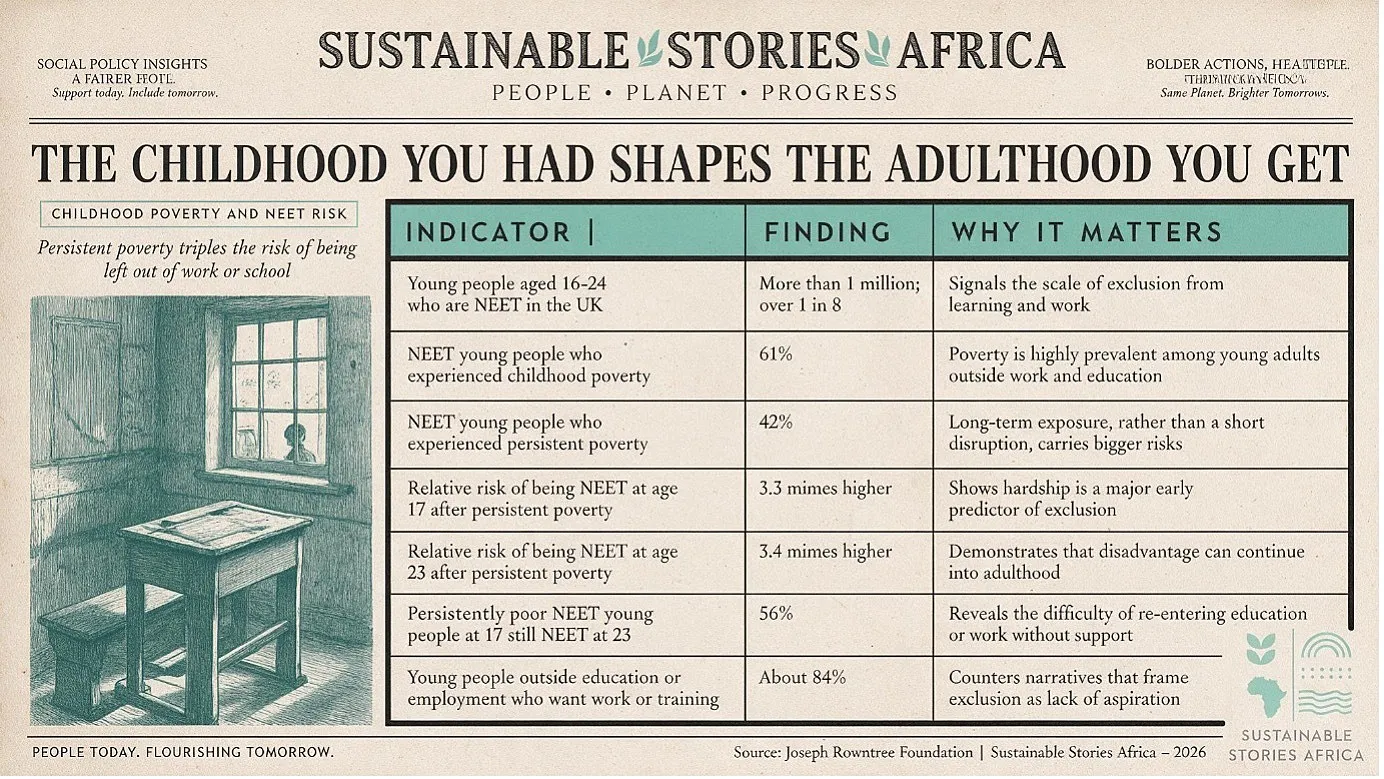
More than one million young people aged 16 to 24 in the United Kingdom are outside education, employment or training, a group commonly described as “not in education, employment or training” (NEET).
Behind that headline is a more troubling finding:
- Persistent poverty during childhood more than triples the likelihood that a young person will be out of both learning and work at ages 17 and 23.
The new briefing, Falling Through the Cracks: How Childhood Hardship Shapes Life Chances, combines analysis of the UK Millennium Cohort Study with interviews and ethnographic research involving young people who have been out of education, employment or training.
Its central argument is clear:
- Poverty should not be treated as one risk factor among many.
- It is often the condition that triggers, deepens or prolongs the other challenges young people face, from poor educational outcomes and mental ill-health to unstable housing, family pressure and weak labour-market attachment.
That distinction matters for policymakers in Africa and other emerging markets, where youth unemployment, underemployment, and informal work are often framed as problems of skills, motivation, or labour-market mismatch alone. Those explanations can be incomplete.
- A young person who lacks regular meals, affordable transport, stable housing, digital access, or basic learning materials does not start on the same line as a peer who has them.
The evidence in this briefing is UK-specific and should not be mechanically applied to African countries.
However, its main insight is highly relevant:
- Social protection, quality public services and accessible pathways into decent work are interconnected investments in human capital, productivity and long-term social stability.
Poverty is the overlooked predictor
The report finds that 61% of young people who were NEET at age 23 had experienced poverty while growing up.
- Of that group, 42% had experienced persistent poverty.
- By contrast, 34% of young people who were in education, training or work had experienced poverty.
- 19% had experienced persistent poverty.
Most starkly, young people who had experienced persistent poverty were 3.3 times more likely to be out of education and employment at age 17, and 3.4 times more likely to be in the same position at age 23, than those who had not experienced poverty.
This is not evidence that poverty determines a young person’s future.
- Many young people facing hardship demonstrate resilience, care for relatives, complete education and build livelihoods against considerable odds.
However, resilience should never excuse policy failure.
- It is a human response to difficult conditions, not a substitute for institutions that prevent avoidable deprivation.
The report challenges damaging assumptions about young people outside work and education:
- That they are disengaged, lacking ambition or unwilling to contribute.
- Around 84% of young people currently outside education or employment say they want a job or training opportunity, according to the government’s Young People and Work review cited in the research.
The issue, then, is not merely willingness.
- It is whether the systems surrounding young people make participation realistically possible.
How disadvantage becomes adult exclusion
Childhood hardship operates through daily, cumulative pressures rather than one dramatic event.
- The research records young people describing inadequate food, anxiety about household bills, unstable family arrangements, limited access to transport and the inability to take part in ordinary school or social activities.
- These conditions can affect concentration, attendance, confidence, relationships and mental wellbeing long before a young person reaches the labour market.
For many, school becomes the place where financial hardship becomes visible.
- A lack of uniforms, learning equipment, transport money or lunch can expose children to stigma and separation from their peers.
- At home, crowded or unstable housing and parental financial stress can make studying harder.
When school attendance declines or behaviour changes, responding may focus on the symptom rather than underlying insecurity.
The consequences can persist across critical transition points.
- Among young people who were out of education and work at age 17, 56% of those who had experienced persistent poverty were still outside both systems at age 23.
- The figure was 57% for those exposed to poverty in early childhood, compared with 33% for those who had not experienced childhood poverty.
The research also exposes a practical contradiction in weak support systems.
- Social-security payments can keep young people afloat, covering food, rent, toiletries, travel and care needs.
However, when support is insufficient, the same young people may be unable to fund the very steps that would help them progress:
- Travelling to interviews, paying for course materials, obtaining a driving licence, arranging childcare or accessing mental-health support.
A safety net without a route forward becomes survival support rather than mobility support.
Build routes back
The policy opportunity is to design support around the reality of young people’s lives, rather than expecting them to navigate fragmented systems while in crisis.
The report points to three connected foundations.
First, financial security must be treated as a prerequisite for participation.
- Young people cannot plan for training, sustain a job search or attend appointments consistently when food, rent, energy or transport costs are uncertain.
- Measures that reduce income support for younger claimants risk entrenching hardship and pushing participation further away, the report argues.
Second, services need to become more coordinated and personal.
- The report recommends a trusted, consistent point of contact capable of helping a young person navigate employment services, education, mental-health provision, housing and financial support.
- This recognises that barriers rarely arrive one at a time.
A young parent may need childcare, transport support, flexible training and confidence-building assistance at the same time; a young carer may require remote-learning options and employment that accommodates care responsibilities.
Third, the labour market must offer real entry points.
- Young people in the study described insecure, low-paid and temporary work that did not create stability or a credible future.
- Stronger transitions would include quality work placements, apprenticeships linked to local demand, flexible training, supportive employers and pathways from informal or precarious work into decent employment.
For African policymakers, this is also a governance and investment question.
- Youth employment strategies should be assessed not only by the number of training places announced, but by whether young people can afford to access them, complete them and convert them into stable livelihoods.
- Investors and employers can contribute by supporting apprenticeships, entry-level hiring, locally relevant skills programmes and fair-work standards.
Governments, meanwhile, can connect social-protection systems to education, healthcare, transport and labour-market policies rather than treating them as separate portfolios.
Path Forward – Secure foundations, real opportunities
Childhood poverty is a long-term development risk, not an individual failing.
Evidence shows that hardship can erode participation in education and work years before young people are labelled unemployed, disengaged or “hard to reach.”
The response must combine adequate income support, early intervention, trusted personalised services and access to decent local work.
When institutions provide both a safety net and a springboard, young people are better placed to turn their ambitions into lasting economic participation.