
Companies are buying technology, talent and market position to compress years of innovation into a single transaction.
With deal activity rising and artificial intelligence shortening product cycles, speed has become a strategic asset.
However, acquisition cannot substitute for an innovation strategy. The question for African and emerging-market businesses is whether they can secure new capabilities without losing talent, culture, capital discipline or competitive trust.
Companies Are Buying Time Through Innovation
Companies facing rapid technological disruption are increasingly using mergers and acquisitions to buy capabilities they cannot build quickly enough.
Rather than acquisition based on revenue, market share or physical assets, buyers are targeting intellectual property, specialist teams, proprietary data, artificial intelligence and strategic positions inside expanding digital ecosystems.
An August 2026 Financier Worldwide analysis says 87% of surveyed UK chief executives expect to increase M&A activity over the next 12 months, with almost half planning transactions intended to improve technology or AI capabilities.
Datasite data cited in the report show global deal initiations rose 22% during the first quarter of 2026.
The attraction is understandable for African and emerging-market companies. Acquisition can overcome limited research budgets, compress product development timelines and accelerate entry into markets such as fintech, renewable energy, digital health and logistics.
However, it also creates a difficult governance test: whether the buyer can integrate the asset without suffocating the innovation that justified the purchase.
Speed Is Repricing Innovation Across Global Markets
An innovation that once created a five-year advantage may now offer only a brief lead.
AI has reduced the cost and time needed to build prototypes, launch products and test markets, allowing small teams to achieve what once required larger organisations and multiple development cycles.
The result: a wider pool of young companies and greater uncertainty over which technologies will endure.
Acquisition offers established businesses a shortcut, buying capability rather than building it internally.
The strategic premium now reflects not just present revenue, but how quickly a buyer can scale and monetise the target's technology.
Recent deals show this clearly. Google completed its $32 billion acquisition of cloud-security platform Wiz on March 11, 2026, integrating it into Google Cloud while retaining its brand.
Palo Alto Networks completed its roughly $25 billion acquisition of CyberArk in February 2026, aiming to make identity security core to its AI-era protection.
These aren't conventional scale deals; they are bids to control technology layers other platforms may depend on.
The Deal Thesis Extends Beyond Technology Ownership
Innovation-led acquisitions can create value through five interconnected assets: technology, talent, data, customers and ecosystem position.
Technology provides immediate capability;
- Talent carries the knowledge to improve it
- Data sharpens development
- Distribution expands adoption
- Ecosystem positioning lets buyers shape emerging markets.
The risk is that buyers value the first asset while neglecting the rest.
Jerome Pottier, Datasite's EMEA chief revenue officer, argues enduring value lies in the people and operating knowledge behind a product.
Filip Drazdou of Aventis Advisors similarly flags culture as an underestimated risk; innovative employees often join smaller firms for speed and autonomy. They may leave once absorbed into larger, slower structures.
When key engineers depart, buyers can retain legal ownership while losing the knowledge that made the technology adaptive, slowing decisions and weakening customer relationships.
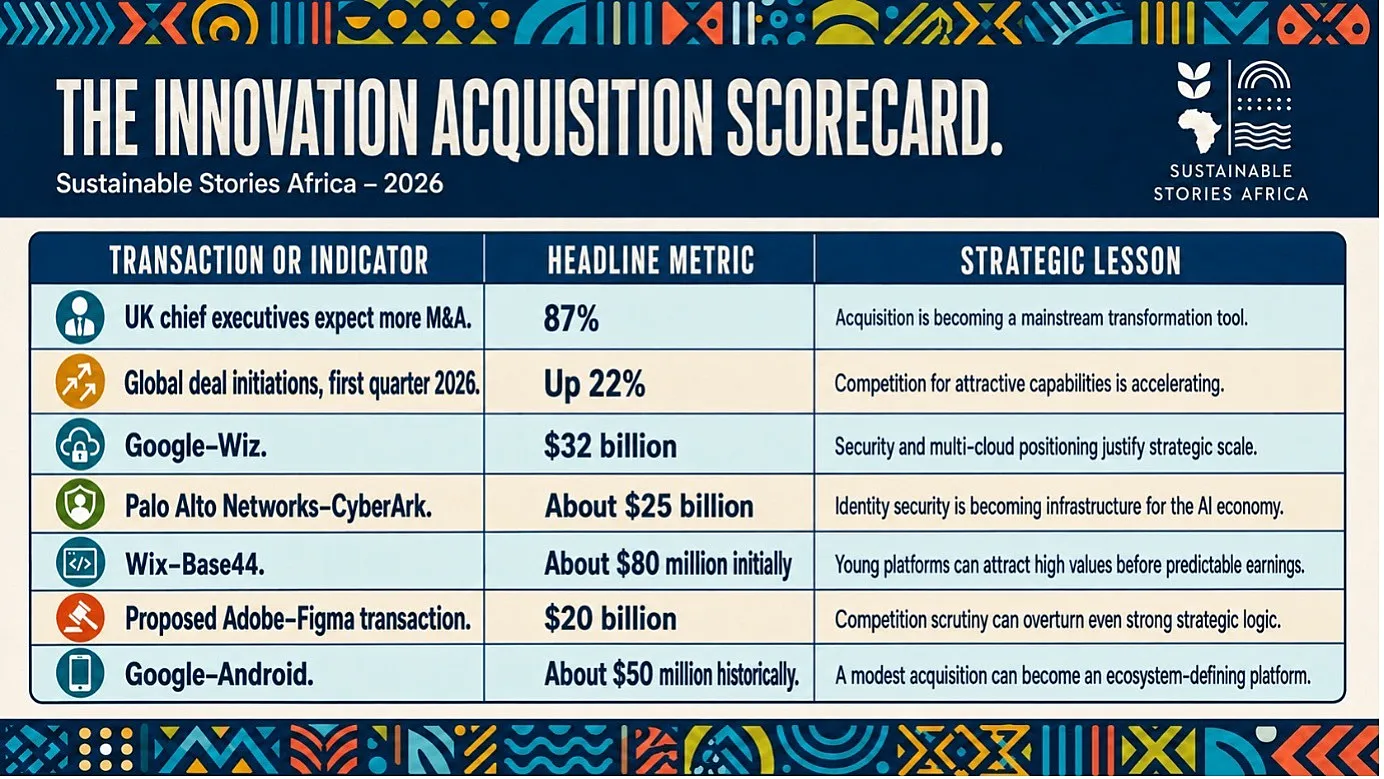
Wix's acquisition of no-code platform Base44 illustrates this. Wix paid roughly $80 million upfront, with performance payments through 2029, allocating $25 million specifically to employee retention, recognising people as part of the purchased asset while preserving Base44's autonomy and momentum.
Successful Acquisitions Can Build Wider Opportunity
For African businesses, capability-focused M&A can offer more than corporate growth.
- A bank acquiring fintech capabilities could deepen financial inclusion
- A healthcare group could extend diagnostics through digital-health acquisitions
- Agricultural businesses could integrate traceability platforms
- Energy companies could gain metering or emissions-management technology.
The wider opportunity lies in connecting local market knowledge with capital, technology and distribution.
Many African innovators understand informal markets and infrastructure constraints more deeply than foreign platforms built for mature economies. Disciplined acquirers can preserve that knowledge while providing scale.
Innovation-led acquisitions can also strengthen sustainability performance, improving environmental measurement, traceability and access to essential services through data, as well as clean-technology capabilities.
However, ESG outcomes aren't automatic. Acquisitions that eliminate disruptive competitors, dismiss employees or concentrate data control can undermine social value and competition. "Killer acquisitions" may protect incumbents while slowing sector-wide innovation.
The abandoned $20 billion Adobe – Figma deal showed regulators now scrutinise future competition rather than just existing market share; boards must ask whether a deal builds capability or removes a threat.
Five Disciplines Protect Innovation After Closing
First, boards need a clear innovation thesis;
- Identifying the capability gap, explaining why acquisition beats partnership or internal development, and defining how the asset will generate value.
- "Buying AI" is not a strategy.
Second;
- Due diligence must extend beyond financial statements to product architecture, cybersecurity, IP ownership, data rights, vendor dependencies and obsolescence risk.
Third;
- Talent retention should begin during diligence, identifying founders, engineers and customer-facing staff whose departure would weaken the investment, with incentives and autonomy negotiated before closing.
Fourth;
- Integration should be selective, aligning finance, compliance and risk controls quickly while preserving product-development autonomy, removing duplication without stifling experimentation.
Finally;
- Performance must be measured against the original thesis, using indicators like talent retention, release frequency, customer migration, revenue from new capabilities and returns on invested capital.
For African companies, added tests should cover foreign-exchange exposure, local data requirements and employment effects, while regulators protect innovation without discouraging responsible investment.
Path Forward – Africa Needs Capability Without Losing Control
African companies should use acquisitions to close genuine capability gaps, not follow technology fashions.
Each transaction needs technical diligence, talent protection, integration milestones and measurable social and financial outcomes.
Regulators and financiers should distinguish productive capability-building from market concentration disguised as innovation.
Acquisition can compress years of development, but sustainable value emerges only when technology, people, governance and purpose continue to work together after the deal closes.