NatureHelm and New Forests have tested seven draft Nature Positive Initiative metrics across a land-based investment portfolio, asking whether biodiversity can be measured consistently enough for TNFD-aligned decisions.
The answer is promising but incomplete: remote sensing unlocked scale, while local ecological evidence remained essential. For African markets, that tension will determine whether nature reporting attracts capital or becomes another compliance burden.
When Nature Becomes A Portfolio Number
More than 400,000 hectares of forests, farmland and conservation areas across Australia, the United States and Africa have become part of an ambitious experiment: determining whether the condition of nature can be measured consistently across an investment portfolio.
Announced on April 30, 2026, the collaboration brought together NatureHelm, a biodiversity-intelligence company, and New Forests, a global investment manager with AU$12 billion under management.
NatureHelm calculated seven draft Nature Positive Initiative, or NPI, metrics across the assets and analysed another 34.8 million hectares of surrounding landscapes. New Forests described it as the most expansive NPI pilot completed at the time.
The stakes reach beyond forestry. Investors, companies and regulators increasingly need evidence showing not only what pressures businesses place on nature, but whether ecosystems and species are actually recovering.
For African markets, where agriculture, forestry, mining, tourism and infrastructure remain closely tied to natural systems, the ability to produce credible, affordable evidence could influence investment, operating licences and community confidence.
Seven Metrics Challenge Fragmented Nature Reporting
The scale of the measurement problem is striking. The NPI found more than 600 sets of environmental metrics in use, leaving businesses to navigate competing definitions, datasets and methodologies.
Its response was a smaller, aligned framework tracking ecosystem extent, ecosystem condition and species health.
During 2025, 29 companies tested the framework across more than 50 sites in 23 countries, spanning forestry, agriculture, mining, infrastructure, renewable energy, manufacturing and finance.
Feedback showed the indicators were applicable in practice, though data availability and ecological differences shaped cost, precision and usefulness, insights that informed revisions released for consultation in early 2026.
New Forests provided a demanding test case, with disclosed pilot areas including approximately 86,400 hectares in sub-Saharan Africa, 7,600 hectares in California and 56,000 hectares in Western Australia.
The exercise also examined nature beyond property boundaries, since intact forests can mask fragmented surrounding habitats or deteriorating waterways.
NatureHelm combined satellite data, biodiversity datasets and machine-learning analysis with field evidence, including camera traps, acoustic monitoring and citizen science, and tested whether low-cost remote sensing could deliver portfolio-scale insights alongside local ecological knowledge.
Satellites Meet Species Records Across Landscapes
The draft framework examined seven indicators. These were pilot metrics rather than final standards and have since been revised through NPI consultation and testing.
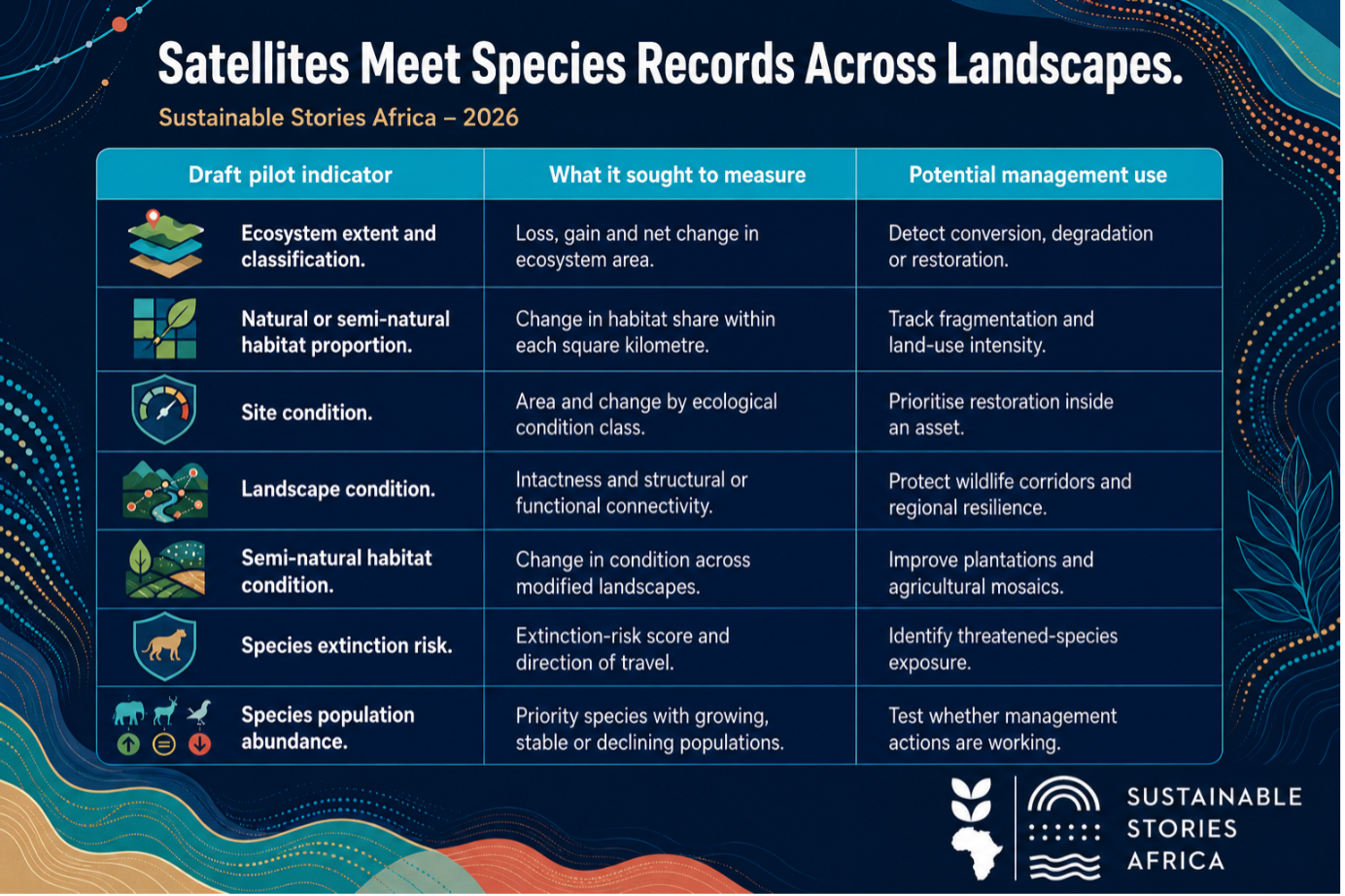
The design matters because biodiversity cannot be reduced to a single universal number, unlike greenhouse gas emissions, which are commonly expressed as tonnes of carbon dioxide equivalent.
A hectare of intact indigenous forest, a commercial plantation and a restored agricultural corridor may have similar tree cover but radically different ecological functions.
The metrics instead create a shared structure for examining several dimensions of nature. Ecosystem extent shows how much habitat remains.
- The condition asks whether that habitat is healthy.
- Connectivity examines whether species can move through the wider landscape.
- Species indicators test what is happening to living populations.
New Forests said the pilot replaced a fragmented approach built around individual projects or species with a more balanced portfolio view.
Jo Saleeba, its global head of sustainability and impact, called the exercise “just the beginning,” acknowledging that both the data and methodology still require improvement.
NatureHelm co-founder and chief executive Debbie Saunders said the work demonstrated that “nature positive is not just a slogan, but a measurable financial and ecological reality.”
Comparable Evidence Can Redirect Natural Capital
The immediate opportunity is better capital allocation. Consistent information can help investment managers distinguish high-condition areas that need protection from degraded locations where restoration translates to greater ecological gains.
Landscape-connectivity results reveal where landowners, communities and public authorities must collaborate.
For New Forests, the site-condition metric will become the biodiversity-impact target for its African Forestry Impact Platform portfolio, shifting biodiversity data from the sustainability appendix into the investment-management system, where it can shape priorities, budgets and performance monitoring.
Comparable evidence could also strengthen natural-capital markets, since transparent baselines and monitorable change make investors more willing to finance conservation and restoration, while measuring increases the risk of greenwashing.
For communities, potential benefits include healthier soils, reliable water systems and better land management.
However, measurement must avoid becoming an extractive data exercise; satellite imagery can describe land-cover change but cannot explain how people use a forest or why an ecosystem changed.
African Markets Must Build Measurement Capacity
The major priority for African businesses is location intelligence.
- Companies cannot assess nature-related dependencies without knowing where operations, suppliers and financed assets interact with ecosystems.
- Banks, insurers, mining companies and infrastructure operators should begin with geocoded asset maps, followed by risk-based ecological screening.
Second;
- Institutions should adopt a phased approach, starting with existing corporate records and satellite datasets before progressing to field surveys, provided uncertainty, data gaps and precision limits are disclosed.
Third;
- African regulators should avoid disconnected national metric regimes, aligning instead with NPI, TNFD, GRI and SBTN while letting local guidance reflect national ecosystems.
- In June 2026, TNFD published proposals for using NPI metrics across assessment and disclosure, with final decisions expected later this year.
Fourth;
- Investors must help finance the data infrastructure they expect companies to use, supporting local ecologists, indigenous knowledge holders and independent assurance, so smaller African businesses aren't disadvantaged by data-poor conditions.
Finally;
- Boards must connect measurements to decisions, letting nature indicators shape site selection, sourcing and credit assessment rather than remaining confined to annual reporting.
The real test is whether evidence changes where capital goes.
Path Forward – From Pilot Evidence To Trusted Markets
The NatureHelm–New Forests pilot shows that portfolio-scale nature measurement is becoming possible.
However, satellite reach must be matched by local evidence, transparent methods and community participation.
African institutions should begin mapping priority locations, strengthening ecological baselines and aligning disclosures with emerging NPI and TNFD guidance.
Well done, nature data can become more than compliance: it can protect livelihoods, direct restoration finance and make investment decisions accountable to the landscapes sustaining them.
Culled From: Measuring the State of Nature for TNFD: Inside the NPI pilot with NatureHelm and New Forests